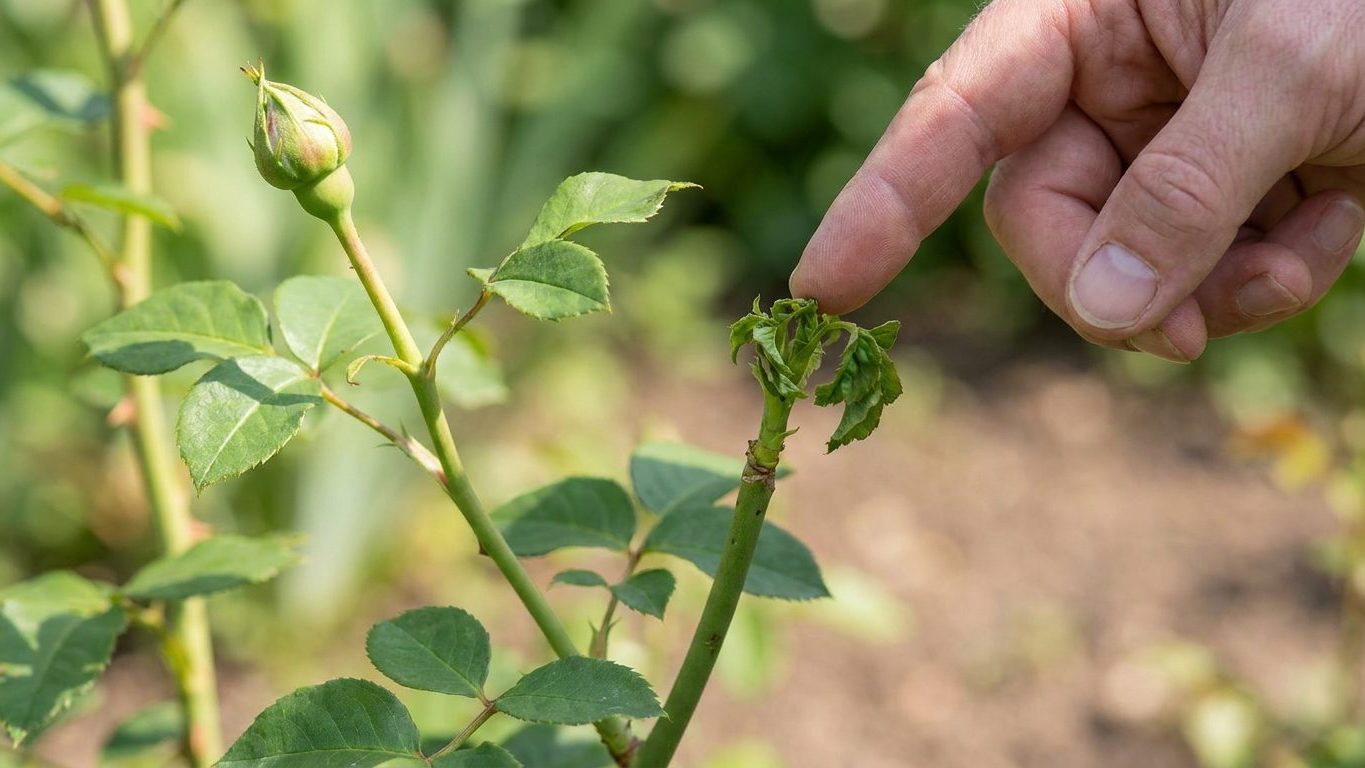

A blind shoot is a rose cane that leafs out normally but stops short of producing a flower bud at its tip. It’s common, not fatal, and usually fixable with one pruning cut. The cane itself is healthy, it’s just decided, for reasons rooted in its growing tip rather than the plant as a whole, not to flower this cycle.
What you are looking at
A blind shoot looks like any other new cane for most of its development. It emerges from the bud union or from a lower node, pushes out a full set of compound leaves, and grows to normal height for that variety. The difference shows up at the very top: instead of a swelling bud that colors up and opens into a bloom, the stem simply ends. Sometimes it terminates in a tight rosette of small, crumpled leaves instead of a bud. Sometimes it just stops growing altogether, with the topmost leaf fully formed and no bud structure visible at all.
Run your fingers along the tip. On a normal cane heading toward bloom, you’ll feel a distinct, rounded swelling, often with sepals just starting to show. On a blind shoot, that swelling is absent. The stem tapers to a point or ends in leaf tissue with nothing else developing.
Don’t confuse this with a shoot that’s simply behind schedule. A cane that’s three or four weeks younger than its neighbors on the same plant may just need more time; give it a growing cycle before you call it blind. Also don’t confuse it with bud balling, where a flower bud forms but never opens because the outer petals fused together in wet, cool weather. Bud balling still shows a bud, just a stuck one. A true blind shoot never forms that structure in the first place. And don’t mistake insect-chewed buds for blind shoots either. A blind shoot has no bud remnant to chew on. If you see a ragged stub or frass at the tip, that’s feeding damage on a bud that did start forming, a different problem with a different fix.
Blind shoots turn up most often on strong basal breaks (the vigorous new canes that shoot up from near the base or graft union) and on repeat-flowering climbers and ramblers. They’re rarely a sign of disease and almost never linked to root problems.
What actually causes it
The common explanation is that blind shoots are just “weak” growth. That’s backwards in most cases. Blind shoots frequently come from the plant’s most vigorous canes, not its weakest. The real driver is damage or disruption to the growing tip at the exact moment it should have been differentiating into a flower bud, weeks before you ever see the blind result.
A rose’s growing tip carries out two jobs in sequence: it extends the stem, then it switches over to forming a flower bud. That switch is a narrow window. Anything that damages or confuses the tip during that window can derail bud formation while leaving the rest of the cane’s growth unaffected. The most frequent culprits:
- Thrips or aphid feeding on the growing tip — these insects target the softest, most active tissue, which is exactly the point where the bud is meant to form.
- A late cold snap hitting a cane just as it starts extending, checking the tip’s development without killing the whole stem.
- Mechanical damage — a snapped or bruised tip early on, from wind, hail, or handling, that the cane grows past without replacing the bud.
- Very vigorous basal breaks that put so much energy into stem extension that bud initiation gets delayed or skipped on that particular flush.
- Low light reaching that specific cane, common on shaded lower growth or on canes tucked behind denser foliage.
To tell these apart, look at timing and location. Damage isolated to one or two canes, especially vigorous new basal shoots, points to insect feeding or mechanical injury on that tip alone. Blind shoots appearing across many canes at once, right after a cold night, points to weather. Blindness concentrated on shaded, interior, or lower growth points to light. The pattern across the plant tells you more than the blind shoot itself does.
What to do now
The bloom that should have formed on that shoot is gone for this cycle. There’s no bringing back a bud that never initiated. But the cane itself is not wasted, and the fix is simple and fast.
Cut the blind shoot back to a strong, outward-facing five-leaflet leaf, using the same angle and logic you’d use for a normal deadheading cut. Removing the blind tip triggers the dormant bud at that leaf axil to break, and that new break has a good chance of forming a normal flower bud on its next flush. On most repeat-flowering roses, that means a bloom in roughly the same span of weeks it would have taken the plant to push a new flowering cane anyway.
Do this as soon as you spot the blind shoot rather than waiting to see if a bud shows up later. A stalled tip on a mature leaf rarely converts to a bud on its own; leaving it in place just delays the cut you’re going to make eventually, and the cane spends that time growing without heading toward bloom.
If several canes on the same plant went blind at once, treat it as a signal rather than a coincidence and look at what happened to the whole plant recently, not just that one stem: a hard pruning, a cold night, a flare-up of thrips or aphids. Fixing the underlying cause matters more than the individual cut, because a repeat cause will blind the next flush of canes too.
One exception: if the blind shoot is thin, pale, or weaker than the plant’s other canes, cut it back further, to a lower, stronger leaf, or remove it at the base if it’s clearly a weak twig rather than a productive cane. Don’t invest a cut in wood that was never going to carry a good bloom regardless of the bud issue.
What does not work
Gardeners often reach for fertilizer first, assuming a blind shoot means the plant is starved for something. That’s rarely the case, and the fixes people try usually target the wrong end of the problem entirely.
Extra phosphorus or “bloom booster” fertilizer won’t reopen a growing tip that has already stalled. Bud formation is a developmental event tied to the tip’s condition at a specific moment; feeding the plant more of any nutrient afterward doesn’t undo the disruption that already happened. If the cause was thrips, a cold snap, or physical damage, no fertilizer schedule touches that.
Waiting it out is the other common instinct, and it wastes the most time. A cane that has fully leafed out with no bud swelling at the tip has, in nearly every case, already made its call. Leaving it uncut on the theory that a bud might still show up just delays the pruning cut that would trigger a real flowering break, and the cane keeps growing leaf tissue in the meantime instead of heading toward bloom.
Pinching just the topmost leaflet, rather than cutting back to a proper five-leaflet leaf with a viable axillary bud, also underperforms. A shallow pinch often leaves the plant working from a weak or immature bud that produces another stunted, non-flowering shoot, so the same problem resurfaces a few weeks later on the same cane.
And blaming the rootstock or assuming the whole plant is in decline is a stretch. Blind shoots are a tip-level event on individual canes. A plant throwing one or two blind shoots among many normal flowering canes is not showing a systemic health problem, and treating it like one (heavy feeding, root drenches, repotting) addresses nothing relevant to what actually happened at that stem’s tip.
Preventing it next time
The single change that reduces blind shoots more than any other is staying ahead of thrips and aphids on new growth. Because the growing tip is the exact tissue these insects prefer, catching an infestation early in spring, before canes reach full extension, protects the bud-initiation window directly. Check the soft, folded new growth at the top of each cane every week or two during the spring flush, since that’s where damage shows up first and where it does the most harm.
Beyond pest watch, a few habits stack in your favor:
- Prune to an outward five-leaflet leaf, not a weak three-leaflet leaf, so the bud that breaks next has real vigor behind it.
- Avoid heavy pruning right before a known cold snap, since fresh cuts push tender new growth that’s more exposed to a late frost hitting the tip mid-development.
- Thin dense, shaded interior growth so every cane, including lower ones, gets enough direct light to complete bud initiation rather than just stem extension.
- Deadhead promptly after each bloom cycle, which keeps the plant cycling through fresh flowering breaks instead of letting older, less responsive wood carry the next flush.
None of these guarantee zero blind shoots in a given season; weather and insect pressure vary too much for that. But a plant with clean growing tips, decent light on every cane, and a fast response to the first blind shoot you spot will produce noticeably fewer of them, and you’ll clear the ones that do appear with a single well-placed cut rather than a guessing game.
Common questions
Are blind shoots a sign my rose is dying?
No. A blind shoot is a localized event at one cane’s growing tip. Plants that produce blind shoots typically also produce normal flowering canes in the same season, and the rose’s overall health is not in question just because one or two tips stalled.
Will a blind shoot ever open into a flower if I just wait?
Rarely. Once a cane has fully leafed out with no bud swelling at the tip, that growing point has already committed to not flowering on that flush. Cutting back to a strong leaf and letting a new break form is faster and more reliable than waiting.
Do all rose types get blind shoots equally?
No. Repeat-flowering climbers, ramblers, and roses throwing strong basal breaks are more prone to it than tidy, compact varieties, simply because vigorous new canes are more likely to outpace bud initiation or take insect damage during their extension phase.
Should I cut a blind shoot all the way to the base?
Only if the cane is thin or clearly weaker than the rest of the plant’s growth. For a normal, healthy-looking cane that simply failed to bud, cut back to a strong outward-facing five-leaflet leaf instead. That preserves the productive wood and gives the plant the best shot at a flowering break on the next flush.