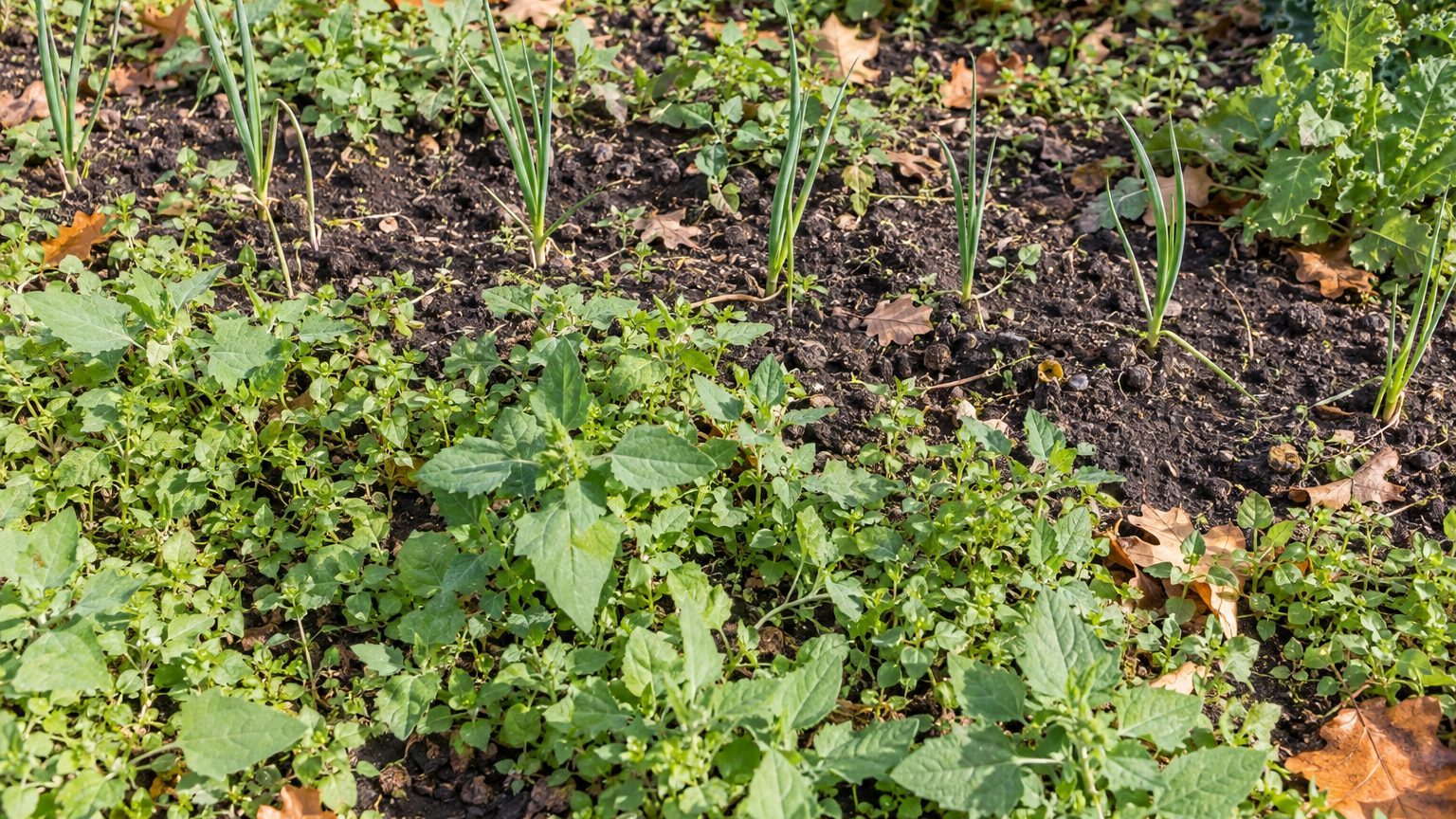

Shallots lose to weeds because almost everything about their anatomy works against them. The leaves are thin and stand straight up, so they shade nothing. The roots are few, unbranched, and stay in the top several inches of soil. And the plants grow slowly for the first month or two, which gives fast weeds a head start they rarely give back. A bed that looks “mostly fine” in May can quietly cost you half your harvest by July.
Built to be outcompeted
Walk past a bed of lamb’s quarters and you’ll see what a good competitor looks like: broad leaves that overlap, a taproot that goes deep, and growth fast enough to double in height within a couple of weeks. Now look at a shallot. A row of green spikes, each roughly as wide as a pencil, with bare soil visible between them for weeks. Nothing about that design blocks light.
Roots are the second problem. Onion-family crops, shallots included, put out a sparse, shallow root system with very few root hairs. Compare that to a weed such as crabgrass or quackgrass, which builds a dense web through the same top few inches of soil. When water and nitrogen are limited, the weed wins the argument every time, because it simply has more root surface to work with.
Then there’s the clock. Shallots planted from sets in early spring, or in fall in milder states, spend the first stretch establishing roots while the foliage barely moves. Cool-season weeds like chickweed and henbit are not slowed by that same cold. They germinate in the same soil temperatures the shallots like, so the two crops start at the same moment, and the weeds are simply faster off the line.
Even the shallot’s best trick works against it in this one respect. A single set multiplies into a cluster of six to ten bulbs, which is why the crop is so generous (more on that in Growing Shallots: One Bulb In, a Handful Out). But a cluster is a crowded underground neighborhood. Weeds that root between the bulbs are hard to pull without tugging the whole clump, and they are exactly where a hoe cannot safely go.
What weeds actually take, and when
Weeds don’t steal in a single dramatic moment. They take three things at once: light, water, and nitrogen. Shallots are light feeders compared with something like corn, but they respond fast to a nitrogen shortage with pale, short tops. And bulb size depends on how much leaf area the plant builds before the bulbs begin to swell. Fewer and smaller leaves mean smaller bulbs. Simple as that.
Extension research on bulb onions, the closest well-studied relative, backs this up. Trials have shown yield losses of more than half under season-long weed pressure, and in very weedy plots the loss climbs far higher. Growers who work onion fields talk about a “critical period” for weed control. It starts shortly after the first true leaves are up and runs for roughly the first two months of growth. Weeds that emerge in that window do the most harm. Weeds that sprout after the bulbs are well along are annoying but matter much less.
That timing is useful, because it tells you where to put your effort. A gardener who weeds carefully for eight weeks and then gets lazy will usually out-harvest the one who weeds a little all season but let things get away in the first month. Early weeds also grow up alongside the shallots, which means their roots intertwine with the crop’s. Pulling them later pulls up soil, and sometimes the sets with it.
Weather muddies the picture. A wet spring boosts weed germination, and a dry stretch hits shallots harder than it hits deep-rooted weeds. If you’re watering to rescue the crop, you may be feeding the competition too. Aiming water at the shallot row rather than flooding the bed helps, and the details are covered in Watering Shallots, and When to Stop.
Keeping the bed clean without wrecking the bulbs
Before the sets go in
The cheapest weed control happens before planting. Try a stale seedbed. Prepare the bed two to three weeks ahead, water it, and let the first flush of weeds sprout. Then scrape them off with a sharp hoe, working no deeper than about an inch, and plant without turning the soil again. Every time you dig, you bring up fresh seeds from below, so skipping that second round of tillage means far fewer seedlings later.
Perennial weeds need a different approach. Quackgrass rhizomes and bindweed roots will regrow from small fragments, and shallots can’t compete with that at all. If a bed has either, dig out the roots by hand (a garden fork works better than a shovel here) or smother the area with cardboard and mulch for a full season before planting. It’s slow. It’s also the only thing that works reliably in an organic garden.
Spacing is the other early decision. Sets planted about 6 to 8 inches apart in rows 12 to 18 inches wide leave room to run a hoe between rows. Planting tighter squeezes more bulbs into the bed but removes your access, and you’ll end up hand weeding on your knees. For most home gardeners, the extra yield from crowding doesn’t make up for the lost weeding time.
After the shoots show
Once shoots are a few inches tall, shallow cultivation is the main tool. A stirrup hoe or a sharp scuffle hoe, pushed just beneath the soil surface, cuts weed seedlings at the root without reaching the shallow shallot roots. Do it on a dry, sunny morning so the cut weeds wither instead of re-rooting. Every seven to ten days is about right in spring. Weeds that are still thread-sized come out easily. Wait until they have true leaves and the job triples in difficulty.
Mulch is the second tool, with a couple of cautions. Two to three inches of straw, shredded leaves, or grass clippings dried first will block light and keep new seeds from germinating. Wait until the shallots are up and the soil has warmed a bit, since mulch over cold soil slows growth. Keep it pulled back an inch or two from the bulbs themselves, because shallots that sit in constantly damp material are more prone to rot. And stick to straw, not hay. Hay is full of seed heads, and you’d be planting a weed crop.
A few other pointers, short enough to list:
- Pull weeds after rain or watering, when roots slide out of loose soil.
- Cut big weeds at the soil line instead of pulling them if they sit right against a cluster.
- Skip uncomposted manure and unfinished compost, which can carry viable seed.
- Fertilize in a band along the row rather than broadcasting across the bed.
That last point matters more than it seems. Broadcast fertilizer feeds every seed in the bed. A narrow band of nitrogen, placed near the shallots and scratched in lightly, goes mostly to the plants that need it.
Landscape fabric or black plastic with holes burned or cut for each plant is a workable option for gardeners who hate weeding. It blocks nearly everything except what grows in the planting holes. The trade-off is that shallot clusters need room to swell, so the holes should be generous, and the fabric can trap moisture around the necks. Many gardeners find straw easier and more forgiving.
Late season, containers, and when to stop
By the time the tops begin to flop and yellow, usually somewhere between 90 and 120 days after planting depending on variety and climate, the weeding is largely over. Weeds that come up now rarely hurt yield. The one exception is anything going to seed. A single lamb’s quarters or pigweed plant can drop thousands of seeds, and you’ll be dealing with them next year. Cut seed heads before they mature and keep them out of the compost pile.
Weeding also stops when you start curing. Shallots are pulled once the tops have mostly fallen, then dried in a shaded, airy spot for a couple of weeks. Leave the soil alone in the last couple of weeks before harvest, because disturbing the roots can nick the bulbs, and nicked bulbs store poorly.
If weeds are consistently beating you in the ground, a container solves most of the problem outright. Fresh potting mix carries almost no weed seed, and a pot sits above the reach of creeping rhizomes. The trade-offs are drying out faster and a smaller harvest per square foot, both covered in Shallots in a Container. A raised bed filled with clean soil gives you much of the same benefit at a larger scale.
One last nuance on timing: in the coldest states, such as Minnesota or Vermont, spring-planted shallots start so slowly that weeds nearly always get ahead of them. Gardeners there often do better planting in October and mulching heavily, so the shallots come up first in spring, ahead of most weed flushes. In that case the straw does double duty, shielding the sets through winter and then holding back seedlings when the thaw arrives.