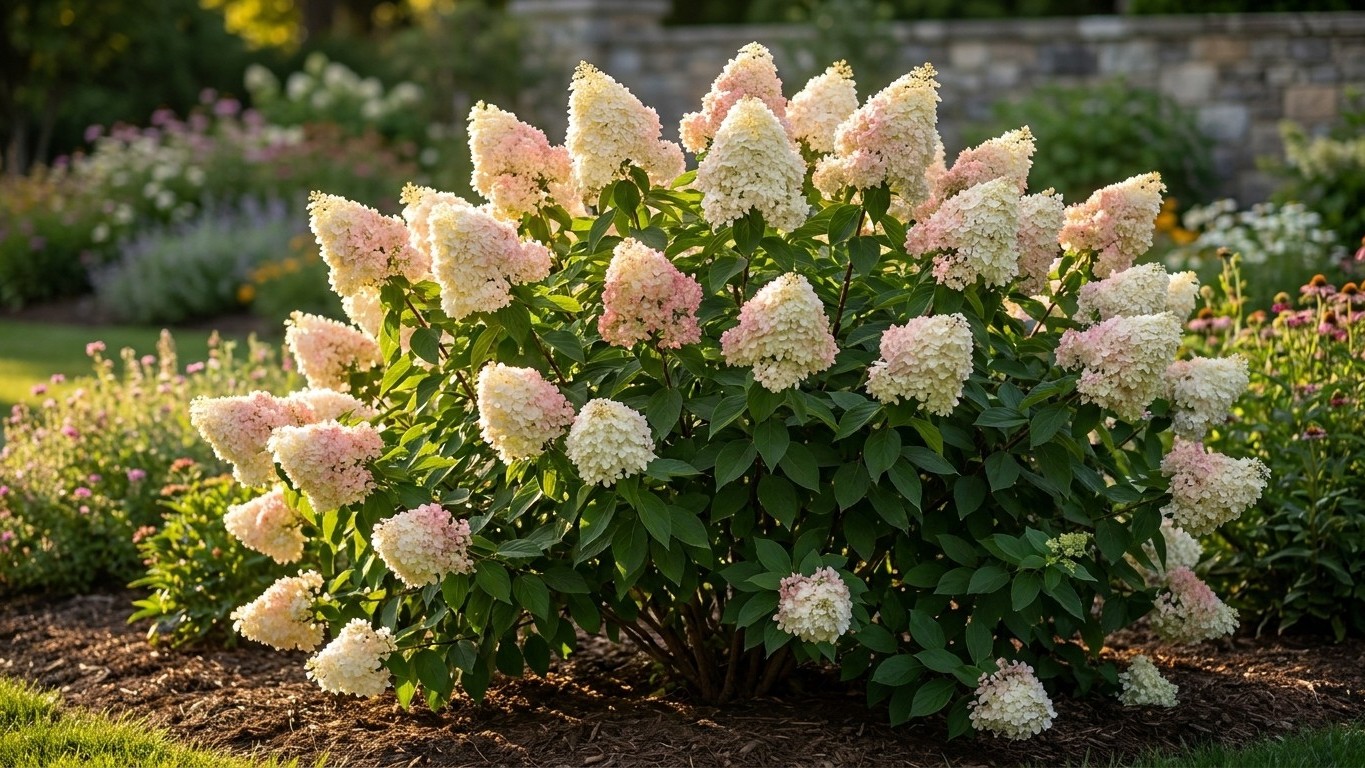

Hydrangea paniculata, sold under names like Panicle Hydrangea and Peegee Hydrangea, is hardy in USDA zones 3a-8b, tolerant of full sun or partial shade, and adaptable to soils from sand to clay as long as drainage is decent. It blooms in summer and fall, reaches 6 to 12 feet across at maturity, and grows fast enough to need real room. Whether it belongs in a particular yard comes down to the winter low there, the light and drainage at the planting site, and whether there’s actually 6 to 12 feet to give it.
Where it will and will not survive

The USDA hardiness range for Hydrangea paniculata is 3a-8b. That’s a wide band as woody shrubs go, but the number that matters most to a reader isn’t where it thrives, it’s where the range ends. Below the bottom of this range, in colder zones, winter kills the plant outright or cuts it back so hard each year that it never builds the woody framework a shrub of this size is supposed to have. Above the top of it, the plant may survive the winter but struggle through summer heat and humidity it wasn’t built for. A hardiness range describes survival, not comfort, and a shrub rated to the warm edge of its zone isn’t necessarily happy spending its summers there.
Zone numbers aren’t uniform across a state, let alone across the country, and guessing at one from memory is exactly how people end up planting the wrong shrub. Anyone unsure where their own property falls should check the hardiness zone guide on this site, which breaks zones down by county rather than by broad region.
The plant data behind this range comes from the North Carolina Extension Gardener Plant Toolbox, and it’s worth being precise about what that source does and doesn’t cover. The USDA hardiness range itself is a national standard and applies anywhere in the country. Any regional planting advice tied to that same source, split by coastal, piedmont, or mountain conditions, is specific to North Carolina and shouldn’t be carried over to a different state’s climate.
The source also classifies this plant with several labels at once: Perennial, Shrub, Tree. That’s not a contradiction so much as a reflection of how it grows, a woody perennial that behaves as a multi-stemmed shrub in most yards but can be trained to a small tree form. Where the source calls it a native plant, that means native to the southeastern United States specifically, not native everywhere it’s sold or planted. Its foliage is deciduous, so expect bare stems through winter regardless of zone.
Light, soil and where it belongs
The source lists a range of conditions this shrub tolerates rather than one ideal setup, and it’s worth reading the list that way. A plant that tolerates clay and sand, acid and neutral pH, isn’t fussy, but tolerating a condition isn’t the same as thriving in it.
| Factor | What it tolerates |
|---|---|
| Light | Full sun (6+ hours direct) or partial shade (2-6 hours direct) |
| Soil texture | Clay, high organic matter, loam/silt, sand |
| Soil pH | Acid (below 6.0) or neutral (6.0-8.0) |
| Drainage | Good drainage, moist, occasionally wet |
Where it sits in a landscape matters as much as what soil it’s in. With a habit described as arching, cascading, erect, horizontal, irregular, multi-stemmed, and vase-shaped, this isn’t a shrub with one predictable silhouette. Depending on the cultivar and pruning, it can read as a loose, informal mass seen from a distance or as a more upright accent viewed up close from a window. Set against a wall or fence, its irregular branching tends to soften a hard line rather than mirror it, which makes it more useful as a backdrop than as a tightly clipped edge.
Space at maturity is 6 to 12 feet, and that single figure implies two different spacings depending on the job. Planted as a hedge or screen, shrubs are typically set closer, using the low end of that range as a rough spacing so the canopies meet and knit together into a continuous line. Planted as a lone specimen, the full 12 feet needs to be open around it, on all sides, not just in front, since it can spread in more than one direction depending on its habit.
When it flowers, and what that decides
Bloom time for this shrub is summer into fall, given as a season rather than a calendar date because bloom timing shifts with latitude and elevation. A garden further south or at lower elevation will likely see flowers earlier in that window than one further north or higher up.
Bloom timing matters less for the display than for what it decides afterward: when to prune. The rule that governs flowering shrubs generally is straightforward. A shrub that sets its flower buds on the previous year’s growth needs to be pruned right after it finishes blooming, so there’s time for new wood to form and set next year’s buds before winter. A shrub that flowers on the current season’s new growth can be pruned before growth starts in late winter or early spring, since the wood that will carry flowers hasn’t grown yet.
The facts available here don’t settle which category this shrub falls into, so the honest answer is to observe it for one season rather than guess. Watch where the flower buds actually form: if they appear at the tips of stems that clearly grew earlier that same spring, prune in late winter before growth resumes. If flowers instead appear on stems that were already woody the previous fall, prune right after the blooms fade. One season of watching settles the question more reliably than any general rule.
After the flowers pass, the plant sets fruit described as a brownish-pink, dehiscent, oval capsule that appears through summer and fall. It’s a seed capsule, not a berry, and it isn’t described as attracting wildlife, so anyone hoping for a bird-friendly fruit display should look elsewhere.
Planting and the first two years
- Plant in fall or early spring, avoiding the hottest stretch of summer.
- Dig a hole wider than it is deep, at least twice the width of the root ball.
- Set the plant so the root flare sits right at grade, not buried and not raised.
- Tease out any roots circling the root ball before backfilling.
- Backfill with the native soil removed from the hole, without amending heavily.
- Water deeply right after planting, then regularly through the first growing season.
- Mulch a few inches deep, keeping it pulled back from direct contact with the stems.
Drought resistance in the source material describes an established plant, one that’s had time to grow roots deep enough to ride out dry stretches. A newly planted shrub hasn’t done that yet, and the first two summers are the ones that actually decide whether it survives, regardless of what the label promises down the road.
It’s common for a shrub like this to sulk in its first year, doing little visible above ground while it builds roots below. Year two usually brings noticeably more growth as it starts filling out, and year three is typically when it performs the way it’s supposed to, with full flowering and mature habit. Knowing that timeline in advance keeps a healthy, slow-starting plant from getting dug up and replaced out of impatience.
What it resists, and what it does not
Resistance in a plant description means a tendency, not a guarantee. A shrub resistant to a given pressure will usually handle it better than one that isn’t, but resistance is never immunity, and stressed conditions can overwhelm even a resistant plant.
| Factor | What the source reports | What that means |
|---|---|---|
| Salt | Unspecified | The source tracks this category but doesn’t rate the degree of tolerance, so treat salty sites (roadside de-icing spray, for instance) with caution rather than assumed safety. |
| Pollution | Unspecified | Same caveat: no rated tolerance either way for urban air pollution exposure. |
| Urban Conditions | Unspecified | No specific rating for compacted soil, heat islands, or other typical urban stressors. |
Growth rate is listed as rapid, and maintenance as medium. Rapid growth means a shrub that fills its allotted space quickly, which is good for a new hedge that needs to close gaps fast but also means it can outgrow a tight spot sooner than expected if the 6 to 12 foot mature size wasn’t respected at planting. Medium maintenance suggests it doesn’t need constant attention, but it does need a yearly pruning decision made at the right time, based on when it actually flowers, to keep its size and shape in check. It’s also listed as attracting pollinators, which is worth factoring in when deciding whether to prune off spent flowers or leave them for the season.
Common questions
Is Hydrangea paniculata the same as Peegee Hydrangea?
Peegee Hydrangea and Panicle Hydrangea are both common names used for this same plant. Common names aren’t standardized, so it’s worth confirming the botanical name, Hydrangea paniculata, when buying or researching to avoid confusion with a different hydrangea species.
Does it need full sun to bloom well?
The source lists both full sun and partial shade as tolerated light conditions, so it isn’t limited to one exposure. Full sun tends to produce denser flowering on many panicle hydrangea types, but partial shade is a workable option where full sun isn’t available.
How far from a house foundation should it be planted?
Given a mature spread of 6 to 12 feet, planting distance from a wall or foundation should account for the higher end of that range, especially for a specimen planting rather than a hedge, to avoid crowding siding or windows years down the line.
Will it survive a harsh winter?
That depends entirely on the local zone. Within USDA zones 3a-8b, the plant is rated to survive winter cold, though a range means survival, not necessarily vigorous growth. Below that range, winter damage or death becomes likely. Checking a zone map for the exact property is the only reliable way to answer this.