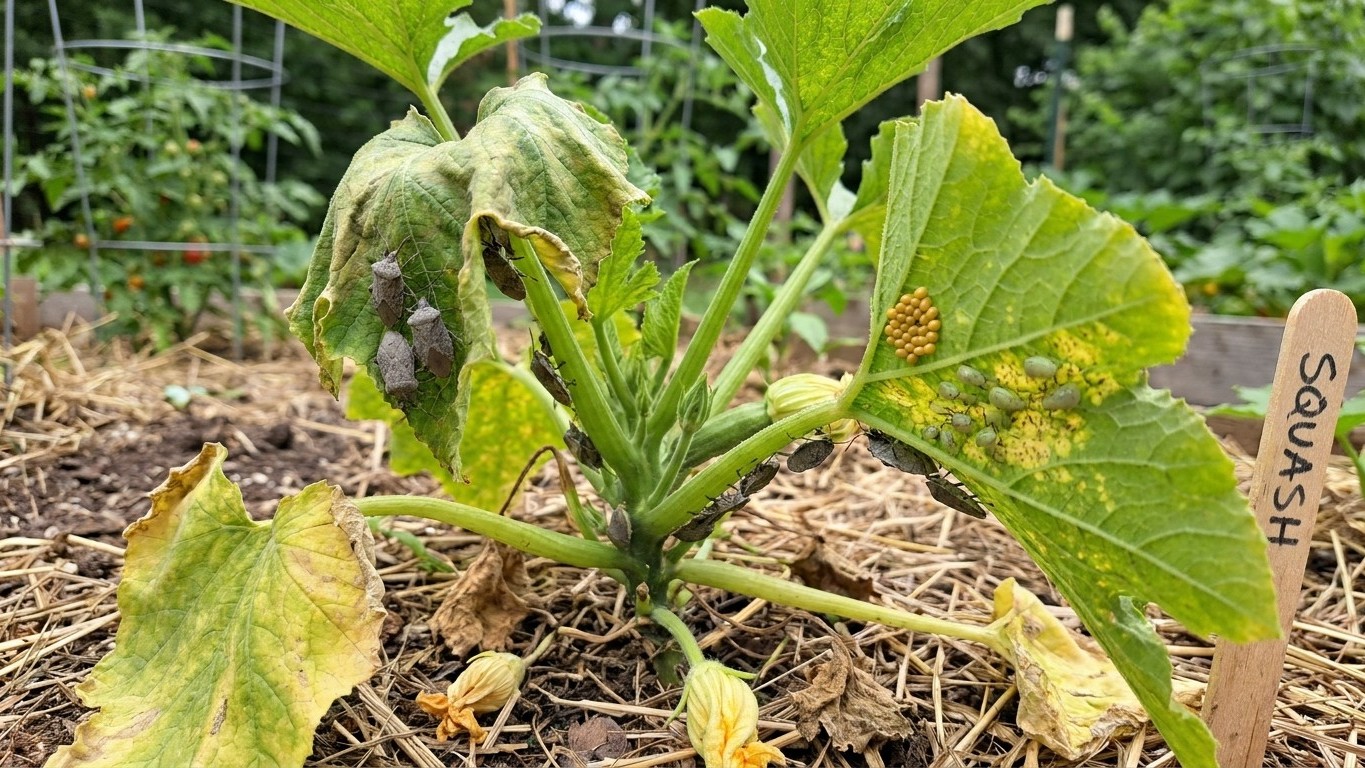

Squash bugs earn their reputation because most of their life happens where you can’t see it. Adults tuck themselves under leaves, mulch, and garden debris during the day, while females lay overlapping batches of eggs for weeks at a time. By the time a plant wilts, several generations may already be established, which is why one spray or one afternoon of hand-picking rarely finishes the job.
What is actually going on
The core problem is timing mismatch. A single female squash bug can lay eggs in staggered batches over a period of weeks, not all at once. That means on any given day in midsummer, a plant might host eggs, newly hatched nymphs, older nymphs, and adults simultaneously. Gardeners who treat once and assume the problem is solved are almost always dealing with a fresh wave within days, because the eggs that hadn’t hatched yet are now nymphs feeding on the same leaves.
Feeding damage compounds the hiding problem. Squash bugs use piercing-sucking mouthparts to draw sap from leaves and stems, injecting saliva that interferes with water movement in the plant. This is why a heavily infested vine can look fine one week and collapse into sudden, irreversible wilting the next. The visible wilting is a lagging indicator. The actual damage started when nymphs were small enough to go unnoticed on the undersides of leaves, near the base of the plant where scouting is easy to skip.
Age of the planting matters too. Younger, smaller squash plants have far less leaf tissue and vascular capacity, so the same number of feeding insects causes proportionally more stress. This is part of why early-season infestations feel disproportionately alarming compared to the same bug numbers showing up on a mature, sprawling vine later in the season. Some squash types show more tolerance to feeding pressure than others, but which types perform best varies by region and by the specific insect pressure in a given growing area. Rather than chasing a single “resistant” variety by name, it makes more sense to check with your state’s cooperative extension service, which tracks regional trial results for exactly this kind of question.
None of this is solved by reaching for a single treatment and hoping it clears the population in one pass. Understanding the staggered egg-laying and the hidden feeding habits is what explains why control has to be a repeated, seasonal habit rather than a one-time event. That shift in expectation, from a single fix to an ongoing routine, is the single biggest mental adjustment gardeners need to make.
In the garden
Squash bug control lives or dies on where you look and how often. The table below breaks down the stages you’ll actually encounter in the garden, where to find them, and what tends to happen when each stage gets missed.
| Life stage | Where it’s found | What happens if it’s missed |
|---|---|---|
| Egg clusters | Undersides of leaves, often in the angle where veins meet, in tight bronze-colored groups | Each cluster hatches into a group of nymphs feeding in the same spot, multiplying the damage on that leaf within days |
| Young nymphs | Clustered near hatched egg sites, pale green to gray, soft-bodied | They disperse across the plant as they grow, becoming harder to track and treat as a single group |
| Older nymphs and adults | Stems, leaf undersides, and increasingly under mulch or garden debris during the heat of the day | They become more mobile and start laying the next batch of eggs, restarting the whole cycle before the current one is under control |
| Overwintering adults | Under boards, plant debris, mulch, or garden edges at the end of the season | They emerge the following year already mated and ready to lay eggs, giving next season’s population a head start |
Removing egg clusters by hand, before they hatch, is the single most effective non-chemical step available, precisely because it interrupts the cycle at the one point where the insects are stationary and visible. Skipping this step and waiting for nymphs to show up means fighting a mobile, dispersed population instead of a fixed one.
Garden sanitation matters just as much as scouting. Leaving squash debris, old mulch, or boards in place after harvest gives adults a place to overwinter close to next year’s planting site. Clearing that debris at the end of the season, and avoiding thick mulch piled directly against stems during the growing season, removes a lot of the shelter that lets adult populations persist between generations. Rotating where squash and related crops are planted from year to year also reduces the odds that overwintering adults emerge right next to a fresh host plant.
None of these practices require naming a specific product or a specific rate. What matters is the practice itself: check leaf undersides on a regular schedule, remove what you find, and reduce the shelter available to adults between plantings. Skipping any one of these steps doesn’t necessarily undo the others, but it does give the population an opening to rebuild faster than expected.
What it depends on where you are
How many squash bug generations show up in a single season, and how early they appear, depends heavily on local conditions that this page can’t specify for every reader. Season length is the biggest factor: in regions with a long, warm growing season, squash bugs can complete more generations before frost, which means the “one wave and it’s over” assumption is even less true than in shorter-season areas. Summer heat speeds up the insect’s development from egg to adult, so a hot stretch can compress what would normally be a slower buildup into a much faster one.
Rainfall patterns play a role too, though less directly. Wet conditions can affect how much mulch and debris accumulates and how quickly it breaks down, which in turn affects how much overwintering shelter is available near the garden. Dry, mulch-heavy gardens in some regions may actually offer more stable shelter for adults than gardens in wetter climates where organic mulch decomposes faster.
This is exactly the kind of variation that a general guide can describe in principle but can’t resolve for a specific location. A gardener in a short-season northern climate is dealing with a genuinely different timeline than one in a long, hot growing region, and the number of scouting passes needed per season reflects that difference. Rather than guess at a schedule that fits everyone, it’s worth checking the state-specific guides on this site for regional planting and pest timing, and pairing that with a call or visit to your local cooperative extension office. Extension services track regional insect pressure, first-appearance timing, and which squash types have performed well in trials for that specific area, information that simply can’t be generalized responsibly at a national level.
The honest takeaway here is that the mechanism (staggered eggs, hidden adults, feeding damage that shows up late) is consistent everywhere. The calendar for when to start scouting, how many generations to expect, and how aggressive sanitation needs to be is local, and no national guide can substitute for that local knowledge.
The mistake that costs the most
The single costliest mistake is treating adult squash bugs as the target while ignoring the eggs. It’s an understandable error: adults are bigger, more visible, and feel like the obvious problem to solve. But by the time adults are noticeable in numbers, a portion of the population has already laid the next batch of eggs, and those eggs are sitting on leaf undersides, untouched, ready to hatch into the next wave regardless of what happens to the adults you can see.
This mistake compounds because it creates a false sense of progress. A gardener who focuses on adults might genuinely reduce the visible population for a few days, feel like the problem is handled, and then be caught off guard when a fresh cluster of nymphs appears a week later. The eggs were never addressed, so the timeline just reset.
The fix is a change in where attention goes, not a more aggressive version of the same approach. Make leaf-underside inspection a routine part of garden walk-throughs, ideally every few days during the growing season, and treat egg removal as the priority action, not an afterthought to adult control. Combine that with reducing shelter for adults (clearing debris, avoiding thick mulch piled against stems) so fewer adults survive to lay the next batch in the first place. This two-part approach, egg removal plus reduced shelter, addresses both ends of the cycle instead of chasing the most visible but least decisive stage.
For gardeners deciding what to plant next season, it’s also worth remembering that squash types vary in how well they tolerate feeding pressure, and that variation is regional. Rather than assuming any single variety will solve the problem outright, check with your state extension service about which types have shown resilience in local trials. That conversation, paired with a consistent habit of checking leaf undersides before reaching for anything else, does more to break the cycle than any single treatment applied after the damage is already visible.