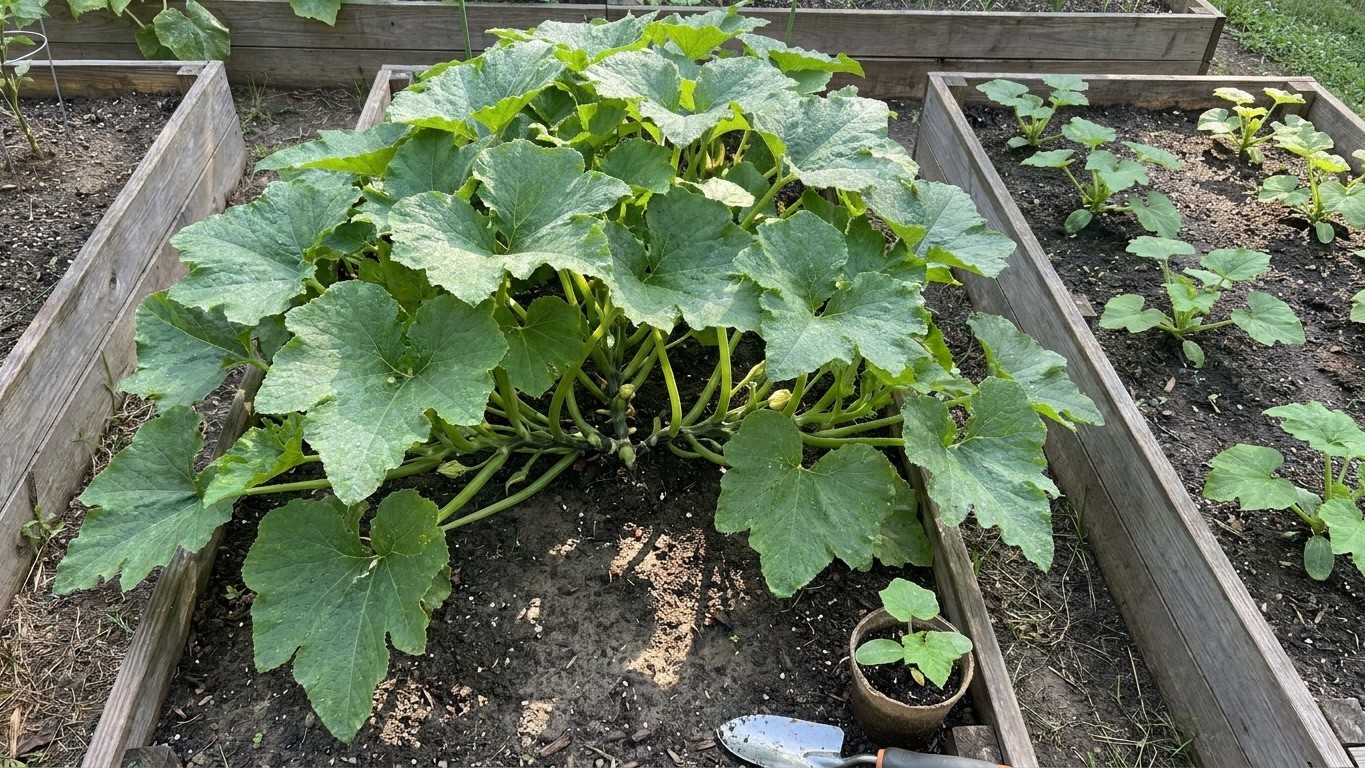

One summer squash plant needs about 3 to 4 feet of open space on every side once it hits full size, not the tidy 12-inch spot the seed packet illustration suggests. That gap isn’t wasted ground. It’s the buffer that keeps the leaves dry enough to stay alive through August.
What is actually going on

Seed packets print spacing numbers based on a young plant, maybe six weeks old, still compact and upright. Nobody photographs the version that shows up ten weeks in: a sprawling dome of leaves three feet across, stems as thick as a broom handle, and a canopy so dense you can’t see the soil underneath. That gap between the packet illustration and garden reality is where most spacing mistakes start.
The thing to understand here is airflow. Summer squash leaves are broad, and when several plants sit close together, those leaves overlap and trap humid air underneath. That still, damp microclimate is exactly what powdery mildew and downy mildew need to get established. Spores don’t need standing water to germinate, just consistently high humidity on the leaf surface, and a crowded planting manufactures that humidity every single night as dew forms and has nowhere to evaporate. Spacing is, in practical terms, the cheapest fungicide a gardener has, because it removes the condition the disease depends on before it ever needs a spray at all.
Squash plants also come in two basic growth habits, and the type you’re growing changes how much that airflow buffer matters. Bush-type plants stay relatively self-contained, forming a rounded clump rather than sending out long runners. Vining types, more common in some winter squash and a handful of summer varieties, send stems out several feet and need room to travel rather than room to bush out. Most zucchini and yellow summer squash sold in home garden seed racks are bush types, but the exact habit varies by variety, and that’s genuinely a case where the reader is better served checking their own state extension service’s vegetable variety trials than trusting a blanket rule from any single article, this one included. Extension trial data reflects what actually grows well in a given region’s heat and humidity, which a national spacing chart can’t account for.
There’s a second, quieter mechanism at play too: root competition. Squash roots spread wide and shallow, often extending two to three feet from the base plant by midseason. Two plants set too close aren’t just fighting for sunlight above the soil, they’re fighting for water and nitrogen below it, and that competition shows up as smaller leaves and fewer flowers well before mildew ever becomes visible.
In the garden
The gap between “recommended spacing” and “what actually happens when you ignore it” is where most gardeners learn the hard way. Here’s what a mature summer squash plant really needs, and what shows up when that space gets cut short.
| Spacing given | What the mature plant does | What goes wrong if you crowd it |
|---|---|---|
| 18 to 24 inches between plants | Leaves touch neighboring plants by midseason, canopy stays partly closed | Humidity builds under the canopy; powdery mildew often appears on lower leaves first, then climbs |
| 36 inches between plants | Canopy fills the space but leaves get some air movement between plants | Still tight in a wet summer; mildew risk drops but doesn’t disappear, especially with overhead watering |
| 48 inches or more between plants | Full canopy with visible gaps between plants, soil surface partly shaded but not sealed off | Rare disease pressure from crowding; the tradeoff is more bare soil to mulch and more walking room needed |
| Rows spaced under 3 feet apart | Foot traffic between rows brushes wet leaves, spreading spores from plant to plant | Disease moves down the row fast once it starts, since brushing wet foliage is one of the most efficient ways to spread mildew spores by hand or sleeve |
Notice that the “wrong” outcomes in that table aren’t about smaller harvests directly. They’re about disease pressure, which then reduces the plant’s productive window because a mildew-covered plant photosynthesizes less and often gets pulled early. Spacing failures show up as a health problem first and a production problem second.
What crowding actually looks like in real time
It rarely announces itself as one obvious mistake. A gardener plants at 18 inches because that’s what fit the bed layout, the plants look fine for the first month, and then sometime in the hottest, most humid stretch of summer the lower leaves start showing a faint white dusting that spreads upward over one to two weeks. By the time it’s obvious, the plants have usually been touching for a month already. The lesson isn’t that 18-inch spacing is always wrong. In a dry climate with good wind exposure, it can work fine. In a humid one, it’s often the exact spacing that turns a healthy planting into a mildew problem by late summer.
What it depends on where you are
Some of this is universal. Squash roots spread a predictable distance regardless of zip code, and the airflow mechanism behind mildew works the same way in Georgia as it does in Minnesota. But how much that mechanism matters, and how tight a gardener can safely plant, is genuinely local.
Summer humidity is the biggest variable. A garden that gets regular dew and warm, moist nights all summer needs more spacing buffer than one in a drier climate, even if both are growing the exact same variety at the exact same spacing on paper. Rainfall patterns matter too, not just total amount but frequency. Frequent light rain that wets the leaves without ever fully drying them out between showers creates far more disease pressure than the same total rainfall delivered in a few heavier storms with dry stretches between.
Season length changes the calculation in a different way. In regions with a short frost-free window, gardeners sometimes crowd plants intentionally to maximize output from limited growing weeks, accepting more disease risk as a tradeoff for a compressed timeline. In regions with a long, hot growing season, that tradeoff usually isn’t necessary, and the wider spacing pays for itself because there’s time for the plant to recover if a disease issue does show up.
Wind exposure is the variable most gardeners never think about. A garden that gets a steady afternoon breeze dries leaf surfaces faster and can often get away with tighter spacing than a sheltered backyard bed surrounded by fences or hedges, even in the same town.
None of this can be reduced to a single national number, which is exactly why state extension services exist. They run variety trials and publish spacing and disease guidance calibrated to actual regional humidity, rainfall, and season length, not averaged across the whole country. Checking a state extension bulletin before finalizing bed layout is a better use of five minutes than trusting any generic spacing chart, including the one on this page’s own tables above.
The mistake that costs the most
The single most expensive mistake isn’t planting too close. It’s planting at the correct distance for a young plant and never adjusting for what that plant becomes. A gardener measures 24 inches between seedlings, feels good about following the packet, and then does nothing as those seedlings grow into a canopy that fully closes within six weeks. The spacing was right on planting day and wrong by midseason, and almost nobody revisits it once it’s set.
What to do instead is treat spacing as something to manage through the season, not just at planting. That means thinning aggressively if more than one seed germinated per hole, rather than leaving both “just in case.” It means watching the canopy in early summer and, if leaves from neighboring plants start overlapping and staying damp into the morning, removing a few of the oldest, lowest leaves on each plant to open a channel for air to move through underneath. Pruning a handful of leaves doesn’t meaningfully hurt production on a bush-type plant, since the top canopy still gets full sun, but it can meaningfully cut the humidity buildup that starts a mildew outbreak.
It also means watering at the soil line instead of overhead once plants are established, since wet leaves are the entry point for most of the fungal problems that crowding makes worse. A drip line or a hose held low does the same job as overhead sprinkling without leaving the canopy damp for hours afterward.
The fix costs nothing and takes ten minutes with a pair of pruners. The mistake, left alone, costs a chunk of the growing season to a disease that spacing alone would have prevented. Anyone unsure whether their specific variety runs compact or sprawling should check their state extension office’s vegetable variety guide before assuming either way.