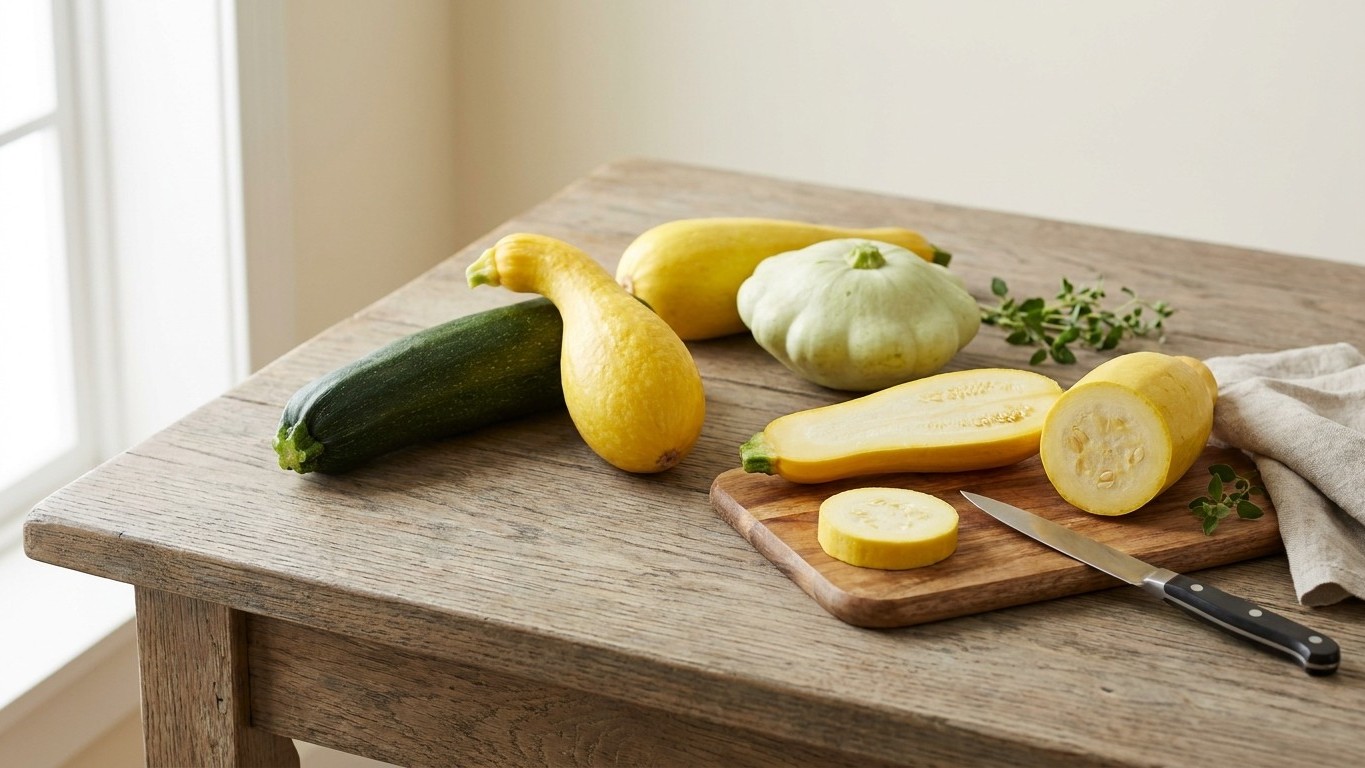

Zucchini, yellow crookneck, yellow straightneck and pattypan all belong to the same species, Cucurbita pepo. What separates them is shape and skin, not some deeper botanical divide. That single fact explains why they cook differently, spoil differently, and why a recipe written for one doesn’t always translate to another.
What is actually going on

The thing to understand here is that these four squash are the same plant shaped by selection into four fruit forms, and each form ages at its own rate. Zucchini is a smooth cylinder. Crookneck curves at the neck and wears a bumpy, sometimes tough skin. Straightneck is the same yellow flesh in a straight tube with smoother skin. Pattypan is the flying-saucer shape, scalloped at the edge, harvested small or it turns starchy fast.
Skin thickness is the variable that matters most in the kitchen. A young zucchini has skin thin enough to eat raw in a salad. Crookneck skin toughens earlier because the fruit itself is built for a slightly longer curing period on the vine, historically valued for storage more than tenderness. Straightneck splits the difference: thinner than crookneck, thicker than baby zucchini, which is why it holds up in a skillet without turning to mush the way an overgrown zucchini will.
Seed cavity coarsening is the other mechanism, and it’s the one gardeners underestimate. Inside every summer squash, the seed cavity starts soft and gelatinous. As the fruit ages, even by a day or two past its ideal size, that cavity firms up and the seeds themselves harden. Pattypan does this fastest of the four, which is why a pattypan picked at the size of a large coin is a different vegetable than one left to reach the size of a dinner plate. Zucchini is the slowest to coarsen relative to its growth rate, which is part of why it’s forgiving for beginners.
None of this is about flavor complexity. Botanically, the flesh is close to identical across all four. What changes is texture, moisture content at harvest, and how the shape affects surface-to-volume ratio during cooking, a straight cylinder sears differently than a scalloped disc. For exact varieties trialled in a given climate, a state extension service publishes trial data specific to that region rather than generic type descriptions.
In the garden
Here’s where shape and skin translate into real decisions about when to pick and what happens if you miss the window.
| Type | Skin | Flesh | Best use | Speed to marrow |
|---|---|---|---|---|
| Zucchini | Thin, smooth, dark or light green | Moist, mild | Raw, grilled, roasted, baked into bread | Slow to moderate |
| Yellow crookneck | Thicker, bumpy, curved neck | Slightly drier, more flavor concentration | Sautéed, stewed, fried | Fast once neck curve sets |
| Yellow straightneck | Smoother than crookneck, straight body | Moist, mild, similar to zucchini | Sautéed, grilled, sliced for casseroles | Moderate |
| Pattypan | Thin when young, firms quickly | Nutty, denser | Roasted whole when small, stuffed when larger | Fastest of the four |
What happens when it goes wrong looks different for each. Leave zucchini too long and it turns into a bat you could swing, the skin toughens, seeds harden, and the flesh gets watery and bland, still usable grated into baked goods but wrong for a skillet. Leave crookneck too long and the neck itself gets fibrous and stringy before the body does, so trimming that curved section becomes non-negotiable rather than optional. Straightneck that’s overgrown gets mealy rather than watery, a texture that no amount of seasoning fixes. Pattypan overgrown is the least forgiving: the scalloped rim gets tough and the interior turns pithy within what feels like a single week of inattention.
A second common failure is picking by calendar days instead of by looking at the plant. Growth rate swings with heat and water, so a squash that would hit ideal size in five days during a mild stretch might get there in three during a heat spike. The fix isn’t a stricter schedule, it’s checking the plant every other day once flowering starts and going by size and skin feel, not by a date circled on a calendar.
Blossom drop and misshapen fruit are the other issue gardeners flag across all four types, usually tied to pollination gaps rather than the variety itself. That’s a pollinator and watering-consistency problem, not a reason to abandon one type for another.
What it depends on where you are
Season length is the honest limiting factor here. Summer squash types generally mature fast relative to other garden vegetables, but “fast” still needs a minimum stretch of warm weather without interruption, and that stretch varies from a short northern season to a long run in the Gulf Coast states.
Heat changes behavior mid-season in a way that catches people off guard. In regions with sustained high summer temperatures, plants can slow fruit-set during the hottest weeks even while continuing to flower, then resume once temperatures ease, which looks like a problem but often isn’t one. In cooler, shorter-summer regions, the opposite issue shows up: plants may still be ramping up production when the season starts to close.
Rainfall and humidity shift disease pressure more than they shift the squash type question. Regions with high summer humidity see powdery mildew and other fungal pressure show up earlier and more aggressively, which affects plant longevity more than it affects which of the four types performs best. Drier regions with irrigation deal less with fungal pressure and more with consistent watering to prevent blossom-end issues.
None of this is a reason to guess. A state extension service publishes planting windows, disease pressure notes, and trial results for varieties actually tested in local conditions, which is far more useful than a national average. Other guides in this series cover state-by-state planting calendars in more detail; if the season length or heat pattern in a specific state matters for a specific planting decision, that’s the place to check before committing to seed.
The mistake that costs the most
The single costliest error is treating all four types as interchangeable at harvest time, picking by size alone without accounting for how fast each one’s seed cavity coarsens. A gardener who lets pattypan sit on the vine the way they’d let zucchini sit ends up with a squash that’s already fibrous by the time it looks “ready” by zucchini standards. The reverse mistake happens too: picking crookneck too early because it looks small compared to a full-grown zucchini, when in fact crookneck’s curved shape means it reaches usable size at a smaller overall length.
What to do instead is learn each type’s own size cue rather than applying one universal rule. For zucchini, err on the side of picking earlier rather than later, six to eight inches is a reasonable ceiling for most types before quality drops. For crookneck and straightneck, check the neck and shoulder area specifically, since that’s where toughness shows first. For pattypan, go by diameter and skin give: if a thumbnail can still dent the skin easily, it’s in range; once the skin resists, it’s already past its best window.
The underlying habit worth building is walking the squash bed every other day once plants start flowering, rather than checking once a week. Summer squash of every type can double in size within 48 hours during a warm stretch, and that window is exactly where the difference between tender and marrow gets decided. A once-a-week check almost guarantees missing that window for at least one type in a mixed planting. Checking more often costs a few minutes; missing the window costs the entire fruit.