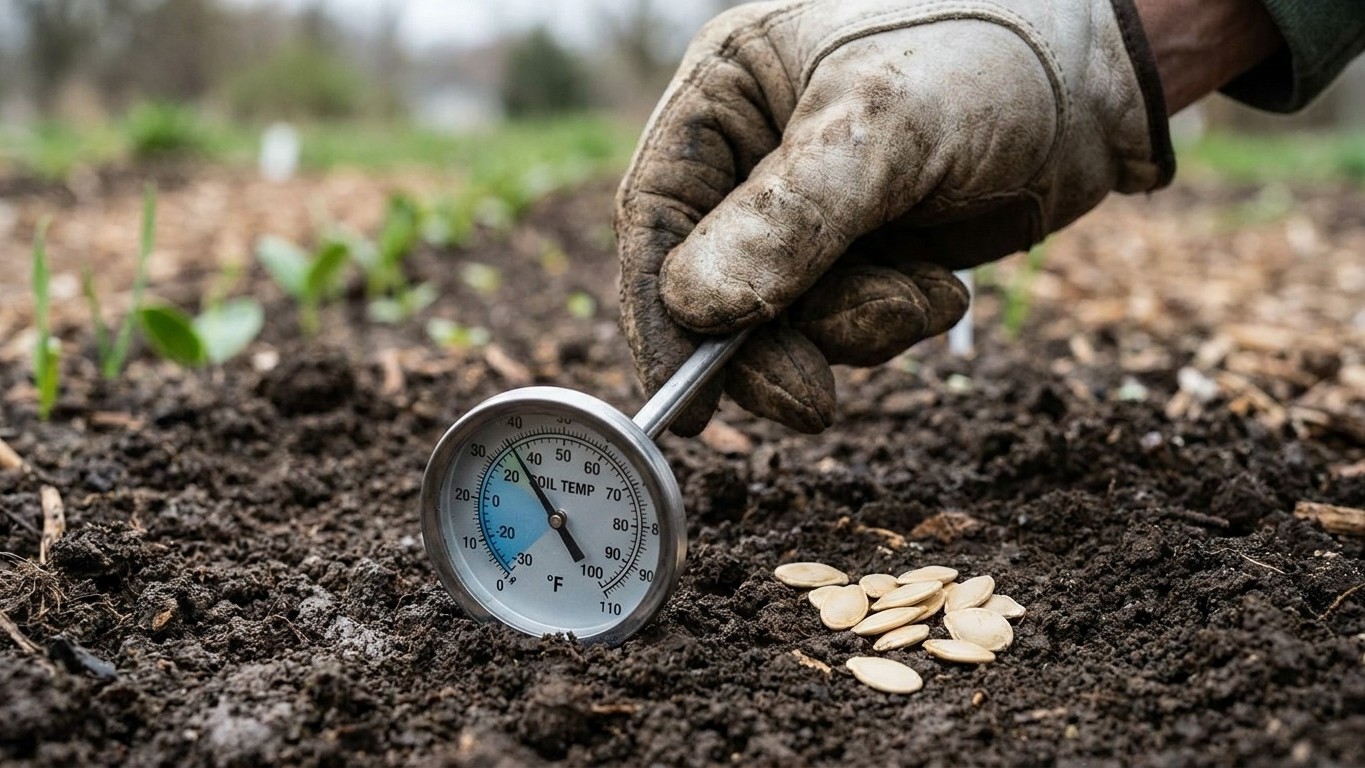

Summer squash germinates reliably once soil temperature holds at 60°F or above, with 70°F to 95°F as the range where seeds come up fast and strong. Below 60°F, seeds sit in wet ground and rot before they sprout. Air temperature on the weather app doesn’t tell you this. A soil thermometer, pushed 2 to 4 inches down at mid-morning, does.
What is actually going on

A squash seed is a dormant plant packed with stored starch and a seed coat built to keep water out until conditions are right. Warmth is the trigger that switches on the enzymes converting that starch into usable sugar. Below 60°F, the enzymes barely function. The seed coat softens anyway, because soil moisture doesn’t wait for the seed to be ready, and that’s the trap: a softened, imbibed seed sitting in cold, damp soil is exactly what soilborne fungi look for. The seed doesn’t fail from cold alone. It fails from cold plus wet plus time, three things that add up to rot before the radicle ever emerges.
This is why air temperature misleads so many gardeners. A sunny 68°F afternoon in April can sit on top of soil that’s still 52°F four inches down, because soil holds winter’s chill far longer than air does. Bare soil warms slowly from the surface downward, and a cold snap at night can undo two days of daytime warming before the heat ever reaches seed depth. Air temperature is a poor proxy because it measures the wrong medium at the wrong depth.
Summer squash belongs to the cucurbit family, the same group as cucumbers, melons, and pumpkins, and all of them share this same cold sensitivity at the germination stage. It’s a warm-season vegetable in the truest sense: not just intolerant of frost as a seedling, but intolerant of cold ground as a seed. That single fact explains most of the “my squash never came up” stories gardeners tell each other every spring. It also explains why the same seed packet, sown two weeks apart, can produce wildly different results. The seed didn’t change. The soil did.
Understanding the mechanism matters more than memorizing a number, because the right number shifts with mulch color, soil type, and moisture. Sandy soil warms faster than clay. Black plastic mulch can push soil temperature up several degrees compared to bare ground. A gardener who understands why warmth matters can read their own garden instead of copying someone else’s calendar. For the types of summer squash suited to a particular climate and season length, a state extension service or land-grant university trial list is the reliable source, not a name picked off a seed rack.
In the garden
Judging soil warmth without a thermometer is possible, but it’s a rougher measure, and each shortcut carries its own failure mode. The table below walks through the common ways gardeners estimate readiness, and what tends to go wrong when the estimate is off.
| Method | What it tells you | What goes wrong when misread |
|---|---|---|
| Soil thermometer, 2-4 inches deep, mid-morning | Direct, reliable reading of the zone where seeds sit | Reading taken right after rain or right after a cold night gives a falsely low number; take it a few hours after sunrise on a settled day |
| Hand test (soil feels warm, not cool, to bare skin) | Rough sense that soil has shed its winter chill | Skin adapts fast, so a gardener who’s been outside for an hour reads soil as “warm” when it’s still in the mid-50s |
| Weed emergence (certain warm-season weeds sprouting nearby) | Local, on-the-ground confirmation soil biology is active | Some early weeds tolerate cooler soil than squash does, so their presence overstates how ready the ground is |
| Calendar date from a seed packet | A national average, not a local fact | Treats a Georgia date and a Minnesota date as interchangeable; soil in the two states can differ by three weeks or more in a given spring |
Why the later sowing often wins
Gardeners who wait an extra week or two past the “safe” date frequently end up with squash that produces earlier than a sibling planted right on schedule into cold ground. The mechanism is simple: a seed sown into 55°F soil sits and swells for days without visible progress, sometimes rotting outright, sometimes germinating weak and stunted. A seed sown ten days later into 65°F soil germinates in under a week and grows without the setback. The early sower spent that head start doing nothing. The patient sower banked it as real growth.
This also argues for succession sowing rather than a single big planting date. Putting in a second round two to three weeks after the first spreads the risk, and it hedges against a late cold snap that can knock back an entire single planting at once. If the first sowing struggles, the second is often already catching up by midseason. Raised beds and black mulch both help by warming the root zone faster than open, bare, in-ground soil, which matters most in regions where spring stays cool late into the season.
What it depends on where you are
The 60°F threshold itself is a biological constant, true from Vermont to Arizona, because it describes how the seed works, not where it’s planted. What isn’t constant is when a given piece of ground reaches that number, how long it stays warm enough to matter, and how much rain falls on it in the meantime. Those three variables (season length, summer heat, and summer rainfall) are entirely local.
A short-season northern garden might not see reliably warm soil until early June, and might lose that warmth again by late August, compressing the whole growing window into ten or eleven weeks. A long, hot southern season can offer warm soil from April into October, but excess heat above roughly 95°F to 100°F brings its own problems, including poor fruit set and blossom drop, which is a different issue from germination but sits on the same seasonal timeline. Rainfall patterns matter too: a region with heavy, cool spring rain keeps soil wetter and slower to warm than a drier region at the same latitude, which is part of why two gardens at similar elevation and similar frost dates can still need different sowing windows.
None of this is a reason to guess. It’s a reason to check two things: the reader’s own state extension service, which publishes soil temperature guidance and recommended sowing windows calibrated to that state’s actual climate data, and the state-specific guides on this site built for exactly this purpose. A number that’s accurate for one region and wrong for another isn’t a useful number at all, and that’s precisely the case with squash sowing dates pulled from a generic calendar rather than local soil data.
The mistake that costs the most
The single costliest mistake is sowing by the calendar instead of the soil, specifically jumping the gun because the date on a favorite planting guide has arrived and the weather finally feels like spring. That impatience is understandable. It’s also the direct cause of most squash germination failures, because it substitutes a fixed date for a variable condition. The soil doesn’t know what the calendar says, and a seed sown into it doesn’t care that the forecast looks promising for the coming week.
What happens next follows a predictable pattern. The seed absorbs moisture from cold, damp soil, softens, and sits there for a week or more without emerging. During that stalled window, soilborne fungi that are perfectly happy in cool, wet conditions get a long, uninterrupted opportunity to attack a seed that has no defenses left. By the time the gardener digs down to check, what they find is often a mushy, rotted seed rather than a slow sprout. The instinct is to blame the seed’s quality, or the seed packet, or bad luck. The actual cause was ground that hadn’t reached 60°F yet.
The fix costs nothing and takes thirty seconds: check the soil itself, at planting depth, on a settled morning, before dropping seed. If it reads below 60°F, wait. If a planting window feels tight because of a short season, warm the soil ahead of time with black plastic mulch or a low tunnel rather than sowing early into cold ground, and consider starting seed indoors under controlled warmth for transplanting once outdoor soil catches up. For the specific types of summer squash that perform best against a particular region’s season length, a state extension service remains the source worth trusting, not a generic date on the back of a seed packet.