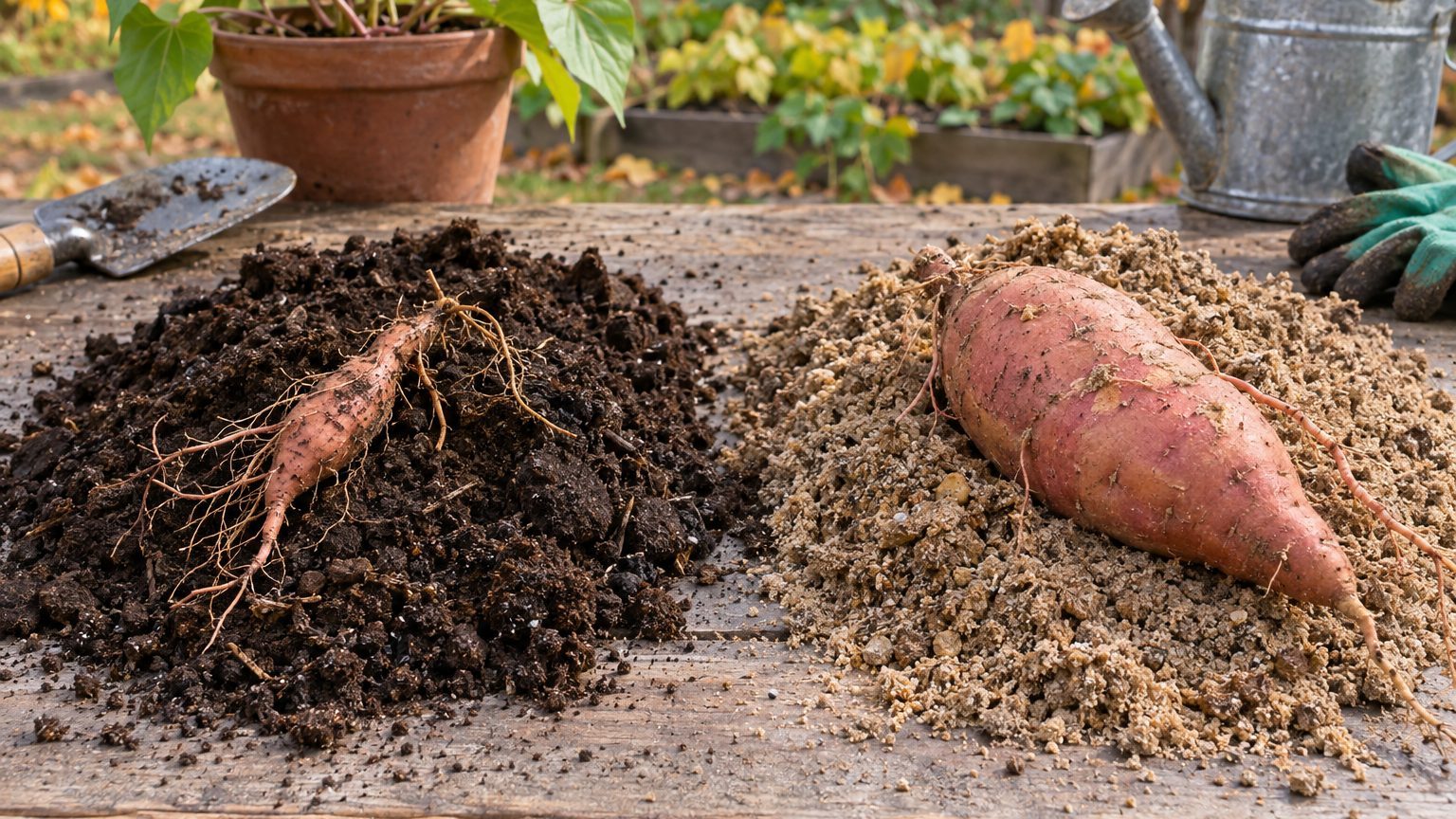

Sweet potatoes want loose, well-drained ground that is modest in fertility and low in nitrogen. Sandy loam is close to ideal. Rich, heavy, freshly fed beds do the opposite of what a gardener hopes: they grow a jungle of vines and a handful of skinny roots. This is a crop that rewards the worst bed in the yard, and the reason comes down to how the roots are built.
What is actually going on
Vines first, roots second
A sweet potato is not a tuber the way a potato is. The edible part is a storage root, and it starts life as an ordinary thin root that grows from the buried base of a slip or from the nodes along it. Early on, each of those roots is undecided. Some thicken into storage roots. Others stay thin and fibrous, or harden into stringy “pencil” roots that never swell. Soil conditions tip the balance.
Rich ground tips it the wrong way. Plenty of available nitrogen tells the plant to spend its energy on leaves and runners, and the vines can race across a bed while very little happens below. Heavy soil adds a second problem. Clay holds water, packs down, and pushes out oxygen, and roots in that environment tend to lignify (turn woody) rather than fatten. What you dig up is a tangle of fibers and a few misshapen lumps.
Why loose, sandy ground works
Sandy or sandy-loam soil solves several things at once. It drains quickly, so the roots stay well supplied with air. It warms early in the season, and this crop, a tropical native, sulks in cold ground. It offers little resistance, so a swelling root can push outward and grow long and even instead of squeezing into a kinked shape. And because it holds few nutrients, it keeps the plant from overfeeding on nitrogen.
Potassium is the nutrient the roots do want in decent supply, since it supports bulking. Soil that is slightly acidic to near neutral suits the plant well. A basic soil test through your state’s cooperative extension service tells you where you stand on both, which beats guessing.
One point of botany clears up a lot of confusion. Sweet potato belongs to the morning glory family. It is not a nightshade, not a yam (the grocery store label is wrong, and true yams are a different plant altogether), and not a potato. Advice written for tomatoes and potatoes, from rich compost to potato rotation schedules, does not transfer. If you want the full sequence from slips to cure, the guide Growing Sweet Potatoes: Slips, Heat, and a Careful Cure covers it. This page stays on the ground itself.
In the garden
Preparing the bed is mostly a matter of loosening and restraint. The table below lists each step and what happens when it goes wrong, because the failures are what teach you to read your own soil.
| Step | What to do | What happens when it goes wrong |
|---|---|---|
| Loosen the soil | Work it deeply enough that roots meet no hard layer. Break up compaction before planting, not after. | Roots hit a hard layer and turn, split, or stay thin. Harvest turns up crooked, stringy roots. |
| Choose the bed | Pick the sandiest, best-draining spot with full sun. | A low, wet spot keeps roots short of air, and rot follows in a wet stretch. |
| Skip high-nitrogen feeding | Use little or no nitrogen fertilizer. Let a soil test guide any addition. | Vines smother the bed while the roots stay small. |
| Go easy on compost and manure | Add only modest amounts of finished compost to very poor ground. Avoid fresh manure entirely. | Extra nitrogen and moisture retention favor leaves. Fresh manure adds rot risk and can burn young slips. |
| Raise the planting row | Build a broad ridge or mound and plant on top. See Why Sweet Potatoes Are Grown on Ridges. | On flat, heavy ground, water pools around the roots and the soil stays cold and dense. |
| Watch the pH | Keep the soil slightly acidic to near neutral, and correct only if a test says so. | Very alkaline ground can stunt growth. Liming an already-fine bed wastes effort and can cause new trouble. |
| Avoid fresh sod | Don’t plant straight into newly turned lawn or pasture. Give sod time to break down first. | Soil pests living in the sod, such as wireworms and grubs, chew or scar the roots. |
Water without drowning
Moisture matters more than most gardeners expect, and the goal is evenness. Young slips need steady water to settle in. Once vines cover the ground the plant handles dry spells fairly well. What hurts is a long dry stretch followed by a soaking, which can crack roots that are swelling. Sandy soil dries fast, so it may need more frequent watering in a dry summer. Clay stays wet longer, which is why it is the harder soil to fix.
Mulch is a fair tool on sandy beds, since it steadies moisture without adding fertility. Choose it for that purpose and keep it off the crowns of young slips until they are established.
What it depends on where you are
Some of this page holds nationwide. The principle that loose, drained, low-nitrogen ground produces better roots applies from a Georgia field to a Michigan backyard, because it comes from how the plant forms roots. The specifics do not travel nearly as well.
Three local factors change the answer. Season length decides how much time roots get to bulk, and in a short season every week of soil warmth counts, so a well-drained ridge that heats early matters more. Summer heat affects how fast the soil dries and how badly a bed of sand will need watering. Summer rainfall might be the biggest variable of all. A gardener in a humid region with heavy summer storms fights drainage and rot. A gardener in a dry region fights to keep sandy soil evenly moist. The same bed could be a good choice in one place and a poor one in the other.
This page does not know your soil, your rainfall, or your first fall frost, and it would be dishonest to pretend otherwise. Naturally sandy ground in one county can sit a few miles from stiff clay in the next. Local conditions also decide which types of sweet potato do best. Some types mature faster and suit shorter seasons, while others need long warm summers. For the specific varieties trialled in your area, ask your state’s cooperative extension service. Extension offices publish variety trial results and can test your soil for a small fee or sometimes for free.
This site also has state pages that cover growing conditions region by region. Start there for the broad picture, then check with your extension office for the county-level detail. When the two disagree, trust the one closer to your garden.
The mistake that costs the most
The costliest error is treating sweet potatoes like a hungry vegetable and giving them the best bed you own. It feels responsible. You’ve spent years building that soil with compost, aged manure, and fertilizer, so it seems natural to plant the crop you care most about in your richest ground.
The result is a bed that looks spectacular for months. Vines spread past the edges, leaves are deep green, and everything says success. Then you dig, and the reward is a few small roots, some thin and stringy, some with no swelling at all. Because the vines looked so good, most gardeners blame the slips, the weather, or the variety. They rarely blame the soil, and so the next year they add more compost.
The fix is to reverse the instinct. Give sweet potatoes the leanest, sandiest, best-drained spot in the garden, and hold back on nitrogen. If your only available bed is rich, you still have options. Build a tall, broad ridge from the topsoil so roots develop in a loose, well-aerated mound. Leave the fertilizer bag in the shed. If the ground is heavy clay, lighten it by working in coarse material and going to a ridge or a raised bed, rather than adding richer amendments. Take a soil test first, and let it tell you whether potassium is short before adding anything.
You can also read your bed as the season goes. If the vines are huge by midsummer and you’re tempted to feed them further, don’t. Vigorous vines are not a sign of a good crop. They are often the warning sign.
Once the crop comes in, the same care continues. Handle the roots gently and cure them as directed in the main guide. Never store sweet potatoes in a refrigerator or a cold cellar, because cold injury is irreversible and it is one of the most common ways a good harvest is lost. If a root develops a soft patch or a weeping spot, that ends the question, whatever the rest of it looks like. For what to inspect and why roots go bad, see Sweet Potatoes That Spoil After Harvest.
Common questions
Can I grow sweet potatoes in heavy clay?
You can, but you have to change the conditions. Build broad, tall ridges or raised beds with loose soil on top so the roots have room and air. Avoid planting flat in clay that stays wet, and don’t work the soil when it is soggy, since that compacts it further. Your extension service can suggest the best way to loosen clay in your region.
Should I add compost or fertilizer before planting?
Usually very little. Poor, sandy ground may benefit from a modest amount of finished compost, but a bed that is already fertile needs nothing. Skip nitrogen-heavy products and fresh manure. If you want to add something, get a soil test first and let the results decide.
Is a sweet potato a yam, and can I rotate it with potatoes?
It is neither. A sweet potato is in the morning glory family, while true yams are a separate plant and potatoes are nightshades. That means it doesn’t belong in a potato or tomato rotation. It is best not to plant sweet potatoes in the same spot year after year, as soilborne problems can build up.
Can I keep harvested sweet potatoes in the refrigerator?
No. Cold storage damages them, and once a root has been chilled below its comfortable storage range the injury cannot be undone. The damage often shows up later as hard centers, off flavor, or rot. Also, never rely on how a root looks to judge whether it is sound. A soft patch or a weeping spot means the root is finished.