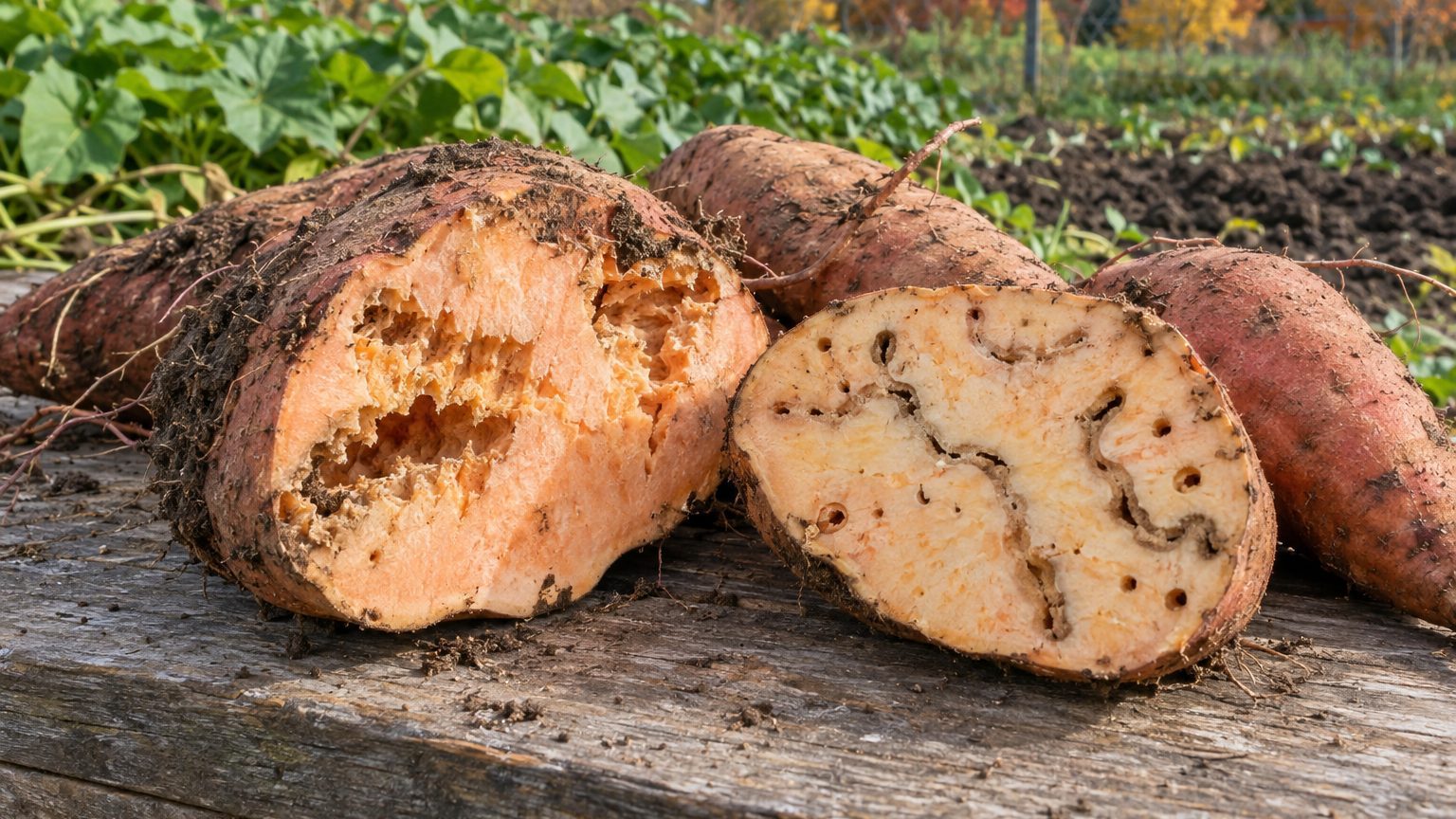

Big, ragged gouges with paired tooth grooves along the edges are voles. Narrow tunnels and pinholes running through the flesh, often with a tiny entry hole in the skin, are wireworms. Both happen underground and stay hidden until the fork goes in, so the bed you choose and how you prepare it are the only real defense. Once the roots are chewed, nothing brings them back.
What is actually going on
These are two very different feeders, and knowing which is which tells you where the problem started. Voles are small rodents, and they eat sweet potatoes the way any rodent eats a dense, starchy, sugary root: they sit and gnaw. The bites are large and irregular, and if you look closely you can see the fine parallel grooves left by their front teeth. Some species travel in surface runways through grass and mulch. Others, such as pine voles, live in their own underground tunnels and go straight for roots. Either way, they show up when the roots begin to bulk up and become worth the trip.
Wireworms are something else entirely. They are the larvae of click beetles, slender, glossy, tough-skinned, tan to orange, and often around an inch long when mature. They do not gnaw chunks. They bore, leaving narrow, winding tunnels through the flesh that can be about as thin as a pencil lead. From the outside a root may show only a few pinpricks. Cut it open and the inside looks like a maze. The larvae spend several years in the soil, and grassland is where their numbers build. That is the connection most gardeners miss: a bed carved out of lawn, pasture or a long-neglected weedy patch arrives with a wireworm population already in place.
Why does it stay hidden? The vines above the soil look fine whether the roots are perfect or ruined. There is no wilting, no leaf spotting, no warning. And because wireworm injury accumulates the longer roots sit in the ground, a root that looked clean in a test dig can be riddled a few weeks later.
Other pests can be mistaken for these two. White grubs chew shallow patches from the surface. In the Southern states, a group of soil insects (wireworms among them, plus certain beetle larvae) is often blamed together for surface scars and tunnels. And the sweetpotato weevil, which is regulated in some states, also tunnels through roots and makes them bitter. If you live in the South and find tunneling you can’t explain, take a damaged root to your county extension office rather than guessing.
One botanical note, since it changes how you plan the bed. A sweet potato is not a potato, not a yam, and not a nightshade. It belongs to the morning glory family, so potato rotation rules do not apply to it. But wireworms do not care about botany. They feed on potatoes, corn, grasses and many other crops, so a bed where potatoes or sod grew recently is a wireworm risk for sweet potatoes regardless of family.
In the garden
Telling the two apart takes about ten seconds with a damaged root. If the missing flesh is a scooped-out crater with a rough, ragged rim and tooth grooves, a vole did it, and the animal probably lives close by. If the surface is mostly intact but riddled with small holes and the interior is threaded with thin channels, suspect wireworms, and read that as a comment on what grew in the bed before. Voles tell you about the edges of your garden (cover, mulch, tall grass). Wireworms tell you about the soil’s history.
Most of the measures that work are physical and happen before planting. The table shows each one and what happens when it is done poorly.
| Measure | Targets | Why it works | When it goes wrong |
|---|---|---|---|
| Check the bed’s history for sod, lawn, pasture or long weedy fallow | Wireworms | Larvae live for years in grass roots | Planting straight into old sod can leave a large share of roots tunneled |
| Cultivate and keep the bed bare the season before planting | Wireworms | Turning soil exposes larvae to birds and drying | One pass followed by regrowing weeds keeps the larvae fed |
| Bait-trap before planting (buried, soaked seed under a cover, dug up after a week or two) | Wireworms | Larvae gather at germinating seed, so you can count them | Skipping it means planting blind; trapping when the soil is too cold catches little and gives false comfort |
| Line a raised bed, or bury a barrier, with small-mesh hardware cloth | Voles | Mesh stops tunneling and gnawing from below and the sides | Wide-mesh wire, shallow burial or gaps at corners let voles walk right in |
| Mow the surroundings and pull mulch back from the bed edge | Voles | Voles avoid crossing open ground | Thick mulch, tall grass or the edge of plastic sheeting becomes a covered highway |
| Set snap traps in a covered box along runways | Voles | Removes the animals actually working the bed | Traps set in the open, or set after the roots have already bulked, are too late |
| Dig when the roots are ready, not weeks later | Both | Injury accumulates with time in the ground | Leaving roots “to size up” hands both pests extra weeks |
Two of these connect to other pages in this series. If your bed borders lawn or you’ve already lost a crop to tunneling, growing in a lined bin sidesteps both problems, and Sweet Potatoes in a Container covers how to do it. Sheeting is a different matter. Black Plastic and Sweet Potatoes: Buying Warmth explains why it helps in cool summers, but the trade-off is that plastic edges and the dense vine canopy give voles cover, so keep the perimeter clean if you use it.
What to do with damaged roots
Tunneled or gnawed roots do not belong in your storage stash. The wounds are entry points for rot, and a damaged root is the first to go soft. Eat them first, and cut away the damage generously. Any soft patch, weeping spot or off smell ends the question, and that root goes to the compost. And never rescue a crop by putting it in a refrigerator or a cold cellar: cold injury below the proper storage range is permanent and ruins good roots as reliably as any pest. The full curing and storage steps are in Growing Sweet Potatoes: Slips, Heat, and a Careful Cure.
What it depends on where you are
Some of this holds anywhere in the country. Voles gnaw, wireworms tunnel, sod carries wireworms, and open ground discourages voles. What changes is how much of it matters in your yard, and this page cannot see your yard.
Season length is the biggest local variable. Sweet potatoes want a long stretch of warm weather, and the longer they stay in the ground, the longer both pests have to work. A gardener with a long season has to be more careful about late digging than one with a short season who harvests just ahead of a frost. Summer heat and rainfall matter too, because wireworm larvae move up and down in the soil with moisture and warmth. Vole pressure also swings from year to year and place to place, depending on the local mix of grass, brush, snow cover the previous winter and predators.
Your state’s page in this series lays out the season and climate for your area, so start there. Then contact your state’s cooperative extension service. It can tell you which soil pests are common locally, help identify damage from a photo or a sample, and point you to the varieties trialled in your state, including any that hold up better in your conditions. Ask about regulated pests, too, especially if you are in the South. That local knowledge is worth more than any national rule of thumb, including this page.
The mistake that costs the most
The costliest error is planting sweet potatoes into ground that was grass last year. It is a tempting shortcut: a sunny lawn corner, a strip along a fence, a patch of pasture, a bed that got a little weedy. The soil is loose enough, the site is warm, and it takes an afternoon to turn over the sod.
But that one decision loads both problems at once. Grass roots are where wireworm larvae have been feeding for years, and a freshly turned sod bed hands them a new crop of fat roots with nothing else to eat. At the same time, grassy edges are prime vole habitat, giving the animals cover right up to the bed. There is no in-season fix, because the roots are already damaged by the time anything shows.
The alternative takes more patience, not more effort. If you must use former lawn, cultivate it repeatedly through the season before planting so the larvae are exposed and the grass does not regrow, then bait-trap in spring to see what you have. Better still, put your sweet potatoes in a bed that has been vegetable garden for a few seasons, or in a lined raised bed or container where you control the soil from the start. Keep the perimeter mowed and mulch pulled back either way.
Common questions
Are sweet potatoes with wireworm holes safe to eat?
Sometimes, but there is no reliable visual test, so judge each root. A dry, localized tunnel can be cut out generously and the rest cooked right away. A soft patch, a weeping spot or a sour or off smell means the root goes in the compost. Do not put tunneled roots into storage, because the wounds invite rot.
Can I tell vole damage from mouse or rat damage?
Not reliably from the root alone. All rodents leave gnaw marks, and voles, mice and rats can share a bed. Vole gouges tend to be broad scoops with fine paired grooves. Look for runways in the grass or small burrow openings near the edge of the bed, and confirm with your extension office if it matters.
Will the same bed have the problem again next year?
It can. Wireworm larvae live in the soil for several years, so a bed with a noticeable population tends to keep one until cultivation, bare fallow or a change of site breaks the cycle. Voles return whenever the cover and food are there. Bait-trap before you replant to see where you stand.
Do containers really avoid both pests?
They avoid wireworms if you fill them with clean potting mix rather than soil from an old lawn, and they help against voles when the container has a solid bottom and sits off bare ground. A pot standing in tall grass with a hole in the base is still an invitation, so keep the surroundings clear and check that nothing can tunnel in from below.