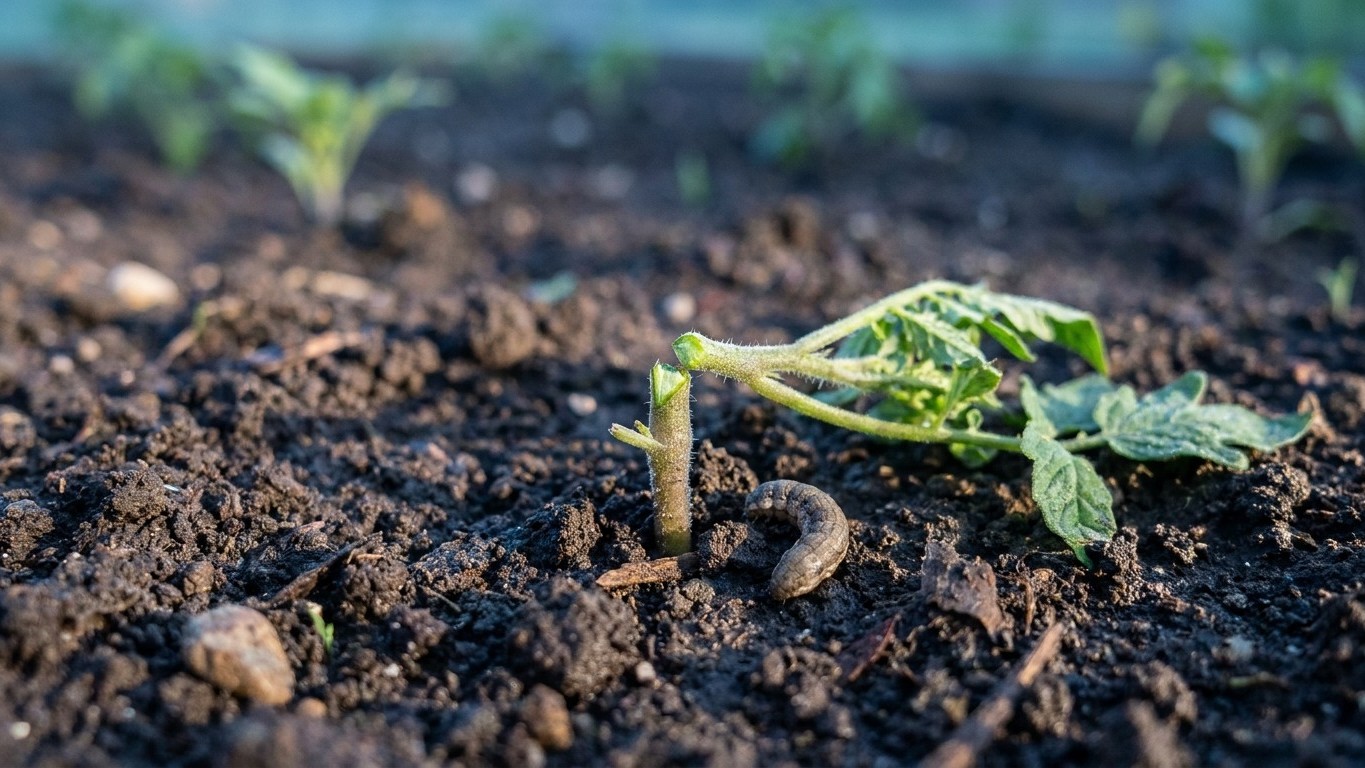

A tomato seedling standing tall at dusk, lying severed at the soil line by morning: that’s the signature of a cutworm. The stem is chewed clean through, not just nibbled, and the top of the plant often lies wilted right next to the stub. On a young transplant this can be fatal. On an established, woody-stemmed tomato plant, the same insect usually can’t do much damage at all.
What the damage looks like

The stem tells the story before you ever see the culprit. A cutworm severs a stalk at or just below the soil surface, leaving a clean, angled cut that looks almost like it was snipped with garden shears. That’s the detail that separates this pest from nearly everything else working a tomato bed. Slugs shred leaf tissue and leave slime trails. Flea beetles punch tiny shot-holes in foliage. Aphids cluster and suck sap, leaving curled, sticky leaves. None of them fell a whole plant overnight by cutting through the base of the stem.
The plant itself often looks fine from a distance, just toppled over, wilting where the top has separated from the root. Sometimes the severed top is dragged a few inches away, sometimes it’s left lying flat next to the stump. Dig into the top inch or two of soil near the damaged stem and you’ll frequently find the culprit: a fat, grayish or brown caterpillar, dull and greasy-looking, curled into a tight C-shape when disturbed. That curling reflex is the closest thing to a fingerprint this pest leaves behind, since the larva itself is nondescript enough to be mistaken for several other soil dwellers.
Cutworms feed at night and burrow into the top layer of soil during daylight hours, which is why gardeners rarely catch the insect in the act. What they catch is the aftermath: a row of seedlings planted one evening, half of them lying flat the next morning. New transplants and direct-seeded starts are the targets. A single larva can cut down several seedlings in one night as it moves along a row, since it doesn’t necessarily eat what it fells.
The scale of the damage matters for figuring out how worried to be. If it’s one or two plants at the edge of a bed, that’s typical, low-level cutworm activity and easy to manage. If an entire flat of transplants is down in one night, the population in that soil is heavier than average and calls for a more active response, covered further down.
Making sure it is this and not something else
Before treating for cutworms, it’s worth ruling out the two pests most often confused with them, since the fixes differ.
Armyworms
Armyworm larvae are also caterpillars, often similarly colored, and they do climb onto foliage to feed rather than staying at soil level. The test: armyworm damage shows up as ragged holes and skeletonized leaves higher up on the plant, not a stem severed at the base. If the leaves are chewed but the stem is intact, it’s not a cutworm.
White grubs
Grubs are the C-shaped larvae of beetles like Japanese beetles or June beetles, and they do curl similarly when unearthed. But grubs feed on roots, not stems, and they’re whitish with a distinct brown head capsule, thicker-bodied and slower moving than a cutworm. Pull a wilted plant and check the roots: chewed, stripped roots point to grubs; a clean-cut stem with intact roots points to a cutworm.
Wireworms
Wireworms are the larvae of click beetles, thin, hard-bodied, and shiny yellow-brown, closer in shape to a piece of wire than a caterpillar. They tunnel into stems and root crops rather than slicing through them, leaving a boring hole rather than a clean severed cut. Their body is stiff and segmented, nothing like the soft curl of a cutworm.
The single fastest confirmation in the field is the stem itself. A clean, angled cut right at the soil line, paired with a soft gray or brown caterpillar curled nearby in the topsoil, is close to conclusive for cutworms. Anything chewed higher on the plant, or roots stripped instead of a severed stem, points elsewhere.
When it shows up
Cutworms are a seedling-stage problem, not a season-long one. The window of real vulnerability runs from the moment a transplant goes into the ground, or a direct-seeded tomato germinates, through the first few weeks after, while the stem is still thin, soft, and green all the way to the soil. Once a tomato stem thickens and begins to turn woody near the base, typically once the plant has several true leaves and has been in the ground long enough to establish, it’s largely out of danger. A cutworm’s mouthparts can sever a pencil-thin stem with ease; they can’t get through a stem that’s thickened past that stage.
Freshly tilled or newly turned soil is the other condition that raises risk, since it disturbs overwintering larvae and pupae and can bring them close to the surface right when new transplants are going in. Beds that were left weedy or covered in dense ground cover through the previous cold season tend to carry heavier larval populations, because grasses and weeds are a preferred egg-laying site for the adult moths and give young larvae food before transplants ever go in. A bed cleared of vegetation well before planting, and left bare for a stretch, generally carries a lighter load of overwintering cutworms than one that was thick with weeds right up until transplant day.
Cool, damp soil conditions right around transplanting also tend to keep cutworms active near the surface, since it’s the layer they retreat to during the day. In dry, hard-baked soil, they burrow deeper and are less likely to reach a newly set transplant.
What to do now
Once a stem is severed, that plant won’t recover, and the priority shifts to protecting what’s left in the row. Start cheap and simple before reaching for anything else.
- Set up a stem collar. A cardboard toilet-paper tube, a section of paper cup with the bottom cut out, or a strip of aluminum foil wrapped loosely around the base of each transplant and pushed an inch into the soil blocks a cutworm from reaching the stem. This single step stops the vast majority of damage and costs nothing.
- Do a nighttime check. Cutworms feed after dark. A flashlight walk through the bed an hour or two after sunset, checking the soil right at the base of any freshly cut plant, often turns up the larva within a few inches. Hand-picking and dropping them into soapy water is free and immediate.
- Loosen the topsoil during the day. Since larvae rest curled just under the surface during daylight, gently turning the top inch of soil around damaged plants with a hand trowel exposes them to birds and to the gardener directly.
- Apply diatomaceous earth around the stem base. A ring of food-grade diatomaceous earth right at the soil line, reapplied after rain or heavy watering, damages the larva’s body as it crosses the barrier. It’s a mechanical control, not a poison, and it’s sold at most garden centers.
- Use a Bacillus thuringiensis (Bt) product labeled for cutworms or caterpillars. Bt is a naturally occurring soil bacterium sold under several brand names as a spray or granule, and it targets caterpillar digestive systems specifically, leaving bees, ladybugs, and other non-caterpillar insects unharmed. This is the least disruptive option once mechanical barriers aren’t enough.
- Reserve broad-spectrum insecticide as the last option. A soil-applied insecticide labeled for cutworms will work, but it kills indiscriminately, including the ground beetles, parasitic wasps, and birds that naturally prey on cutworm larvae. Because several broad-spectrum products carry state-specific restrictions, check the label and local extension guidance before buying, and use this only if the first five steps haven’t controlled a heavy infestation.
Stopping it coming back
- Clear weeds and grass from the bed well before the next planting date, since dense ground cover in late season is where adult moths lay eggs.
- Till or lightly turn the soil a few weeks ahead of transplanting rather than the same week, so any disturbed larvae are exposed to birds and weather instead of sheltering right where new stems will go in.
- Keep stem collars on hand for every transplant, not just after damage appears. A collar costs nothing and takes seconds to slip on, making it worth doing as routine practice rather than a reaction.
- Avoid broad-spectrum sprays as a preventive measure. Ground beetles and parasitic wasps that hunt cutworm larvae in the soil are wiped out just as easily as the pest itself, and a bed without them tends to see worse cutworm pressure the following year.
- Let a strip of the bed edge go slightly bare or mulched rather than weedy through the cold season, reducing the egg-laying habitat that carries a population into next year’s transplant window.
- Rotate where transplants go if the same bed has had repeat cutworm damage two seasons running, since larvae and pupae overwinter in place and a new bed location interrupts that cycle.
Common questions
Will a cutworm come back and cut a second plant after I remove the first?
Yes. A single larva moves along a row and can sever several seedlings over consecutive nights before it matures past the stage where it feeds this way. That’s why a flashlight check on nearby, still-standing transplants matters as much as dealing with the one already down.
Can a severed tomato seedling be saved?
No, once the stem is cut through at the base, the top can’t be reattached and the root alone won’t regrow a productive plant. The practical move is to replace it, ideally with a collar in place from day one.
Do cutworms affect tomatoes planted from seed differently than transplants?
The stem is just as vulnerable at the same thin, soft stage regardless of how the plant got there. Direct-seeded tomatoes are more exposed early on since there’s no head start in stem thickness the way a nursery transplant has.
Are cutworms harmful to established tomato plants later in the season?
Rarely. Once the stem has thickened past the seedling stage, cutworms generally can’t sever it, and any minor surface feeding at that point is cosmetic rather than a threat to the plant’s survival.