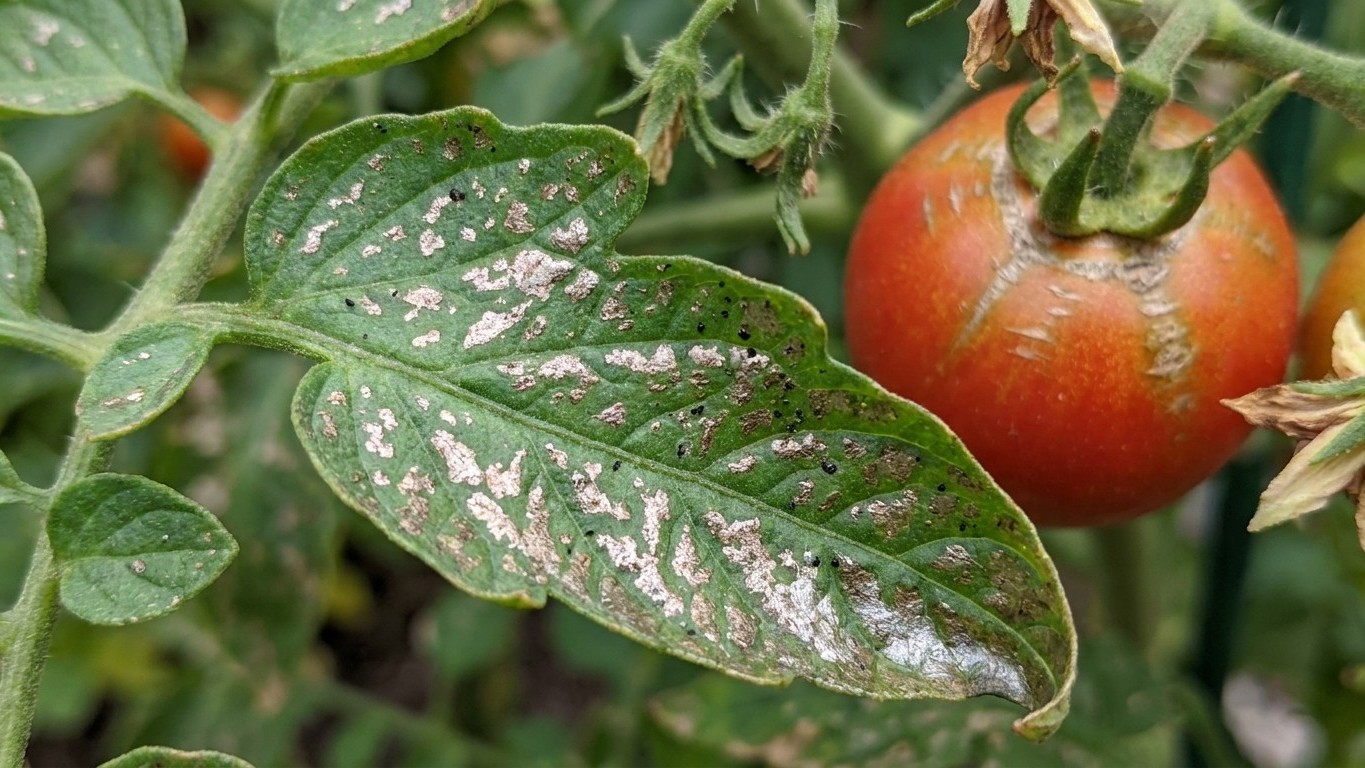

Silvery or bronze patches on tomato leaves, tiny black flecks scattered across them, and streaked or scarred fruit usually mean thrips. Most of the time this is cosmetic on a mature plant. The real concern is a virus some thrips species carry, tomato spotted wilt virus, which can stunt or kill a plant outright and has no cure once established.
What the damage looks like

Start with the leaf undersides. Thrips feeding leaves behind a silvery or bronze sheen that looks almost metallic under bright light, and scattered through that sheen are tiny black dots. Those dots are thrips frass, and they’re the single detail that separates this damage from spider mites or lace bugs, neither of which leaves visible droppings. Run a finger across the leaf and it will feel dry and slightly rough, not sticky.
New growth often comes in twisted or cupped, sometimes with a faint bronze cast before the leaf has even fully expanded. Flowers show the damage too: petals develop pale streaks or brown edges, and blossoms may drop before setting fruit. On the fruit itself, thrips leave fine scarring near the stem end, sometimes described as a halo or ring pattern, and in heavy infestations the surface takes on a rough, silvered texture that looks almost sandblasted.
The distinction that matters comes down to which symptom you’re seeing. Feeding damage alone, silvering, black specks, minor scarring, is annoying but rarely fatal on an established, fruiting plant. It’s a cosmetic problem that costs you some leaf surface and maybe a few blemished tomatoes.
Virus symptoms are different and more serious. If you see bronze ring spots on green fruit, purple or dark streaking running down one side of the stem, or a plant that’s stunted and one-sided while its neighbor looks normal, that points to tomato spotted wilt virus, transmitted by thrips feeding on the plant while carrying the pathogen from a previous host. There’s no treatment for a plant once infected. The decision at that point is whether to remove it before it becomes a source for spreading the virus to healthy plants nearby.
Making sure it is this and not something else
Thrips are easy to miss because the insects themselves are barely a sixteenth of an inch long, thin, and pale yellow to dark brown depending on species and age. The single reliable test is the tap test: hold a sheet of white paper or a white plate under a suspect flower or leaf cluster, tap it firmly, and look for thin, fast-moving slivers running across the paper. They won’t jump and they won’t fly off immediately, they’ll scurry.
Spider mites
Spider mite damage produces a fine, dusty stippling rather than a silvery sheen, and there are no black frass specks. Fine webbing between leaves and stems, especially in heavy infestations, is the giveaway. Tap the leaf and you’ll see tiny red, orange, or tan specks moving, not the elongated shape of a thrips.
Aphids
Aphids are visible to the naked eye without tapping anything, clustered in soft-bodied groups on stems and new growth. They leave sticky honeydew behind, which often grows a black sooty mold on the leaf surface below. Thrips damage is dry, never sticky.
Whiteflies
Disturb a whitefly-infested plant and a small cloud of tiny white insects lifts off immediately, then resettles. Thrips don’t fly on disturbance the same way, and whiteflies leave no black specks or silvery scarring behind, just honeydew and, eventually, sooty mold similar to aphid damage.
When it shows up
Thrips pressure tracks two plant stages rather than a calendar date. The first is the seedling and young transplant stage, when a plant has limited leaf area and any feeding or virus transmission has an outsized effect. A thrips-vectored infection on a six-inch transplant can stunt or kill it outright, which is why this stage carries the real risk in this pest’s story.
The second is flowering. Thrips feed heavily on pollen, so once a tomato plant starts setting blossoms, it becomes far more attractive to adults moving in from elsewhere. This is also when streaked petals and scarred young fruit tend to show up first, simply because that’s where the insects are concentrated.
Weather and surrounding vegetation matter more than a date on the calendar. Thrips populations build fastest during hot, dry stretches, and they move in waves when a nearby food source, weeds, a flowering ornamental bed, a neighboring field, dries down or gets mowed. When that happens, adults migrate in numbers looking for the next available bloom, and a tomato patch in flower is an easy landing spot. A plant that looked clean a week earlier can show a sudden spike in silvering and streaked flowers after one of these migration events, which is why timing this pest by stage and condition works better than trying to predict it by month.
An established plant well past the seedling stage, growing vigorously with plenty of foliage, tolerates thrips feeding without much consequence. The alarm is really reserved for young transplants and for any plant showing the ring-spot or one-sided stunting pattern described above.
What to do now
- Hose them off. A firm spray of water aimed at leaf undersides and flower clusters physically knocks adults and larvae loose and reduces numbers with no cost and no risk to beneficial insects. Repeat every few days during a population spike.
- Remove any plant showing virus symptoms. If you see the bronze ring spots, purple stem streaking, or one-sided stunting described earlier, pull that plant and dispose of it away from the garden. There’s no cure, and it becomes a reservoir the thrips can spread from.
- Set out blue sticky traps near flowering plants. Thrips are drawn to blue more strongly than yellow, and traps double as an early warning system so you know a population is building before damage shows up on fruit.
- Lay reflective mulch, aluminum-coated or metallic plastic, around the base of young plants. The reflected light disorients incoming adults and measurably reduces landing rates, particularly useful during the vulnerable transplant stage.
- Let predators do the work where you can. Minute pirate bugs, lacewing larvae, and predatory mites all feed on thrips and often keep populations in check on their own in an established garden. This only works if you skip broad-spectrum insecticides, which kill the predators along with the pest and can make thrips problems worse over time.
- For active infestations that need more than water and traps, insecticidal soap or horticultural oil applied directly to flowers and leaf undersides gives contact control with low toxicity to most beneficial insects, provided it’s applied when bees aren’t actively foraging.
- Spinosad, an organic option sold in ready-to-use formulations for home gardens, targets thrips more specifically and is widely available at garden centers. Apply in the evening to limit exposure to pollinators.
- Treat any broad-spectrum synthetic insecticide as a last resort. Several products, particularly certain neonicotinoids, carry state-level restrictions on residential use because of pollinator impact, and check your state’s rules before buying. These sprays also wipe out the pirate bugs and predatory mites that would otherwise keep thrips down for free.
Stopping it coming back
- Keep weeds and flowering ornamentals near the vegetable garden mowed or removed. These are common thrips reservoirs, and cutting off that food source reduces the migration waves that hit tomatoes hardest.
- Avoid heavy nitrogen fertilizing, which pushes soft, succulent new growth that thrips prefer over tougher, more mature foliage.
- Cover young transplants with floating row cover until they’re established and past the most vulnerable seedling stage, removing it once flowering starts so pollinators can reach the blossoms.
- Rotate tomatoes away from beds that hosted onions, garlic, or other alliums the previous season, since these crops are thrips favorites and can leave residual populations behind.
- Buy transplants from a source that inspects for pests and virus symptoms rather than bringing in unknown stock, since an infected transplant introduces both the insect and the virus at once.
- Put out sticky traps early in the season, before flowering starts, so you catch a building population while water spraying and reflective mulch are still enough to handle it.
Common questions
Do thrips kill tomato plants? Rarely from feeding alone. The real risk is tomato spotted wilt virus, which some thrips carry and which can stunt or kill a plant, especially at the seedling stage. Feeding damage by itself is mostly cosmetic on an established plant.
Can I eat tomatoes with thrips scarring? Yes. Surface scarring from feeding doesn’t affect the interior of the fruit or make it unsafe, though heavily scarred fruit may look less appealing and can be trimmed if the marks bother you.
Will neem oil get rid of thrips? Neem oil offers some suppression as a contact and repellent treatment, but it’s inconsistent against thrips compared to insecticidal soap or spinosad. It’s a reasonable low-toxicity option to try before moving to stronger products.
How do I know if my thrips are carrying the virus? You can’t tell from the insect itself. Watch the plant instead: ring-spotted fruit, purple stem streaking, and lopsided stunting are the signs that the virus, not just the feeding, is present.