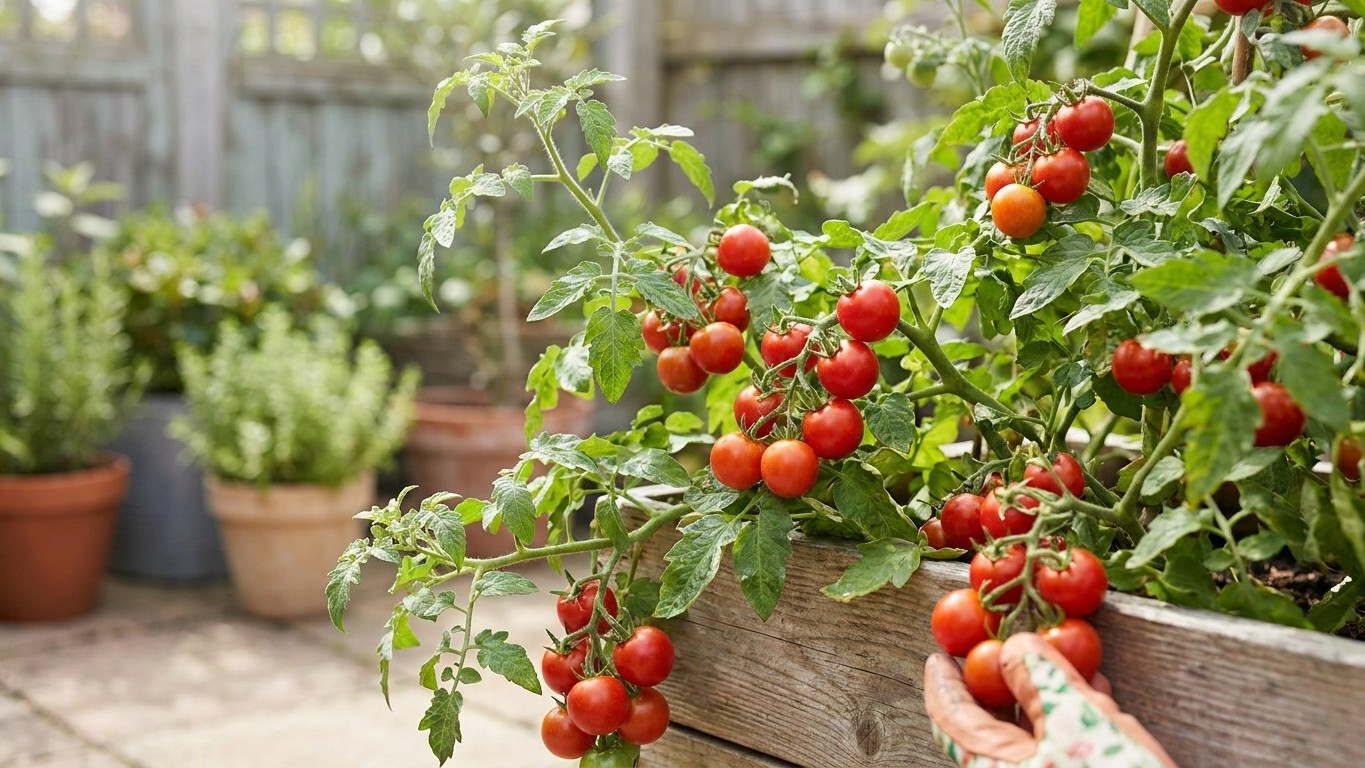

Attracta is an indeterminate cherry tomato bred to keep setting fruit from midsummer clear through to the first frost, rather than ripening in one heavy flush. Seed packets list it at around 58 days from transplant, not from sowing, which puts first fruit roughly two months after the seedling goes into the ground. The one thing to check before you commit garden space to it: how many frost-free days your area actually has left past that 60-day mark, because that gap decides whether you get months of picking or a single flush before frost cuts it short.
What Attracta actually is

Attracta is a cherry tomato, not a slicer: round, thin-skinned fruit borne in loose clusters, meant for eating off the vine or tossing whole into salads rather than slicing for sandwiches. The catalogue figure most seed packets list is around 58 days from transplant, and that distinction matters because a lot of new gardeners count from the day they sow seed indoors instead. Sow indoors on your usual schedule, then start counting the 58 days from the day the seedling actually goes into the garden, not from the day it germinated on a windowsill.
Its growth habit is indeterminate. The vine keeps growing and setting new flower trusses all season instead of stopping once it sets one flush of fruit, which is the whole point of a variety marketed as cropping until frost. That habit calls for different handling than a compact bush type gets: a stake or cage tall enough to hold six feet or more of vine, room between plants for air to move, and a feeding plan built for months of production rather than one quick push. Anyone still weighing which growth habit suits their space should look through the fuller rundown of tomato varieties before picking a support system, because staking decisions are far easier made before transplant than after the vine is four feet tall and leaning.
What Attracta is good for
Being a cherry tomato settles the question of what Attracta is for before any question of taste comes up. Small fruit has a high skin-to-flesh ratio and a wall thin enough to burst under gentle pressure, so the water inside sits close to the surface rather than being locked into a thick core of flesh. That’s exactly why cherry types get eaten raw, whole, standing at the plant or tossed into a salad bowl: there’s nothing to cook down, and cooking would just boil off the little water they hold and leave you with skins.
Attracta’s watery flesh and thin walls are also why it will disappoint anyone hoping to reduce it into sauce. Paste tomatoes work in a pan because they carry dense flesh and comparatively little water, so a pot of them collapses into sauce in twenty minutes without needing extra liquid added or extra time spent boiling it off. A cherry tomato run through the same process mostly evaporates; you’d end up simmering a large volume down to a small one, which is a poor use of a fruit that costs more per pound to grow than a paste variety and tastes better fresh anyway.
The indeterminate habit reinforces the salad-and-snacking use rather than working against it: because the vine keeps flowering and setting fruit for months instead of ripening one large flush, you get a steady trickle of a few ripe cherries at a time rather than a harvest heavy enough to justify canning or batch sauce-making. Steady small pickings suit the kitchen counter and the salad bowl, not the stockpot.
Beyond that, nothing about flavor, sweetness, or acidity is documented here. What can be said is only what the category and use imply: thin skin, juicy interior, meant to be eaten out of hand or raw in a dish, not cooked down.
Where it ripens in time, and where it is a gamble
The arithmetic is simple once you have the pieces: take the frost-free window, subtract the two or so weeks the soil needs to warm before transplants can safely go out, subtract Attracta’s roughly 60-day run to first ripe fruit, and what is left is how many weeks of picking you actually get before frost ends the season. A margin under thirty days means one flush of fruit, and a cool year takes even that before a second wave forms.
The short-season territories
In Yukon, working from Whitehorse’s station data, transplants go out in mid June and first ripe fruit lands in mid August, leaving only about 9 days before frost. That is not enough for a variety built to keep fruiting for months, and the season’s total accumulated warmth runs far short of what a tomato needs regardless of frost timing, so a greenhouse or high tunnel is the only way Attracta earns its keep there. Nunavut, measured at Rankin Inlet, is similar: set out early July, first ripe late August, a 14-day margin and a season too cool in cumulative heat to finish outdoors.
Northwest Territories (Yellowknife) and Alberta (Calgary) look better on paper, with margins around 44 to 46 days, but both still fall short on cumulative warmth, which is why cover makes up the shortfall the calendar alone cannot. Manitoba (Winnipeg) and Saskatchewan (Saskatoon) sit right at the edge, with 50 and 51 days of margin. A grower there who uses a heat-banking trick like black plastic mulch to push soil temperature up a few degrees can turn a marginal season into a reliable one.
The long-season territories
Further south the math stops being tight at all. Washington (Seattle) shows a 168-day margin, South Carolina (Charleston) 176 days, and Florida (Jacksonville), Texas (Houston), Nevada (Las Vegas) and Louisiana (New Orleans) all clear 190 days or more. In those places the frost calendar is not the limiting factor at all. Heat is, and that is the next problem.
| Territory (station) | Set out | First ripe | Margin to frost | Verdict |
|---|---|---|---|---|
| Yukon (Whitehorse) | mid June | mid August | 9 days | Risky, cover needed |
| Nunavut (Rankin Inlet) | early July | late August | 14 days | Risky, cover needed |
| Manitoba (Winnipeg) | early June | early August | 50 days | Tight, greenhouse helps |
| Florida (Jacksonville) | early to late March | mid May | 192 days | Comfortable |
| Nevada (Las Vegas) | late January to mid February | mid April | 238 days | Comfortable |
The two ways a season goes wrong
A long frost-free window on paper does not guarantee a good tomato season, and Attracta’s whole appeal, fruit that keeps coming for months, is exactly the trait that exposes both failure modes.
Cold that never adds up
In the northern territories above, the frost-free margin can look workable while the total heat for the season still falls short. Tomatoes do not set fruit once nights fall below 50F, even if the days are warm and frost is still weeks away, and a season built mostly of cool nights simply never accumulates enough warmth for a 60-day cherry to finish a full run of clusters. That is a different problem from frost, and it is why a margin of 44 to 51 days, as in Alberta, Manitoba or Saskatchewan, is not automatically safe. The plant needs sustained warmth, not just an absence of freezing, to keep the flowering and ripening cycle going the way its until-frost reputation promises.
Heat that shuts down the flowers
The opposite failure shows up in the long-margin states. Pollen goes sterile above roughly 86F, and flowers that open during that stretch drop without setting fruit at all. In Florida, Texas, Louisiana, Nevada and South Carolina, that window lands squarely across the hottest months of summer, which is why growers there run a spring crop and a separate autumn crop rather than one continuous season. For Attracta specifically, that heat pause is the more damaging of the two limits, because the variety’s whole reason for existing is a long, unbroken run of clusters. A grower in Houston or New Orleans who expects it to crop nonstop from spring straight through fall will instead get a spring flush, a dead middle, and a smaller autumn flush once temperatures drop back down.
What it resists, and what it does not
Attracta carries high resistance to Fusarium wilt races 1 and 2, meaning the fungus struggles to establish in the plant’s vascular tissue even in soil where it is already present. That is a real advantage in gardens with a history of fusarium yellowing and wilting, and it is one of the few traits actually printed on the seed packet rather than something growers have to guess at.
That is where the resistance list stops. Attracta’s catalogue listing carries no resistance code for early blight, late blight, verticillium wilt, or root-knot nematodes, which means the plant has no built-in defense against any of those and needs the same watching any unprotected tomato does. Set alongside a variety bred with a broader package, such as Defiant PhR, which is built around late blight tolerance for a single-flush slicer, the difference is real: Attracta’s protection is narrower and specific to fusarium. Growers who have dealt with late blight or verticillium before should not read “resistant” and relax. Keep rotating tomato beds away from last year’s spot, keep foliage dry with drip irrigation instead of overhead watering, and check the lower leaves regularly for the yellowing or spotting that signals trouble before it climbs the vine.
- Fusarium wilt races 1, 2: high resistance, printed on the seed packet
- Early blight, late blight, verticillium wilt: no resistance listed
- Root-knot nematodes: no resistance listed
Growing it without the usual mistakes
Because Attracta is indeterminate, the support has to go in at transplant, not after the vine is already sprawling. A single thin stake will not hold a plant that keeps adding height and side growth for months. A five to six foot cage, or a sturdy stake tied off every twelve inches or so as the vine climbs, is the minimum. Space plants far enough apart that neighboring foliage does not touch by midsummer. Cramped cherry tomatoes hold humidity in the canopy, and that is exactly the condition fungal disease needs.
Feeding for the long run, not the first flush
A determinate variety gets one push of fertilizer and is done in a few weeks. Attracta is cropping for months, so the mistake is feeding it like a sprinter. Cut back on nitrogen once the first cluster of fruit has set, and switch to a feed weighted toward potassium instead. Heavy nitrogen late in the season buys leafy growth at the expense of fruit, and on a variety whose whole selling point is a long harvest, that trade is the wrong one.
Consistent moisture matters more here than on a one-flush tomato, because the plant is filling and ripening new fruit continuously rather than in one batch. Uneven watering, a dry week followed by a heavy soak, is what splits cherry tomatoes, and a split cluster on a vine that still has two more months of production ahead is a bigger loss over the season than the same split on a plant that was almost finished anyway. Mulch to even out soil moisture and water on a regular schedule rather than reacting to how dry the top inch looks.
Pick often. A cherry tomato left ripe on the vine an extra day or two in warm weather is more likely to crack, and a vine that is not being picked slows its own flowering, the plant’s way of signaling it already has enough fruit in the pipeline. For a grower who wants the opposite rhythm, a single heavy harvest to can or preserve all at once, a determinate slicer like Legend ripens together instead of trickling in, which is a completely different kind of season to plan around.
Common questions
Is Attracta a determinate or indeterminate tomato?
Indeterminate. The vine keeps growing and setting new fruit clusters all season instead of stopping after one flush, which is why it needs a tall cage or stake rather than the short support a bush type gets.
Can I grow Attracta in a pot on a patio?
You can, but size the container to the vine, not the fruit. Because it keeps growing for months, a five gallon pot that suits a compact patio tomato will run out of root room by midsummer. Go with something in the fifteen to twenty gallon range and give it the same tall support you would use in the ground.
Why did my Attracta plant stop producing in the middle of summer?
Most likely heat, not disease. Once temperatures push past roughly 86F, tomato pollen goes sterile and flowers drop without setting fruit, which shows up as a dead stretch in exactly the hottest weeks. Production usually picks back up once nights cool off again.
How many plants do I need to keep a family in cherry tomatoes all season?
Two to three plants is usually plenty for fresh eating through the season, since a single indeterminate cherry vine can carry a dozen or more clusters over its run. Add more only if you are canning or dehydrating in volume, and check your local extension office for a yield estimate closer to your own climate.