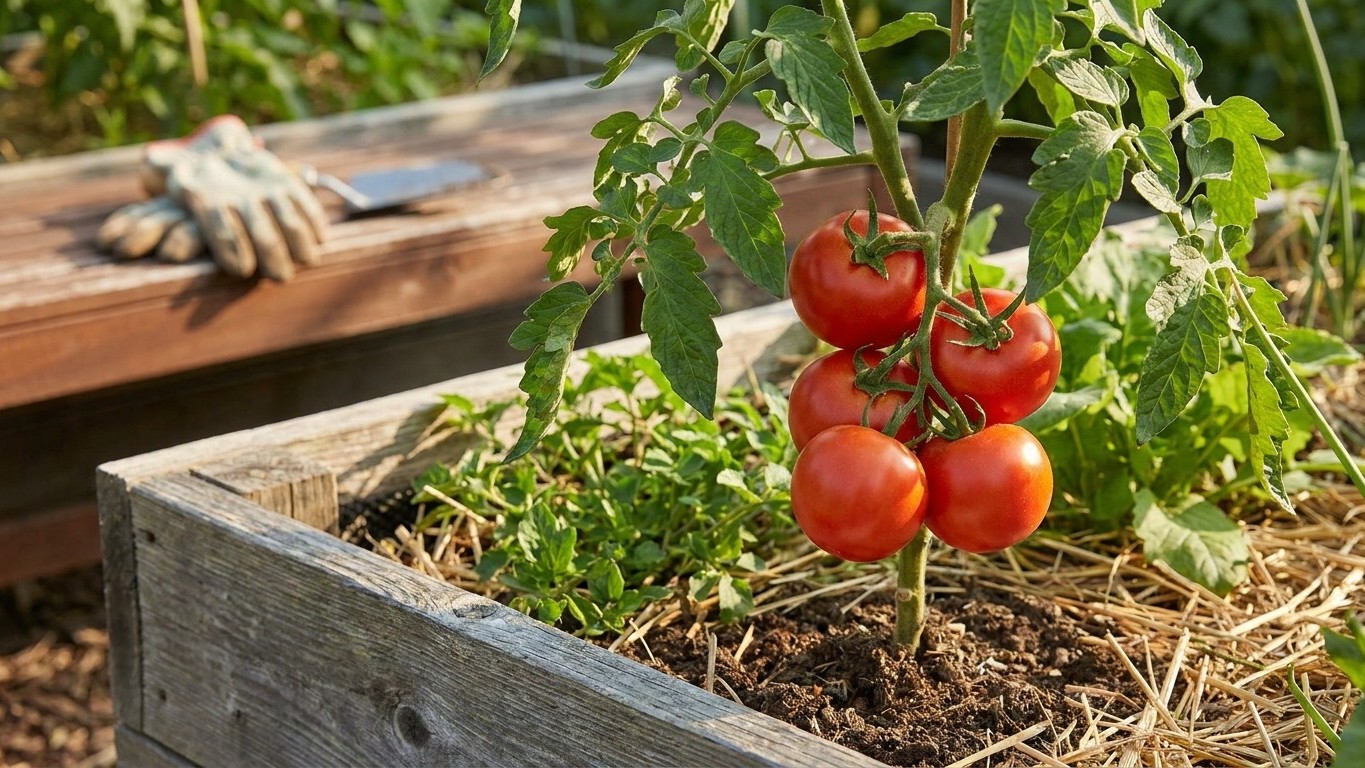

Legend’s whole reputation rests on that one word: determinate. Plant it like a regular slicer, on the usual “get tomatoes in when it’s warm enough” schedule, and you’ll get exactly what the name promises — a single heavy flush of fruit, all ready inside a week or two. But that flush lands on a clock that started ticking the day you transplanted, not the day the calendar said tomato season. Miss the window by two weeks either direction and the whole harvest shifts with it.
What Legend actually is

Legend is determinate, which means the plant grows to a set size, roughly three feet, and stops putting on new vegetative growth once it starts fruiting. Nearly the entire crop ripens in one concentrated flush instead of trickling in over the summer the way an indeterminate slicer does. That habit is exactly why the variety suits a short season: it puts its energy into fruit early rather than spending half the summer building more vine.
Fruit and habit
The fruit is large, round, and red at full ripeness, typically running 12 to 16 ounces on a well-fed plant, with meaty flesh and a low seed count that suits fresh slicing as well as canning. The 68-day figure is counted from the day you set out a started plant, not from the day you sow seed indoors, and catalog figures like this one commonly run a week or so longer in a cool, cloudy spring and a week or so shorter in a warm one. Because it’s determinate, it needs a cage or a sturdy stake to keep the heavy fruit off the ground, but it does not demand the season-long tying and pruning that an indeterminate variety like the ones covered in our guide to tomato varieties requires.
What Legend is good for
Legend is built for the cutting board rather than the jar, though it can do both. The flesh itself is meaty and low in water, with few seeds, so it holds its shape when you cut it, and a slice sits on a burger or sandwich instead of sliding off in a puddle of juice. A watery, seedy tomato collapses into liquid the moment a knife goes through it; this one doesn’t, which is the whole reason a slicing type is graded on texture rather than on how fast it breaks down in a pot.
That same density means it doesn’t need to be babied down into sauce with a long simmer to drive off water, but it also isn’t the dedicated paste tomato that a cook would reach for to build a thick sauce from scratch with minimal reduction. The 12-to-16-ounce size and low seed count make it workable for canning in halves or chunks, which is a middle ground: not a paste tomato’s job, but a reasonable one for a home canner who wants big, meaty slabs of fruit rather than tiny pastes.
The determinate habit adds a second, separate reason it suits canning and batch cooking: because nearly the whole crop ripens in one flush rather than trickling in weekly, a grower ends up with a large pile of ripe fruit all at once. That’s inconvenient for someone who wants a steady trickle of a few tomatoes a week for salads all summer, but it’s exactly the pattern a canning day wants — one harvest, one big batch, done.
Legend is described as sweet, with an acidity that matches rather than disappears, which is the balance that keeps a ripe tomato from tasting flat. What can be said is limited to what the fruit’s structure and the plant’s habit make it good at: firm slices for fresh eating, and a fruit that lends itself to a concentrated canning session rather than a slow dribble into the kitchen.
Where it ripens in time, and where it is a gamble
The math that decides whether Legend ripens at all is simple to write out and worth doing for your own address. Take your area’s frost-free window, subtract the two weeks or so that cool spring soil holds a transplant back before it really starts growing, then subtract the 68 days to first ripe fruit. What’s left is the margin you actually have to pick a crop before frost ends it. Under thirty days of margin means one flush, and a cool year takes it entirely.
The far ends of the range
At the tight end, the reference station at Whitehorse puts Yukon at negative one day of margin: growers setting out in mid June can expect first ripe fruit only in late August, by which point the average first frost has already come and gone. That’s not a target you’re likely to hit outdoors most years, greenhouse or high tunnel only. A little further along, the reference station at Rankin Inlet gives Nunavut four days of margin, set out in early July with first fruit expected early September. Four days is one flush at best, and a single cool week erases it.
At the other end of the twelve Territories in this comparison, the reference station at New Orleans puts Louisiana at 230 days of margin, with growers there setting out as early as early February and picking first fruit by early May. Nevada’s Las Vegas station shows a similarly wide 228-day margin with a set-out window running from late January into mid February. In both places the frost calendar is not the limiting factor at all, which is a different problem covered below.
In between sit the prairie provinces. The reference stations at Yellowknife, Calgary, Winnipeg, and Saskatoon all return greenhouse verdicts for Northwest Territories, Alberta, Manitoba, and Saskatchewan even though their frost-free margins, 34 to 41 days, look workable on paper. The reason isn’t frost timing. It’s covered in the next section.
| Territory (reference station) | Margin before frost | Set out window |
|---|---|---|
| Yukon (Whitehorse) | -1 days | mid June |
| Nunavut (Rankin Inlet) | 4 days | early July |
| Northwest Territories (Yellowknife) | 34 days | early June |
| Alberta (Calgary) | 36 days | early June |
| Manitoba (Winnipeg) | 40 days | early June |
| Saskatchewan (Saskatoon) | 41 days | early June |
| Washington (Seattle) | 158 days | mid March to early April |
| Louisiana (New Orleans) | 230 days | early February to late February |
The two ways a season goes wrong
A long frost-free window doesn’t guarantee a good tomato season, and Legend’s numbers show why in two different ways depending on where you garden.
Cold ceiling in the north
In the prairie provinces, the limiting factor isn’t days left before frost, it’s accumulated warmth over the whole season. The reference stations show why the greenhouse verdict holds even with 34 to 41 days of margin: Yellowknife totals roughly 905 growing degree-days across the year, Calgary about 1,171, Saskatoon about 1,549, and Winnipeg about 1,832. Those last two are described as borderline rather than clearly sufficient, and an early, cool-tolerant variety with plastic mulch to warm the root zone is exactly the kind of adjustment that can tip a marginal year into a ripe one. This is where Legend’s breeding actually pays off, since it was selected specifically to set fruit at temperatures that stall most other full-size slicers.
Heat ceiling in the south
Further south the problem flips. Tomato pollen goes largely sterile above roughly 86°F, and in South Carolina, Florida, Texas, and Nevada, that threshold is crossed for most or all of the summer months. Flowers open and drop without setting fruit, which is why growers in those states plant a spring crop and a separate autumn crop rather than trying to run one long season through July and August. Legend’s cool-weather trait does nothing for this problem, since heat sterility is a ceiling, not a floor. For this variety, the accumulated-warmth limit in the north is the one where its breeding genuinely changes the outcome. The heat ceiling in the south catches every tomato variety equally, Legend included.
What it resists, and what it does not
Legend’s standout trait is tolerance to late blight (Phytophthora infestans), the disease that famously wiped out entire tomato and potato crops in wet, cool years. Catalog descriptions credit it with this tolerance specifically because it was bred and selected for it, which is unusual in a full-size, open-pollinated slicer. Tolerance is not immunity: the plant slows the disease and often keeps producing where an unprotected variety would collapse, but it can still show symptoms in a bad blight year, especially with poor airflow or overhead watering.
Outside of late blight, Legend does not carry the resistance package that many modern hybrids do. Treat it as susceptible to the usual list unless you know your soil’s history:
- Fusarium wilt: no listed resistance
- Verticillium wilt: no listed resistance
- Early blight (Alternaria): no listed resistance
- Root-knot nematodes: no listed resistance
That gap matters most if you’ve grown tomatoes in the same bed for several years running. Rotate Legend away from ground that grew tomatoes, potatoes, peppers, or eggplant the previous two seasons, and mulch to keep soil-borne spores from splashing onto the lower leaves during rain or overhead watering.
Growing it without the usual mistakes
Because Legend is determinate, the growing plan is different from a season-long indeterminate slicer like the one described in our guide to Mortgage Lifter, which keeps setting new fruit until frost. Legend puts on most of its growth early, sets its flowers over a shorter window, and then ripens nearly everything at once. Feeding it like a June-to-October indeterminate is the most common mistake: heavy nitrogen late in the season pushes leaf growth the plant no longer needs and can delay the very ripening you’re counting on.
Spacing, support, and the glut problem
Space plants closer than you would a sprawling indeterminate, since the compact determinate habit doesn’t need the room a vine does. A cage sized for a heavy-fruited plant works better than a single stake, which can snap under the weight of a whole flush ripening together. Stop side-dressing with nitrogen once the first fruit sets and switch to a lower-nitrogen feed if you feed at all past that point.
The real planning problem with a variety like this is the glut. If you grow only one planting of Legend, you’ll get a week or two of more tomatoes than one household can use, followed by nothing. Staggering two sowings three to four weeks apart, or pairing Legend with an indeterminate that ripens over a longer stretch, spreads the harvest out instead of dumping it all at once. If you want a paste tomato that ripens in a similarly concentrated flush for canning day, our guide to the Kuzco variety covers a determinate that behaves the same way.
Common questions
Is Legend a hybrid?
No, Legend is open-pollinated, not a hybrid. You can save seed from a ripe fruit and expect it to grow true to type the following year, which isn’t the case with hybrid slicers.
Can I grow Legend in a container?
Yes, its determinate, compact habit suits a large container better than most indeterminate slicers do. Use the biggest pot you can manage, since fruit size and yield both drop in cramped roots, and keep watering consistent to avoid the cracking that comes with a dry spell followed by a heavy soak.
Why did all my tomatoes ripen at once and then the plant just sat there?
That’s the determinate habit working as designed, not a problem. The plant sets nearly all its fruit in one window and stops producing new flowers once that flush matures. If you want a longer harvest, stagger a second planting a few weeks behind the first rather than expecting one plant to keep going.
Does Legend need different spacing than other slicers?
Most catalog listings recommend spacing determinate varieties like this one somewhat closer than sprawling indeterminates, since the bush stays compact instead of running. Check the spacing printed on your specific seed packet, since it can vary slightly between seed companies, and confirm row spacing with your state extension service if you’re planting a large bed.