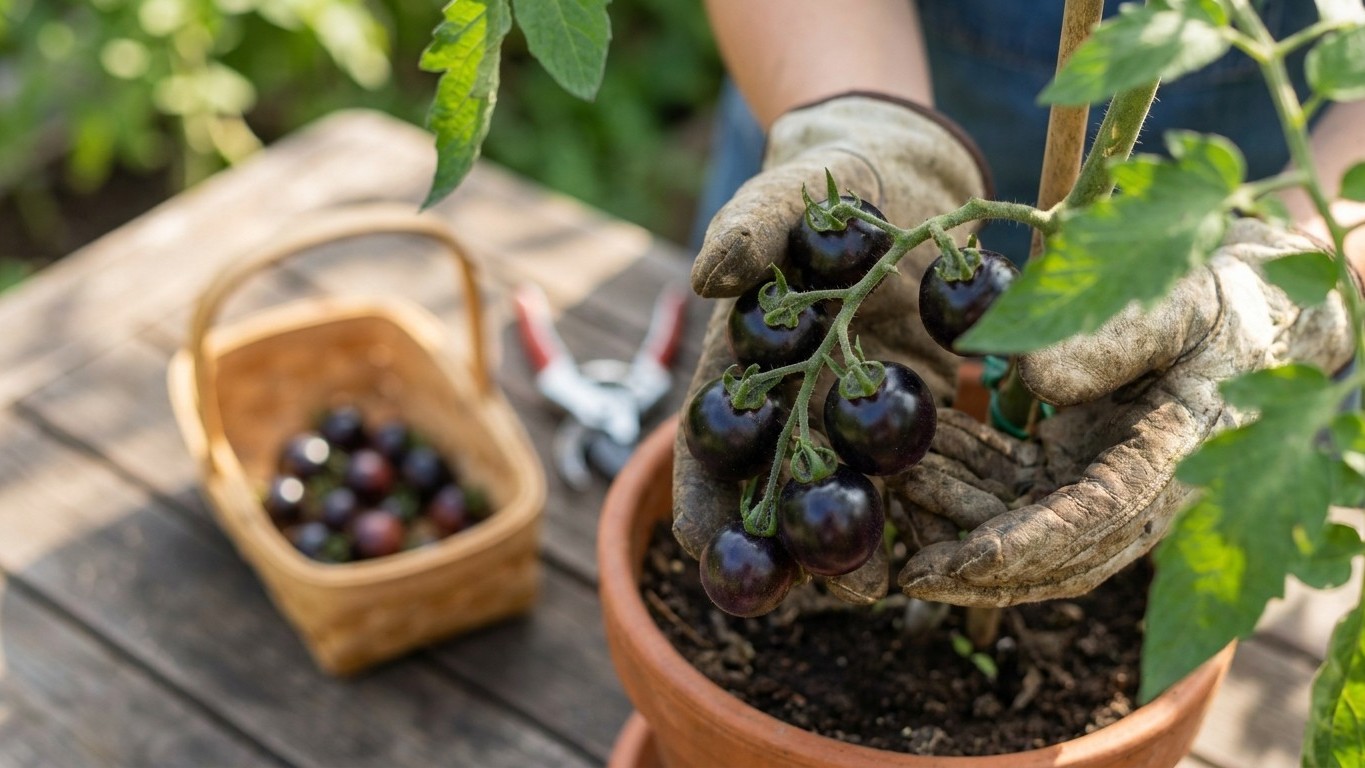

Black Cherry is an indeterminate heirloom-type cherry tomato that ripens in about 64 days from transplant, a figure carried on most seed catalog listings for the variety. That count starts the day a started plant goes into the ground, not the day you sow seed indoors, and it stretches by a week or two in a cool or cloudy season. Before you order seed, hold that 64-day mark up against your own area’s frost-free window, because in the far north the days left for actually picking fruit can run into single digits.
What Black Cherry actually is

Black Cherry belongs to the same crop family covered across our Tomato Varieties guide, but it sits at a specific point in that family: an indeterminate vine that keeps growing and setting new trusses until frost or disease stops it, rather than a determinate bush that fruits once and quits. That habit means a Black Cherry plant left unstaked will sprawl into a six-foot tangle by midsummer, so it needs a cage or stake tall enough to carry it the whole season, not the short hoop that works for a patio type.
The fruit is round, an inch or so across, and ripens to a dusky purplish-brown skin with reddish undertones rather than the plain red of a typical cherry tomato. The flesh is sweet with a faint smoky note that shows up in the skin color, which is why it gets used raw in salads and on snacking trays more than cooked down into sauce. The 64-day figure is a catalog number, not a promise: it assumes transplants set into warm soil with steady nights above the mid-50s, and any stretch of cool weather right after transplanting pushes first ripe fruit later than the packet suggests.
What Black Cherry is good for
A cherry tomato like this one is built for eating out of hand: at an inch across, each fruit is mostly skin and juice relative to its small core of flesh, leaving little solid matter to work with. Cooking a panful down into sauce means driving off water until what’s left concentrates into something thick, and a tray of cherry tomatoes gives you very little to concentrate. That’s why paste tomatoes exist as a separate category — their dense, low-water flesh reduces on its own heat without needing help from the stove, while a cherry tomato in the same pan just steams itself into a watery mess.
Slicing tomatoes solve a different problem: big, juicy discs meant to sit raw on a sandwich or burger, where that same high water content is the point rather than a liability. Black Cherry doesn’t fit either of those jobs. It’s built to be picked and eaten straight off the vine, which is a large part of why cherry tomatoes as a category rarely make it as far as the cutting board — a warm one splits open in the mouth before it occurs to anyone to cook it.
That leaves salads, snacking, skewers, and anything else that wants a whole, uncooked tomato with sweet, dynamic flavor rather than a cooked-down base. You can certainly roast or halve them into a quick pan sauce in a pinch, but doing that with a cherry tomato is working against its shape, not with it. Black Cherry’s flesh and juice are the only culinary traits actually documented for this variety — no data on skin thickness for drying, sugar content for preserving, or how it holds up canned, so treat those uses as untested rather than ruled out.
Where it ripens in time, and where it is a gamble
The question that actually decides whether Black Cherry belongs in a given garden is not the frost-free window by itself, but what is left of it after you subtract the time soil needs to warm and the 64 days the fruit needs to mature. Start with the frost-free window, take off roughly two weeks before you can set transplants out with any confidence, then subtract the 64 days to maturity. Whatever remains is the picking margin, the stretch during which fruit actually ripens before the first fall frost ends the season. Under thirty days of margin, one flush of fruit is all a grower gets, and a cool year can take even that.
The tightest margins in the country
At Whitehorse, the reference station for the Yukon, growers set transplants out around mid June and see first ripe fruit by late August, which checks out against the 64-day catalog figure. But that leaves only about 3 days of margin before the average first frost, which is why the verdict there is risky rather than workable outdoors: one bad week of cloud in August and the crop never ripens at all. Rankin Inlet, the station for Nunavut, is only slightly better with an 8-day margin after a transplant set out in early July and first ripe fruit in early September. In both places the deeper problem is not frost timing but accumulated warmth: Whitehorse totals around 600 growing degree-days across the year and Rankin Inlet around 159, and Black Cherry needs sustained heat to fill out that many trusses regardless of how long the frost-free stretch runs. A greenhouse or high tunnel does more for this variety in those Territories than any amount of careful date-picking.
The comfortable end
Contrast that with New Orleans, the reference station for Louisiana, where transplants go in early to late February and first ripe fruit shows up by late April, leaving roughly 234 days of margin before frost. Las Vegas, standing for Nevada, runs a similar 232-day margin with an even earlier transplant window in late January to mid February. Neither of those places is short on time. The limiting factor there is not frost at all, and the next section explains what takes its place.
| Territory | Reference station | Set out | First ripe | Margin before frost |
|---|---|---|---|---|
| Yukon | Whitehorse | mid June | late August | 3 days |
| Nunavut | Rankin Inlet | early July | early September | 8 days |
| Manitoba | Winnipeg | early June | early August | 44 days |
| Nevada | Las Vegas | late January to mid February | mid April | 232 days |
| Louisiana | New Orleans | early to late February | late April | 234 days |
The two ways a season goes wrong
A long frost-free window does not automatically mean an easy season, and a frost table on its own cannot show either of the two limits that actually stop fruit from setting. In the north, the problem is often accumulated warmth rather than time: a place can run months without frost and still fall short on growing degree-days, and Black Cherry’s flowers simply will not set fruit when night temperatures drop below roughly 50F, no matter how many frost-free days remain on the calendar. Manitoba and Saskatchewan, at 1832 and 1549 growing degree-days respectively by their reference stations at Winnipeg and Saskatoon, sit right at that margin, which is why an early variety and black plastic mulch to hold soil warmth change the outcome there more than an extra week of frost-free window would.
In the south, the limit runs the other way. Above roughly 86F, tomato pollen goes sterile and flowers drop without setting fruit, which is why growers around Houston, Jacksonville, Charleston and New Orleans run a spring crop and a separate autumn crop rather than one continuous season. The stretch from early summer through late summer is effectively a dead zone for fruit set in those places, whatever the thermometer says about frost. Given Black Cherry’s 64-day maturity, it fits neatly into either of those shorter windows, spring or fall, which makes it a better fit for a two-season plan than a longer-season beefsteak would be.
For this particular variety, the southern limit matters more in practice than the northern one, because 64 days is short enough to dodge the summer pollen crash entirely if it goes in early. The northern degree-day shortfall is the harder problem to work around, since no amount of rescheduling adds heat that the climate does not have.
What it resists, and what it does not
Black Cherry is sold and grown as an heirloom-type variety, and catalog listings for it carry no bred-in disease resistance codes, unlike many modern hybrids. That is a real difference worth naming plainly rather than glossing over: a hybrid beefsteak such as the Marnero Tomato ships with resistance ratings printed on the packet, and Black Cherry does not carry that kind of protection at all. It is not that Black Cherry is unusually fragile, it is that nothing in its breeding has been selected against the common tomato diseases, so it meets them on the same footing as any unimproved plant.
In practice that means the usual pressure points apply at full strength:
- Early blight shows up as dark rings on lower leaves in humid stretches and needs airflow and mulch, not a resistant gene, to slow it down.
- Fusarium and verticillium wilt can take a plant down mid-season in soil that has grown tomatoes repeatedly without rotation.
- Fruit cracking is common on this variety because the skin is thin, and irregular watering after a dry spell is usually the trigger rather than any pathogen.
None of this rules Black Cherry out. It just means the usual cultural work, crop rotation, mulch, and even watering, carries more of the load than it would with a resistant hybrid, because there is no genetic backstop behind it.
Growing it without the usual mistakes
Support and spacing
Because Black Cherry is indeterminate, it needs a stake or cage tall enough to carry a full season of growth, not the short hoop cage sized for a determinate bush. Space plants far enough apart that the mature vine gets airflow through the middle, since a crowded, shaded canopy is exactly where early blight and fruit splitting take hold. A single strong stake with the leader tied up every week or two works better here than a flimsy wire cage that the vine outgrows by midsummer.
Feeding and watering
Stop pushing nitrogen once the first trusses have set fruit. An indeterminate cherry tomato fed heavily all season will put its energy into more vine rather than more ripe fruit, and a rangy Black Cherry plant is already hard enough to manage without encouraging it further. Even, consistent watering matters more for this variety than for a thick-skinned beefsteak like the STM 2255 Tomato, because Black Cherry’s thin skin splits readily after a dry week followed by heavy rain or irrigation.
Harvest rhythm
The mistake its timing invites is under-harvesting. An indeterminate cherry variety sets fruit in clusters continuously once it gets going, and a plant left unpicked for a week can drop a dozen overripe fruit to the ground, which draws pests and encourages rot on the remaining cluster. Pick every two to three days once fruiting starts, and expect that rhythm to hold from first ripe fruit right up to frost, or, in the hot-summer regions running a spring and fall split, right up to the point where daytime heat shuts flowering down for the season.
Common questions
Is Black Cherry the same thing as Black Krim?
No. Black Krim is a large slicing tomato with a similar dark skin color, while Black Cherry is a small, round cherry-type fruit on an indeterminate vine. They share a color family and little else, including days to maturity and fruit size.
Why are my Black Cherry tomatoes splitting on the vine?
Splitting usually follows a dry stretch broken by a heavy watering or rainstorm, which swells the fruit faster than the thin skin can stretch. Keeping soil moisture even with mulch and a regular watering schedule reduces it, though some cracking is normal for this thin-skinned variety even with good care.
Can I save seed from Black Cherry tomatoes?
Yes, Black Cherry is open-pollinated, so seed saved from ripe fruit will grow true to type next season. Keep some distance from other tomato varieties flowering at the same time if you want to avoid occasional cross-pollination, and ferment the seed briefly to remove the gel coating before drying it.
How many tomatoes will one Black Cherry plant actually produce?
Catalog and grower reports describe it as a heavy producer over a full indeterminate season, with clusters setting continuously rather than one large flush. The real number in your garden depends heavily on how much of the frost-free season the plant gets to work with, which is exactly the margin calculation covered above for your own region.