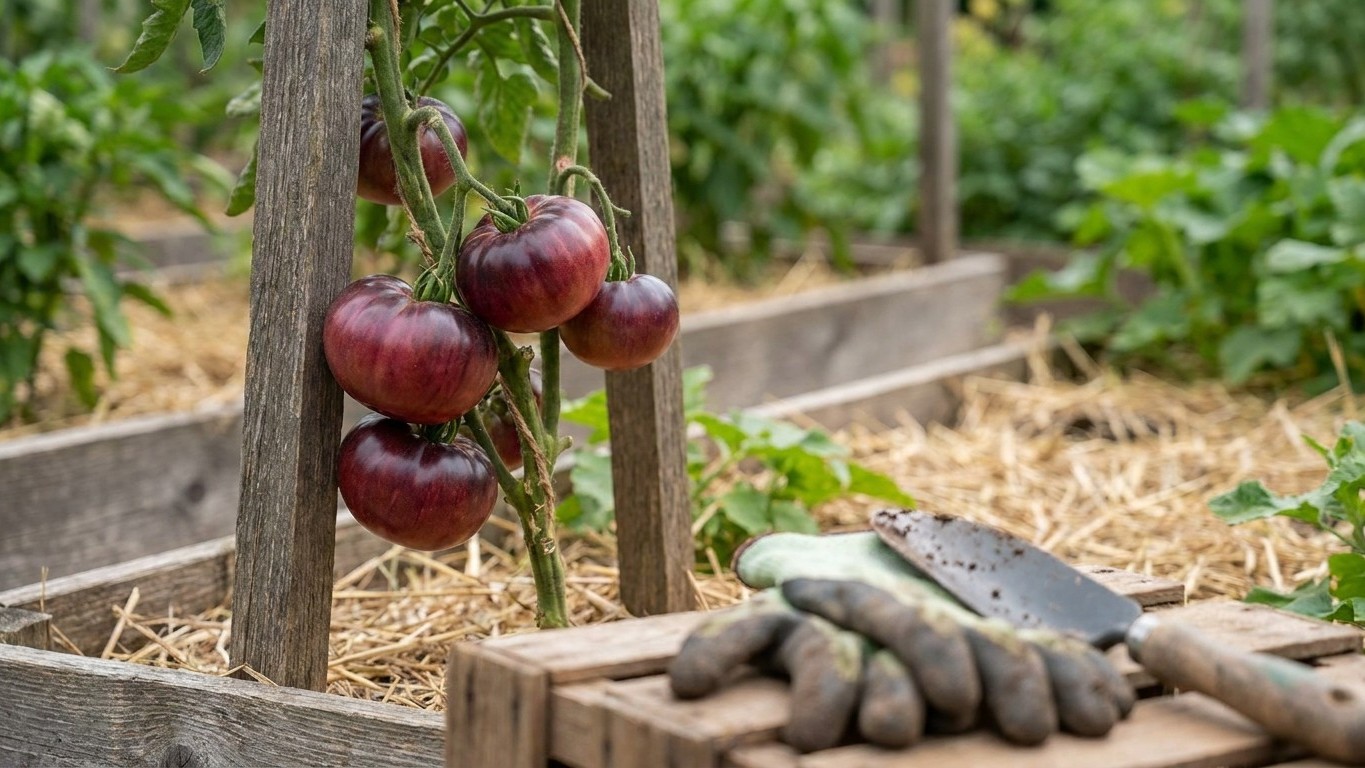

Marnero is an indeterminate purple beefsteak tomato bred for slicing, ripening in about 72 days from transplant per the seed packet. That maturity window fits comfortably inside the frost-free season across most of the continental United States, but it runs into real trouble in short-season Canadian territories where accumulated warmth, not frost timing, becomes the limiting factor. Check your local frost-free window against that 80-day figure before you set plants out, and if your season is short, plan on a greenhouse or high tunnel rather than open ground.
What Marnero actually is

Marnero is an indeterminate beefsteak tomato, bred for slicing rather than sauce, and it needs a sturdy stake or cage because the vine keeps growing and setting fruit until frost stops it. Marnero sits among the many purple and black tomato varieties bred primarily for slicing rather than canning. The fruit itself is the reason growers seek it out: a purple-to-mahogany beefsteak, flattened and ribbed at the shoulder like a classic slicer, with dense, meaty flesh and few seed cavities. It is a sandwich tomato, not a paste tomato.
The days-to-maturity figure printed on the seed packet is about 72 days from transplant, not from the day you sowed seed indoors. That distinction matters more with a variety this size: an 80-day beefsteak needs a full stretch of sustained warmth to size up and ripen, not just enough time to survive to the first frost. Catalog figures also shift by a week or so either side depending on the season, so treat 72 days as a planning number rather than a guarantee.
Because it is indeterminate, Marnero does not ripen in one flush the way a determinate variety does. It sets fruit in waves along the vine through the growing season, which suits a home gardener who wants a steady supply of slicers rather than a single canning-day harvest. It also means the plant is still carrying green fruit when the first frost is forecast in shorter-season gardens.
What Marnero is good for
A beefsteak carries most of its mass in flesh walls thick enough to slice into slabs that hold their shape, with just enough internal moisture to stay juicy rather than dry. That structure is what makes it a knife-and-bread tomato: cut a slice, lay it on a sandwich or a plate with salt and oil, and the flesh needs no further work. Put the same fruit in a pot and the opposite problem shows up — the water content that makes a slice juicy is exactly what keeps a sauce thin, so it takes far longer at the stove to reduce than a paste tomato with dense, dry flesh and small seed cavities would. Marnero’s few seed cavities help here too: less gel and liquid to drain away, more solid material per slice, which is why it holds together on a sandwich instead of sliding apart.
The purple-to-mahogany skin and flesh place Marnero among tomatoes generally described as having a deeper, less acidic-tasting profile than red slicers, but that is a category-level tendency, not a documented trait for this specific variety. Beyond “heirloom-quality flavor and look,” no specific taste notes — sweetness level, acidity, or balance — are published for Marnero, and none should be assumed just because of the color.
Because the plant is indeterminate, it won’t hand over a single large harvest for canning or batch sauce-making; fruit comes in a rolling supply through the season, which suits eating fresh as it ripens rather than processing in bulk. If the kitchen goal is fresh slicing tomatoes over a long stretch — sandwiches, salads, a platter with good oil — that is what this variety is built for. If the goal is a jar of sauce, this is not the plant to grow for it.
Where it ripens in time, and where it is a gamble
Start with the frost-free window at your own location, then work backward: subtract roughly two weeks for the soil to warm enough to set transplants out, then subtract the 72 days Marnero needs from transplant to first ripe fruit. What is left over is your margin, the number of days between the first ripe tomato and the first fall frost. A margin under thirty days means one good flush of fruit, and a cool year takes the rest.
Where the margin is razor thin
At the tight end, Yukon (station: Whitehorse) actually runs a negative margin of about five days: set plants out mid June, and the first ripe fruit would not arrive until after the average first frost in late August. Nunavut (station: Rankin Inlet) fares little better, at zero days of margin, with plants set out in early July and first fruit expected around mid September, the same week frost typically arrives. In both places the problem is not just frost timing. Whitehorse accumulates only about 600 growing-degree-days across the year and Rankin Inlet about 159, far short of what a beefsteak-class tomato needs regardless of how long the frost-free stretch runs. Open ground is not a realistic option in either location. A heated greenhouse or high tunnel is the only path to ripe fruit.
Where a greenhouse is the safer bet
Move into the prairie provinces and the picture improves but does not clear. Manitoba (station: Winnipeg) and Saskatchewan (station: Saskatoon) both post margins in the mid-thirties, enough for a real harvest if the season runs warm, but their growing-degree-day totals, roughly 1832 and 1549, sit right at the edge of what Marnero needs to fill out fruit of this size. A plastic mulch to warm the root zone and a head start under cover can tip a marginal year into a good one, but a greenhouse verdict is still the safer planning assumption. Gardeners in these short-season provinces who would rather skip the tunnel entirely might do better with a faster-finishing slicer like the Nova tomato, which needs far fewer accumulated warm days to ripen.
Where the margin is wide open
At the wide end, Louisiana (station: New Orleans) shows a margin of 226 days, with plants set out early to late February and first fruit by early May. Nevada (station: Las Vegas) and Texas (station: Houston) post similarly wide margins, all well past the 154-day margin logged at Washington (station: Seattle). None of these places will lose the crop to frost. Their limiting factor, covered next, is heat, not cold.
The full comparison, tightest margin to widest, looks like this:
| Territory | Reference station | Margin | Verdict |
|---|---|---|---|
| Yukon | Whitehorse | -5 days | Impossible in open ground |
| Nunavut | Rankin Inlet | 0 days | Risky, one flush only |
| Northwest Territories | Yellowknife | 30 days | Greenhouse recommended |
| Alberta | Calgary | 32 days | Greenhouse recommended |
| Manitoba | Winnipeg | 36 days | Greenhouse recommended |
| Saskatchewan | Saskatoon | 37 days | Greenhouse recommended |
| Washington | Seattle | 154 days | Comfortable |
| Texas | Houston | 189 days | Comfortable, split season |
| Nevada | Las Vegas | 224 days | Comfortable, split season |
| Louisiana | New Orleans | 226 days | Comfortable, split season |
The two ways a season goes wrong
A long frost-free window does not guarantee a good tomato season, and Marnero’s 80-day maturity makes both failure modes worth naming.
Too little accumulated warmth
In the short-season territories above, the frost-free window can be technically wide enough on paper while the total heat available across the season is not. Growing-degree-days measure that accumulated warmth, and figures like the 905 recorded at Yellowknife or the 1171 at Calgary fall well short of what an 80-day beefsteak needs to actually fill out fruit, independent of when the first and last frosts land. Nights that drop below 50F during flowering stop pollen from developing properly, so even a plant that survives the season can end up with far fewer fruit than a similar plant grown somewhere with warmer nights. This is the limit that matters most for Marnero specifically, because its fruit size and maturity length ask for a long stretch of consistently warm nights that short-season gardens simply do not have.
Too much heat in mid-summer
At the other end, once temperatures push above 86F, especially overnight, tomato pollen goes sterile and flowers drop without setting fruit. This is why the comfortable-margin states named above, South Carolina, Florida, Texas, Nevada and Louisiana among them, effectively run two tomato seasons rather than one long one: a spring crop that finishes before the hottest stretch and an autumn crop planted once temperatures ease. A 226-day margin like Louisiana’s is not 226 days of continuous fruit set. It is a spring window and a fall window with a dead stretch in between.
For a gardener weighing the two problems, the practical takeaway is this: in the north, protection, a greenhouse or tunnel, buys you the missing heat units. In the south, timing, a spring transplant date early enough to finish before the heat and a second planting for fall, does the job that season length alone cannot.
What it resists, and what it does not
Marnero carries high resistance to three soil-borne diseases, and the seed packet grading is worth taking at face value rather than rounding up. It resists Verticillium Wilt at a high level, along with Fusarium Wilt races 1 and Fusarium Crown and Root Rot, both also graded high. High resistance means a plant growing in infected soil is unlikely to show symptoms at all, which is a real advantage if you have grown tomatoes in the same bed for years and suspect a buildup of either pathogen. Growers who want a similar resistance profile in a paste-type fruit instead of a slicer might look at the Plum Regal tomato.
What the catalog does not list matters just as much. There is no resistance rating for late blight, early blight, Septoria leaf spot, root-knot nematodes or tomato spotted wilt virus, all common problems in home gardens regardless of region. Do not read the strong performance against wilts as protection against foliar disease. Scout for leaf spotting and blight the same way you would on a variety with no resistance at all. Crop rotation, drip irrigation instead of overhead watering, and mulching to keep soil from splashing onto lower leaves all still matter with this variety exactly as much as with any other beefsteak.
Growing it without the usual mistakes
Because Marnero is indeterminate, it needs a different plan from a determinate beefsteak that ripens its whole crop in a few weeks and then stops. Give it a stake or cage tall enough for a plant that keeps growing past head height by midsummer, at least five to six feet, and set plants far enough apart that you can walk around each one to prune and harvest through the season. Crowding an indeterminate variety this vigorous invites poor air circulation, exactly the condition foliar diseases like blight need, and this variety carries no resistance to those.
Feeding and support
Prune to two or three main leaders rather than letting every sucker grow, both to control the size of the plant and to keep fruit off the ground where slugs and rot get to it first. Stop nitrogen feeding once fruit set begins in earnest; a plant pushed hard on nitrogen through midsummer puts on leaf growth at the expense of the fruit you are waiting on, and with an 80-day variety there is no season to spare on a leafy detour. Switch to a potassium-leaning feed once the first trusses start sizing up.
The mistake its timing invites
The most common error with a variety in Marnero’s maturity range is planting it too late in a marginal-season garden and hoping the long indeterminate habit will make up the difference. It will not. An indeterminate vine set out three weeks late is still carrying green fruit three weeks later than a vine set out on time, and frost does not wait for it to catch up. If your local frost-free window and this variety’s 80-day maturity leave you a tight margin, start the earliest of your transplants under cover and get them into the ground as soon as your local extension service’s soil temperature guidance says the bed is ready, rather than gambling on the calendar date alone.
Common questions
How do I find my exact frost dates to run this calculation myself?
Check NOAA’s climate normals or your state’s cooperative extension service, both of which publish average first and last frost dates for weather stations near you. The territories and figures in this article are examples from named reference stations, not a substitute for the numbers specific to your own county, which can run a week or more earlier or later even a short drive away.
Can I grow Marnero in a container?
Yes, but budget for a large one. This is a vigorous indeterminate plant that will outgrow anything under about fifteen to twenty gallons by midsummer, and it still needs the same stake or cage height as a plant grown in the ground. A smaller pot works against you twice, by limiting root growth and by drying out fast enough to worsen the fruit cracking this variety is already prone to.
Is Marnero resistant to blossom end rot?
No, and it was never bred to be. Blossom end rot comes from uneven calcium delivery and inconsistent watering, not a disease the catalog resistance ratings cover, and a large beefsteak like Marnero is more prone to it than a smaller-fruited variety simply because it takes longer for calcium to reach the far side of a big fruit. Even, consistent watering through fruit fill matters more here than on a cherry or plum type.
Do I need more than one Marnero plant?
For fresh eating, one or two plants usually keep a household in slicing tomatoes for most of the season, because the indeterminate habit spreads the harvest out rather than dumping it all at once. If you are canning or giving fruit away, plan on more, and remember that each additional plant needs the same five to six feet of stake height and the same spacing to avoid the crowding that invites foliar disease.