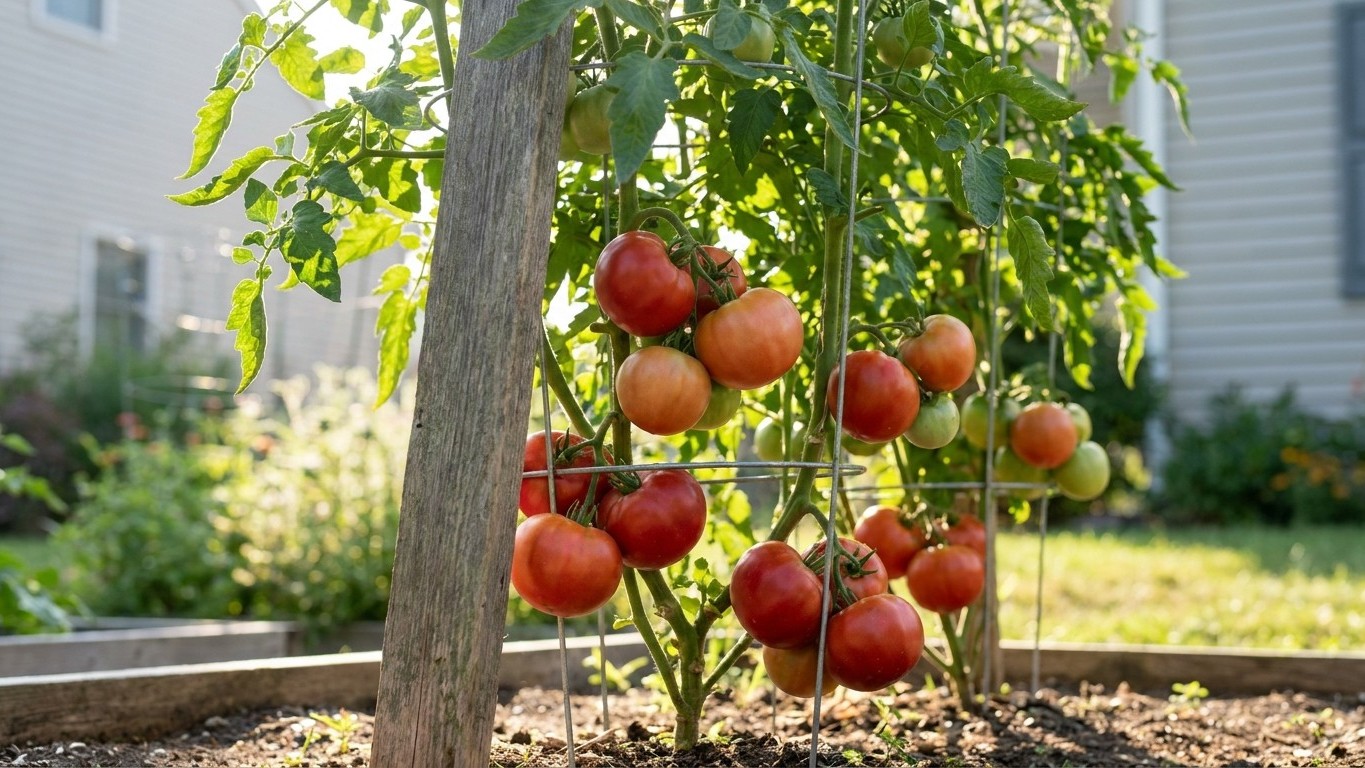

Bush Goliath ripens its first fruit about 85 days after you set transplants in the ground, but because it keeps growing and setting new fruit until frost, that 85-day mark is a starting line, not a finish. The real planting question is simpler than it sounds: does your area give this vine enough warm weeks after that first harvest to make the ongoing crop worth the stake and cage it demands?
What Bush Goliath actually is
Despite the name, Bush Goliath is not a compact, self-topping plant. Published catalogue data lists its habit as indeterminate, meaning the vine keeps extending and flowering right up until a hard frost stops it. That single fact changes everything about how you support and plant it: this is not a tomato you can let sprawl in a small cage meant for a determinate bush type. It needs a tall stake or a heavy-duty cage built for a vine that may still be adding fruit clusters in September.
Days to maturity is listed at 85 days, counted from transplant, not from the day you sowed seed indoors. That distinction matters because seed-starting adds several weeks before a plant is ever ready to go outside, and confusing the two figures is the most common way gardeners misjudge their harvest date.
The fruit itself is described as firm, with few seeds, a texture better suited to slicing and canning than to the soft, juicy interior some heirloom types are known for. That firmness also tends to hold up longer on the counter and travel better from garden to kitchen, which is worth knowing if you’re planning to preserve a chunk of the harvest rather than eat everything fresh within a day or two of picking.
Where it ripens in time, and where it is a gamble
No station-by-station frost dataset accompanies this page, so what follows is the arithmetic rather than a table of exact local dates. Pull your own frost-free window from a local extension office or from NOAA’s climate records for the nearest station, then run this same subtraction for your yard.
Start with your area’s frost-free window, the stretch between the average last spring frost and the average first fall frost. Subtract roughly two weeks from the front end, because tomato roots stall in cold soil and most gardeners wait until the ground has warmed before transplanting, even if the air is technically frost-free. Then subtract the 85 days to first ripe fruit. Whatever is left is your margin for an ongoing indeterminate harvest, not just one picking.
In broad terms, regions with long, hot growing seasons, the Gulf Coast, peninsular Florida, and much of the Deep South, commonly see frost-free stretches well past 220 days. Run the math there and Bush Goliath has months of margin after that first fruit sets, plenty of room for the vine to keep producing.
The Mid-Atlantic and much of the Mid-South typically fall in a more moderate range, often somewhere between 180 and 220 frost-free days depending on elevation and distance from the coast. Subtract the two-week soil-warming buffer and the 85 days, and there’s usually still a solid stretch of continued cropping left, though a late, cool spring can eat into that margin fast.
The tightest math shows up in the Upper Midwest, the northern Great Plains, and high-elevation mountain valleys, where frost-free windows often run closer to 100 to 130 days. Subtract two weeks for soil warming and 85 days for first fruit, and a grower there may be left with only a few weeks of ongoing harvest before frost ends the season, assuming nothing goes wrong along the way. That’s not impossible, but it leaves almost no cushion for a cold snap, a late transplant, or a slow start.
Coastal Pacific Northwest gardens sit in between: frost-free windows often run 180 to 200 days, generous on paper, but summer nights there frequently stay cooler than the interior valleys and plains, which brings us to the limit a frost table alone can’t show.
The two ways a season goes wrong
A long frost-free window on paper doesn’t guarantee a good tomato season, because two separate thresholds sit inside that window and neither shows up on a frost calendar.
In cooler and northern regions, the limiting factor is often accumulated warmth, not the calendar date of the first frost. Tomato flowers won’t set fruit reliably when nighttime temperatures drop below 50°F, and in short, cool-summer regions those chilly nights can arrive weeks before the official frost date, closing the fruit-setting window early even though the plant itself survives longer.
In hot southern regions, the opposite problem shows up in the middle of summer rather than at the edges. Once daytime temperatures climb above roughly 86°F for stretches at a time, tomato pollen becomes sterile and blossoms drop without setting fruit. That’s why many southern growers split their season into a spring crop and a separate fall crop rather than expecting one unbroken harvest, because the plant effectively goes idle through the hottest weeks.
For an 85-day indeterminate like Bush Goliath, the southern heat threshold is the more relevant risk. Because the plant is built to keep flowering and fruiting continuously rather than ripening in one flush, it needs a long stretch of tolerable nighttime and daytime temperatures to keep setting new fruit after that first 85-day harvest. A spring-planted vine in a hot climate can hit the mid-80s heat wall right as it’s hitting its stride, leaving a real gap in production until temperatures ease in early fall. Northern growers face the cooler-night problem mainly at the season’s tail end, which trims the ongoing harvest rather than blocking it outright.
What it resists, and what it does not
Published catalogue data credits Bush Goliath with resistance to three specific pressures: nematodes, Verticillium wilt, and Tobacco Mosaic Virus. Those are the only resistances listed, and the level of resistance for each is not specified in the catalogue entry, meaning it isn’t graded as either “high” or “intermediate” the way some other resistance traits are on other varieties. An unspecified rating should be read as some documented protection, not as a guarantee the plant will sail through an infestation untouched.
That distinction matters in practice. “Intermediate” resistance on any tomato, when a catalogue does spell it out, generally means the plant slows disease progress rather than avoiding infection altogether. Treating any resistance rating as full immunity is how gardeners get caught off guard by a wilt or virus they assumed the plant would simply shrug off.
Just as important is what isn’t on the list. There’s no published resistance here for Fusarium wilt, no listed resistance for early blight, late blight, or Septoria leaf spot, three of the most common foliar and soil-borne problems tomato growers run into during a humid summer. If those diseases are active in your area or have shown up in your soil before, Bush Goliath’s nematode, Verticillium, and TMV resistance won’t help. Crop rotation, air circulation around the vine, and watching for early leaf spotting remain the grower’s job here, not the plant’s built-in defense.
Growing it without the usual mistakes
Because Bush Goliath is indeterminate despite its name, the single biggest planning mistake is treating it like a determinate bush that finishes in one flush. It doesn’t. The vine keeps extending, flowering, and setting fruit until frost cuts it down, so the support structure needs to be sized for a full season of growth, not for a compact plant that tops out early. A tall stake driven deep, or a heavy cage built for an indeterminate vine, set up at transplant time rather than added later, saves a lot of frustration once the plant is six feet tall and loaded with fruit.
Feeding follows the same logic. A determinate variety can often be fed heavily early and then largely left alone once fruit sets, because the harvest arrives in a short window. An indeterminate plant like this one needs steady nutrition through the whole season, tapering nitrogen once fruiting is well underway so the plant doesn’t put all its energy into leafy growth at the expense of new fruit clusters, but continuing potassium and phosphorus support to keep new blossoms coming.
The timing mistake specific to this variety is assuming the 85-day mark means the season is over. It doesn’t. That date is the first ripe tomato, not the last. Gardeners who stop watering consistently or ease off on support maintenance once they’ve picked the first fruit often shortchange themselves on everything the vine would have produced through late summer and into fall, right up until the weather actually stops it.
Common questions
Is Bush Goliath actually a bush-type tomato?
No. Despite the name, published habit data lists it as indeterminate, meaning it keeps growing and fruiting like a vining tomato rather than stopping at a compact size. Plan for a tall cage or stake, not a small bush cage.
How many days until Bush Goliath is ready to harvest?
Catalogue data lists 85 days to maturity, counted from the day you transplant seedlings into the garden, not from the day you sow seed. Because it’s indeterminate, that date marks the first ripe fruit, not the end of the harvest.
Does Bush Goliath resist tomato diseases?
It carries published resistance to nematodes, Verticillium wilt, and Tobacco Mosaic Virus, with no resistance level specified for any of the three. It has no listed resistance to Fusarium wilt, early blight, late blight, or Septoria leaf spot, so those risks still need to be managed through rotation and garden hygiene.
Can I grow Bush Goliath in a short-season climate?
It depends on the math for your specific location. Take your area’s frost-free window, subtract about two weeks for soil warming before transplant, then subtract the 85 days to maturity. What remains is your margin for ongoing harvest before frost, and in areas with frost-free windows under about 130 days, that margin can be thin.