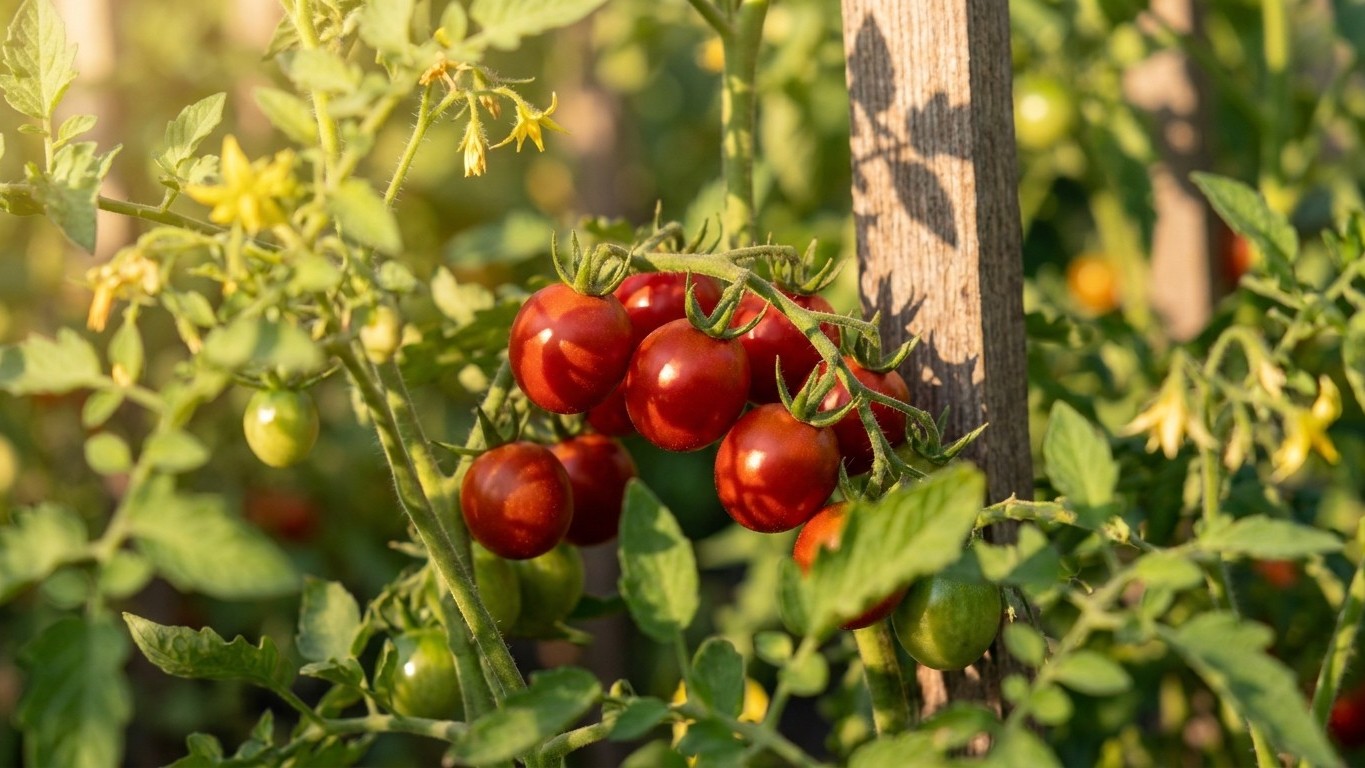

Husky Red Cherry Tomato is a snacking-type cherry tomato built to keep bearing fruit from midsummer straight through to the first hard frost, ripening its first fruit in about 65 days from transplant. Whether that promise holds up depends less on the plant and more on where it’s planted, how the local frost dates line up with that 65-day clock, and whether the grower treats an indeterminate vine like the sprawling, season-long plant it actually is.
What Brandywine actually is
Husky Red Cherry Tomato is an indeterminate variety, meaning the vine doesn’t stop growing or setting fruit once it reaches a certain height the way a determinate bush does. It keeps climbing, branching, and flowering until frost finally shuts it down, which is exactly why it needs a tall cage or a sturdy stake rather than the low wire ring that works for a compact patio type. Left unsupported, the vine will sprawl across a bed and the fruit will rot on damp soil.
The catalog figure for days to maturity is 65, and that count starts from transplant into the garden, not from the day the seed goes into a tray indoors. That distinction matters for planning: a grower who starts seed 6 weeks before the last frost and then transplants after the soil has warmed is really looking at 65 more days on top of that indoor head start, not 65 days total from sowing.
The fruit itself is small, round, and described as very sweet and juicy, which is why its listed use is snacking rather than sauce or canning. That’s a fair distinction to keep in mind before choosing a planting plan built around preserving a big harvest all at once, since this variety is meant to be picked and eaten steadily over a long window rather than gathered in one bulk crop.
Where it ripens in time, and where it is a gamble
The 65-day maturity figure only tells half the story. What actually determines whether Husky Red Cherry Tomato has time to produce is the length of the local frost-free growing season, minus the two or three weeks the soil typically needs after the last frost date before it’s warm enough to safely set out tomato transplants without stalling the plant, minus the 65 days themselves. Whatever is left over is the picking window, the stretch of weeks during which the plant can keep flowering and ripening fruit before the first fall frost cuts it off.
In a region with a frost-free window in the neighborhood of 180 to 200 days, the arithmetic is comfortable. Subtract two weeks for soil warm-up, subtract 65 days for the plant to reach first ripe fruit, and there are still roughly three months left for the vine to keep producing before frost returns. That’s a wide enough margin that a grower can transplant a bit later than ideal, or lose a week to a cool, wet spring, and still harvest cherry tomatoes well into fall.
In a region where the frost-free window runs closer to 100 to 110 days, the same math leaves far less room. Two weeks for soil warming and 65 days to first fruit already consume most of that window, which means the plant may only get a few weeks of actual harvest before frost arrives, rather than the extended, keep-coming-until-frost performance the variety is known for elsewhere. This isn’t a claim that Husky Red Cherry Tomato can’t be grown in a short-season climate; a 65-day tomato is on the faster end and will outrun many longer-season varieties in that same garden. But the payoff looks more like a modest few weeks of fruit than a long summer-into-fall harvest.
No specific frost-date station figures are published on this page, so the useful exercise for any reader is to pull their own local average last-spring-frost and first-fall-frost dates and run this same subtraction. The shape of the answer doesn’t change: shorter frost-free windows compress the harvest, longer ones stretch it, and the 65-day maturity mark is the fixed number in that equation.
The two ways a season goes wrong
A long frost-free window on paper doesn’t guarantee a long harvest in practice, because two separate limits sit outside what any frost table can show.
In cooler northern gardens, the frost-free count can look generous while the accumulated warmth through the season stays thin. Tomatoes don’t just need the absence of frost, they need consistently warm nights to set fruit at all, and when nighttime temperatures drop below 50°F, pollen doesn’t function properly and flowers simply fail to set. A garden can have 150 frost-free days on the calendar and still lose several weeks of productive fruiting to a run of cool nights in early June or again in September.
In hot southern and Gulf-region gardens, the opposite failure shows up in the middle of summer rather than at the edges of the season. Once daytime highs push consistently above roughly 86°F, tomato pollen goes sterile and flowers drop without setting fruit, effectively pausing production during the hottest weeks of July and August. That’s exactly why experienced growers in those regions plant a spring crop and a separate fall crop rather than counting on one uninterrupted harvest.
For a fast, 65-day, continuously bearing indeterminate like this one, the summer heat gap matters more than the cold-edge risk. Its whole appeal is that it keeps producing until frost, and a midsummer sterility pause is what most directly undercuts that promise, cutting the season into two shorter bursts rather than one long stretch. Northern cold mainly delays or shortens the season at the start and end; southern heat interrupts it right in the middle, where the plant would otherwise be at peak production.
What it resists, and what it does not
Husky Red Cherry Tomato is listed with resistance to two soil-borne diseases: Fusarium Wilt and Verticillium Wilt. The published rating for both doesn’t specify a level, meaning the catalog data doesn’t distinguish between high resistance and intermediate resistance the way some other varieties’ listings do. Without that distinction spelled out, it’s worth treating the protection as a baseline rather than a guarantee. Resistance, even at a high grade, reduces how severely a disease develops in the plant; it doesn’t make the plant immune, and an intermediate rating in particular means symptoms can still appear under heavy disease pressure, just more slowly and less severely than in an unprotected variety.
Just as important is what isn’t on that list. No resistance is published for early blight, late blight, Septoria leaf spot, or root-knot nematodes, all common problems in home vegetable gardens. That means the usual precautions still apply in full: rotate tomatoes away from last year’s tomato or pepper bed, avoid overhead watering that splashes soil onto lower leaves, and keep an eye out for the dark leaf spotting that signals early blight moving up the plant. A grower who assumes the Fusarium and Verticillium listing covers the plant generally is exposed to exactly the diseases the catalog doesn’t mention.
Growing it without the usual mistakes
Because Husky Red Cherry Tomato is indeterminate, it needs a different support plan than a compact determinate that ripens in one flush and finishes. A tall cage, at least 5 to 6 feet, or a single stake with regular tying, gives the vine somewhere to go as it keeps extending new growth all season. The most common mistake with cherry tomatoes specifically is undersizing the support, on the assumption that small fruit means a small plant. An indeterminate cherry vine can easily outgrow a standard tomato cage by midsummer and topple under its own weight once loaded with fruit clusters.
Because the plant is built to keep fruiting until frost rather than finish in one wave, feeding should continue through the season rather than tapering off early the way it might for a determinate variety that’s done its main job by late summer. A light, steady feeding schedule through the growing season supports the ongoing flush of new flowers the plant keeps producing.
Consistent watering matters more than usual here too, since the fruit is described as very sweet and juicy, and juicy cherry tomatoes are the ones most prone to splitting when a dry stretch is suddenly followed by heavy watering or rain. Even soil moisture, rather than a feast-or-famine cycle, keeps that cracking in check.
Finally, the fast 65-day maturity tempts gardeners to transplant early to get a jump on the season. Setting plants out into soil that hasn’t warmed enough stalls growth and can erase the speed advantage entirely, so it’s worth waiting for genuinely warm soil rather than racing the calendar.
Common questions
Is Husky Red Cherry Tomato a good choice for a short-season climate?
Its 65-day maturity is faster than many varieties, which helps in a short-season garden, but a very narrow frost-free window still limits how long the harvest can run once the plant starts producing.
Does it need a cage or can it be left to sprawl?
It needs support. As an indeterminate variety, it keeps growing and fruiting all season, and without a tall cage or stake the vine will sprawl and the fruit will sit on wet soil.
Are the Fusarium and Verticillium resistances enough to skip crop rotation?
No. Those resistances address two specific diseases at an unspecified level, not immunity, and they don’t cover common problems like early blight or root-knot nematodes, so rotation and normal disease precautions still matter.
Why does the harvest slow down in the middle of summer in hot climates?
Once daytime temperatures push consistently above roughly 86°F, tomato pollen becomes sterile and fruit set drops off, pausing production during the hottest weeks even though the plant keeps growing.