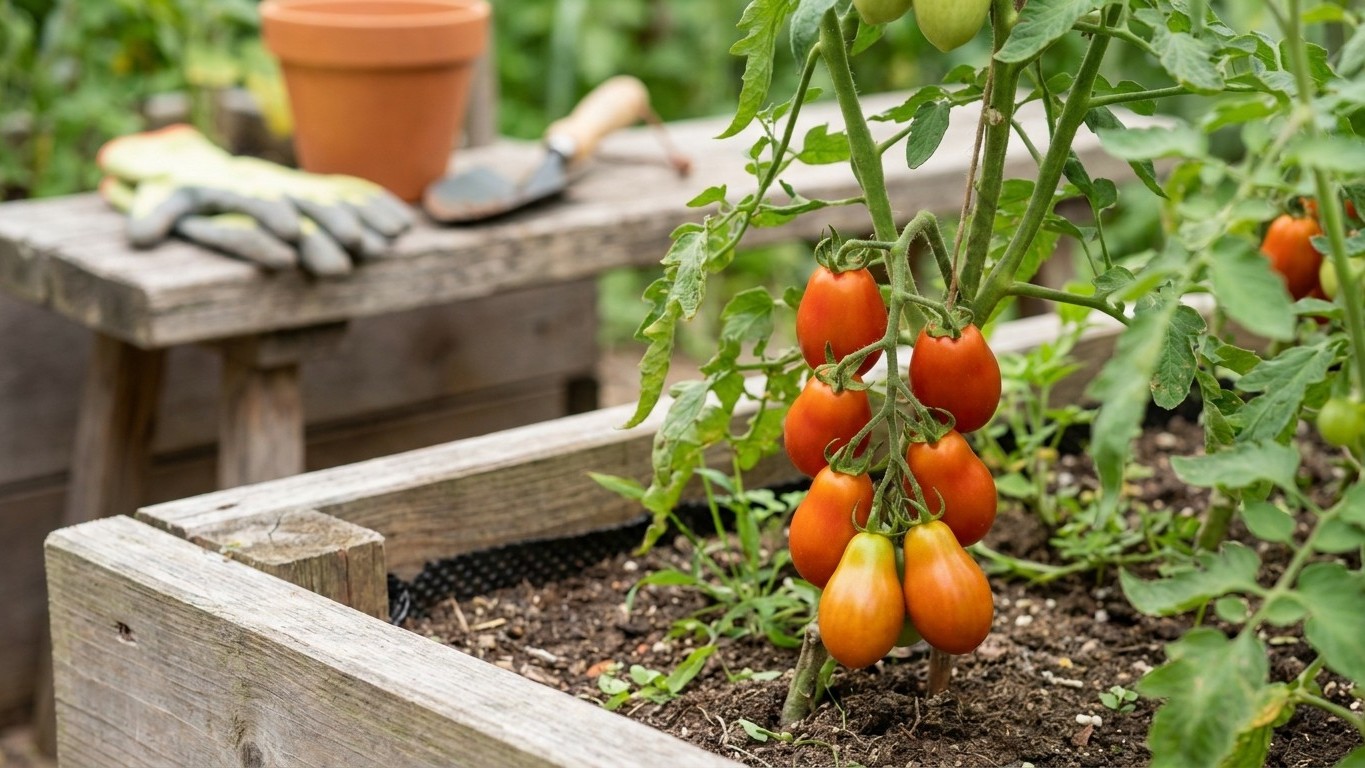

Kuzco is a determinate paste tomato bred to set its fruit in one concentrated flush rather than trickle out a few tomatoes a week, which makes it a canning and sauce variety first and a slicer a distant second. Seed catalogs list it at about 66 days from transplant, not from the day you sow the seed indoors. Before you commit a bed to it, check your local frost-free window against that 75 to 66 day span plus the two weeks the soil needs to warm before you can set plants out at all.
What Kuzco actually is

Kuzco belongs to the same family of business as other tomato varieties grown specifically for preserving: a determinate habit, a blocky plum-shaped fruit with thick meaty walls and few seeds, and a harvest that arrives in a compressed window instead of stretching across the summer. That determinate habit is the whole point of choosing it. A determinate plant sets a fixed number of flower clusters, stops growing taller once it has done so, and then ripens most of its fruit within a couple of weeks of each other. That is exactly what you want if your plan is one big canning day rather than a colander of tomatoes every evening.
The catalog figure of 66 days from transplant is the number that matters for planning, and it moves by a week or so depending on how warm the season runs and how much stress the transplants took on the way to the garden. Counting from seed instead of from transplant will throw your dates off by four to six weeks, which is long enough to miss a short growing season entirely. The fruit itself runs to the size of a large plum, dense and low in juice, which is why it holds up in a sauce pot and does not turn to soup when jarred.
What Kuzco is good for
Kuzco’s low water content and dense flesh mean the fruit needs little to no reduction time in the pot. A slicing tomato is mostly water suspended in a thin skin, so a sauce made from it has to simmer for an hour or more just to cook off the liquid before it starts to taste like anything. Kuzco’s walls are thick and the seed cavities small, so there’s less water to begin with. Chopped and put over heat, it breaks down into something that already resembles sauce rather than soup, and it gets there faster.
That same density is a liability raw. Cut a Kuzco open for a sandwich or a salad and the texture is closer to meat than to a juicy slicing tomato — firm, a little dry, and not built to be eaten in a wedge. Nothing here says it tastes bad raw; nothing says it tastes good either, because flavor for this variety isn’t documented beyond what the paste category implies. What the category does tell you is the job it’s suited for: canning, sauce, paste, and anywhere else you want tomato flavor concentrated rather than diluted by juice.
The determinate habit reinforces the same use case rather than adding a new one. Because the crop ripens in a short window instead of trickling in all season, it produces exactly the kind of bulk delivery a canning day requires — a counter full of tomatoes at once, not two or three a week for months. If your kitchen plans center on jars, ketchup, or a freezer of sauce, that concentrated harvest is a feature, not an inconvenience.
What this variety is not suited for is a garden where the goal is fresh eating spread across the summer — a slicer or a cherry tomato does that job on the vine; Kuzco does its job on the stove.
Where it ripens in time, and where it is a gamble
The arithmetic that decides whether Kuzco fits your garden is simple: take the frost-free window, subtract the two weeks the soil needs to warm before transplanting, and subtract the 66 days to maturity. What is left is your margin, the number of days between the first ripe fruit and the first fall frost. Anything under thirty days means you are betting on a warm year, because a single cool stretch can push ripening past the point where frost takes the crop.
Where the margin is thin
At the tight end, growers near Yukon, measured at the Whitehorse station, set transplants out in mid June and see first ripe fruit in late August, which leaves a margin of just one day before frost typically arrives. That is not a planting window, that is a coin flip, and it is made worse by the fact that Whitehorse accumulates only around 600 growing degree-days in a year. Kuzco needs sustained warmth to fill out its fruit, not just a frost-free stretch, so even a season technically long enough to avoid frost can still leave green tomatoes on the vine. Growers near Nunavut, at the Rankin Inlet station, face the same problem with a six-day margin and only about 159 accumulated degree-days, numbers that point toward a greenhouse or high tunnel rather than an open bed.
Where it is workable with help
A middle group gets Kuzco across the line but only with season-extending tricks. Growers near Manitoba, measured at Winnipeg, see a 42-day margin with about 1,832 degree-days, and growers near Saskatchewan, measured at Saskatoon, see 43 days with roughly 1,549 degree-days. Both extension notes flag the accumulated heat as marginal, meaning an early-maturing tomato and black plastic mulch to warm the root zone make a real difference to whether fruit finishes on time.
Where margin stops being the limit
At the wide end, margin practically disappears as a concern. Growers near Nevada, measured at Las Vegas, see a 230-day margin, and growers near Louisiana, measured at New Orleans, see 232 days. In both places the constraint shifts from frost entirely to something the frost table never shows, which is what the next section covers.
| Territory | Reference station | Margin | Verdict |
|---|---|---|---|
| Yukon | Whitehorse | 1 day | Risky, open ground |
| Nunavut | Rankin Inlet | 6 days | Risky, needs cover |
| Manitoba | Winnipeg | 42 days | Workable with mulch |
| Saskatchewan | Saskatoon | 43 days | Workable with mulch |
| Nevada | Las Vegas | 230 days | Comfortable |
| Louisiana | New Orleans | 232 days | Comfortable |
The two ways a season goes wrong
A long frost-free window does not guarantee a good crop, and two limits explain why. In the north, accumulated warmth can run short even when the calendar gives you plenty of frost-free days. A tomato does not just need to avoid frost, it needs enough cumulative heat to build and ripen fruit, and a place like Whitehorse or Rankin Inlet can post a technically survivable frost-free stretch while still falling far short of the degree-days Kuzco needs. On top of that, tomato flowers generally fail to set fruit once nights drop below 50°F, which happens routinely at the start and end of short northern seasons and quietly erases weeks from the usable window.
In the south, the opposite problem shows up. Once daytime temperatures push past roughly 86°F, tomato pollen goes sterile and flowers drop without setting fruit at all. That is why growers in South Carolina, Florida, Texas, Nevada and Louisiana effectively run two separate tomato seasons, a spring crop and a fall crop, rather than one long harvest through the hottest months.
For a determinate variety like Kuzco, the southern heat problem matters more than it would for an indeterminate type. An indeterminate plant like the one described in our guide to the Attracta tomato keeps flowering for months, so a few weeks lost to heat sterility just delay some of the harvest. Kuzco sets nearly all its fruit clusters in one narrow stretch, so if that stretch lands squarely inside the hot months, the entire crop can fail to set at once rather than just slowing down. In the south, timing the transplant date to land Kuzco’s flowering before the heat arrives, or after it breaks in early fall, is the single most important decision a grower there makes.
What it resists, and what it does not
Kuzco carries a high resistance rating to Verticillium wilt, per its catalog listing, meaning plants hold up well against the soil fungus that causes older leaves to yellow and wilt starting on one side of the plant. High resistance is a real, useful trait for anyone who has lost a paste tomato patch to Verticillium before, and it is worth naming specifically rather than describing generically, because it is Verticillium Wilt resistance and not protection against wilt diseases in general.
That distinction matters because Kuzco’s catalog listing does not carry resistance codes for Fusarium wilt, early blight, late blight, or root-knot nematodes, the other common threats to a paste tomato planting. A high resistance rating to one disease does not translate to tolerance of a different one, even when the symptoms look similar in the garden. If your soil has a history of Fusarium wilt or your region sees regular late blight pressure, plan on crop rotation, mulching to reduce soil splash, and a fungicide program rather than counting on the plant’s genetics to carry it through.
Because paste tomatoes are frequently grown in a dedicated block for canning, the same bed often gets planted with tomatoes year after year, which is exactly the practice that lets soil-borne diseases build up. Rotating Kuzco through a different section of the garden every year, even a modest three-year rotation, does more for long-term disease pressure than any single resistance trait on the seed packet.
Growing it without the usual mistakes
Kuzco’s determinate habit changes the whole growing plan compared to an indeterminate slicer. The plant reaches a fixed height, sets its flower clusters, and stops, so it does not need the tall stakes or continual tying that a sprawling indeterminate like a beefsteak demands. A sturdy cage or a single stake set at planting time is usually enough, because the plant’s own genetics limit how tall and wide it gets.
Spacing and feeding
Because Kuzco puts its energy into a fixed number of fruit clusters rather than continuous new growth, it can be planted closer than a rambling indeterminate without the crowding problems that invite disease in a sprawling plant. Heavy nitrogen feeding late in the season is wasted on a determinate variety since it is not going to keep producing new growth to use it. Push feeding early to build a strong plant, then taper off once fruit clusters have set, and let the plant put its remaining energy into filling out the tomatoes it already has rather than chasing new growth.
The mistake its timing invites
The single biggest mistake gardeners make with a one-flush paste tomato is not being ready for the flush. Unlike a determinate slicer such as the one covered in our Celebrity tomato guide, where a concentrated harvest just means more salads for a couple of weeks, a concentrated harvest of paste tomatoes usually means a canning or sauce-making session that needs equipment ready in advance. Have jars, lids and a water bath or pressure canner set up before the first fruit colors, not after.
- Cage or single-stake support set at transplanting, not added later
- Full sun and consistent moisture, since determinate plants cannot compensate for a dry spell by extending the season
- Feeding tapered off once fruit clusters have set, not maintained at seedling-stage rates
- Canning supplies staged before the first fruit turns color, since the harvest arrives over roughly two weeks
If you want a staggered rather than a single-day harvest, the practical fix is not to expect Kuzco itself to spread out its ripening. Instead, start a second batch of transplants three to four weeks behind the first, effectively running two separate one-flush harvests rather than trying to turn a determinate plant into something it is not.
Common questions
Is Kuzco a determinate or indeterminate tomato?
Kuzco is determinate. It grows to a fixed size, sets a limited number of flower clusters, and ripens most of its fruit within a couple of weeks of the first ripe tomato, which is why it suits a canning day rather than a summer of steady picking.
Can I grow Kuzco in a container?
Yes, its determinate habit and moderate size make it more container-friendly than a sprawling indeterminate, though it still needs a large pot, consistent watering, and a cage for support since a plant loaded with paste tomatoes gets top-heavy fast.
Why did my Kuzco plants stop setting fruit in midsummer?
That is almost always heat, not disease. Once daytime temperatures climb past roughly 86°F, tomato pollen becomes sterile and flowers drop without setting, which is why growers in hot climates plant a spring crop and a separate fall crop instead of expecting one continuous harvest.
Does Kuzco need pruning like an indeterminate tomato?
No, and heavy pruning generally hurts a determinate variety more than it helps. Removing suckers on a determinate plant cuts into the fixed number of flower clusters it was going to set, which means fewer tomatoes at harvest rather than a tidier plant.