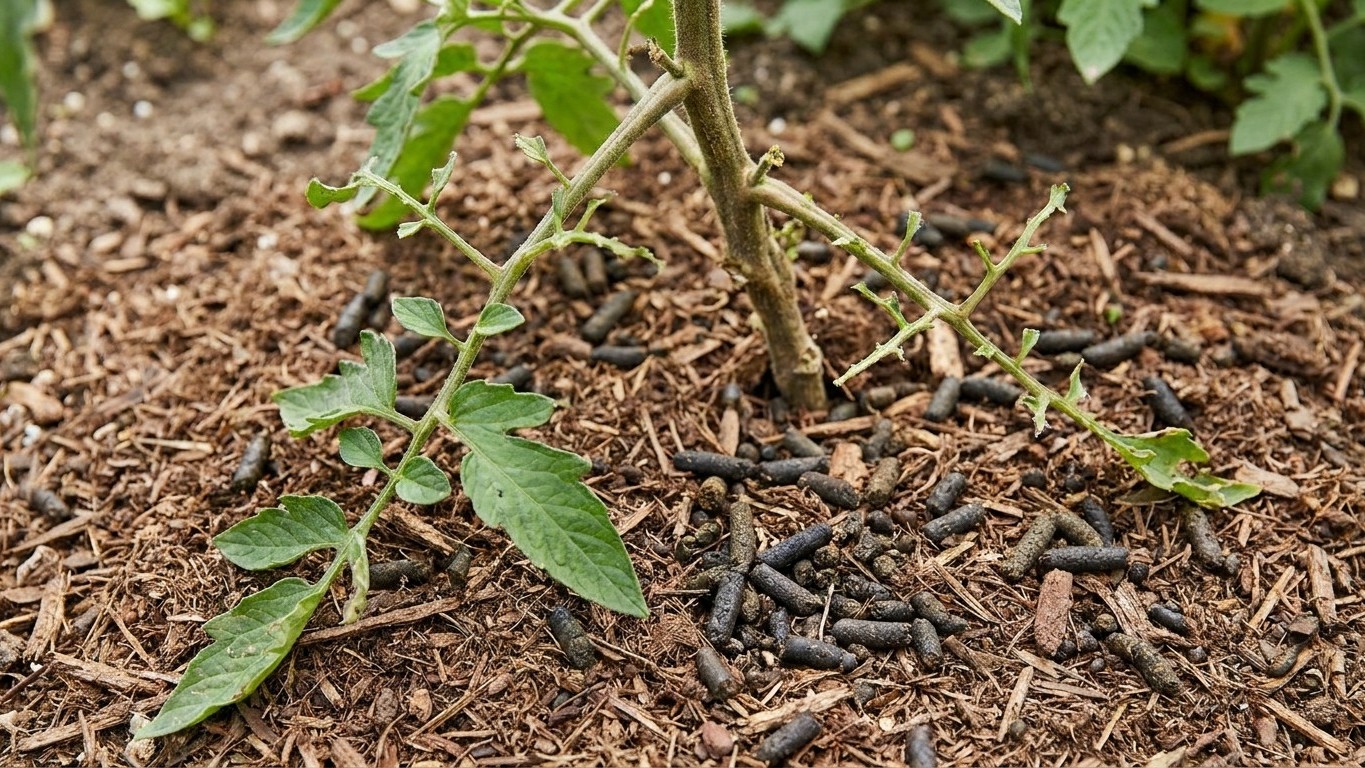

If you’re staring at a tomato plant that’s lost half its leaves overnight and finding dark, crumbly pellets scattered on the mulch below, you’re looking at tomato hornworm damage before you’re looking at the hornworm itself. That’s normal. The caterpillar is bright green, up to four inches long, and shaped exactly like the stem it clings to. Most gardeners spot the frass first. On an established, healthy plant, this is manageable. On a young seedling, it can be fatal within a couple of days.
What the damage looks like

Start with the ground, not the plant. Underneath a stripped branch you’ll usually find a scatter of dark green to black pellets, ribbed and roughly the size of a grain of rice when the caterpillar is young, closer to a coffee bean once it’s grown. That frass is the first clue most people notice, days before they ever see the insect responsible. It’s a giveaway specific to this pest: the caterpillar feeds mostly at night and rests flat against a stem by day, colored so close to the foliage that even an experienced gardener can stand a foot away and miss it.
Above the debris, look at the pattern of the loss. Tomato hornworm damage tends to start near the growing tip and work backward, leaving bare, woody stems where leaves used to be while lower foliage stays untouched for longer. Whole leaves disappear, not just chewed edges, sometimes down to the midrib and petiole with nothing left but a stub. Fruit is usually left alone unless the population is heavy, though a hornworm will occasionally take a bite out of a green tomato near the stem end.
What separates this from other defoliation on this site is the near-total absence of a visible culprit during daylight hours. Aphid colonies cluster where you can see them. Flea beetles leave a shotgun-hole pattern you can photograph in five minutes. Tomato hornworm damage is different: heavy destruction, almost no insect in sight, and droppings underneath that don’t match anything sized for a smaller pest. If you run a hand along a bare stem and find a caterpillar gripping it with prolegs like suction cups, and it has a curved horn-like spike on its rear end, that confirms what the frass already told you.
Making sure it is this and not something else
Two caterpillars get confused with each other constantly, and a couple of unrelated pests get blamed for damage that looks similar at a glance. The frass-and-defoliation pattern above is specific enough that you’re almost certainly dealing with a hornworm species. The question left is which one, and whether anything else could be doing this.
Tobacco hornworm
The tomato hornworm (Manduca quinquemaculata) and the tobacco hornworm (Manduca sexta) are close cousins, both feed on tomato plants, and both look almost identical to anyone who isn’t studying them closely. The tomato hornworm has V-shaped white chevrons along its sides and a dark, blue-black horn. The tobacco hornworm has diagonal white stripes and a red horn. For a home gardener, the distinction is trivia rather than a decision point: the damage is the same, the control methods are the same, and neither one needs a different response.
Cutworms and other defoliators
Cutworms attack seedlings at ground level, severing the stem so the whole plant topples over, which is a completely different injury pattern from a hornworm stripping upper leaves on an established plant. Armyworms and other caterpillars that feed in groups tend to skeletonize leaves in patches rather than remove them wholesale, and they leave much smaller, more numerous droppings spread across a wider area instead of concentrated pellets under one damaged branch. If the plant is young, low to the ground, and simply cut off rather than defoliated from the top down, look elsewhere; that’s not a hornworm problem.
When it shows up
Timing here tracks the plant, not the calendar. Adult moths, sometimes called hawk moths or sphinx moths, seek out tomato, pepper, eggplant, and potato plants once those plants have enough leaf mass to support a hatching caterpillar through several growth stages. That means the earliest risk window opens once a transplant is established and putting on new leaves, not the day it goes into the ground.
The heaviest damage tends to arrive once plants are flowering and setting their first fruit, because that’s when foliage is dense enough to hide a caterpillar and abundant enough to feed one to full size. A single hornworm goes through several molts before it’s ready to drop into the soil and pupate, and each molt brings a bigger appetite, so the damage accelerates rather than staying steady. A plant that looked fine three days ago can look half-stripped by the next weekend, purely because the caterpillar crossed into a later, hungrier stage.
Warm, humid stretches without heavy rain tend to favor a bigger emergence, since the pupae overwintering in soil need the ground to warm consistently before the adult moths emerge. In many parts of the country there’s a second wave later in the season, after the first generation has pupated and a new set of moths lays eggs on the same plants. That’s why a garden that seemed clear can show fresh frass again once the vines are full and fruiting heavily a second time.
What to do now
- Hand-pick after dusk or before sunrise. This is free, effective, and works precisely because the caterpillar’s camouflage fails under flashlight beam; the green body throws a strange, almost glowing reflection at close range. Drop what you find into soapy water.
- Check for white cocoons before you remove anything. A hornworm carrying small, rice-grain-shaped white cocoons on its back has already been parasitized by a braconid wasp. Leave that individual in place. It will die soon regardless, and the wasps that emerge will go on to parasitize other hornworms in the garden, which is a better long-term outcome than pulling it off the plant.
- Apply Bacillus thuringiensis kurstaki (Bt). This is a naturally occurring bacterium sold as a spray or concentrate at most garden centers, and it targets caterpillars specifically while leaving bees, ladybugs, and other beneficial insects unharmed. It works best on younger caterpillars and needs to be reapplied after rain.
- Use insecticidal soap or spinosad if Bt isn’t cutting it. Spinosad is broader-spectrum than Bt but still far more targeted than a general insecticide. Apply it in the evening, after bees have finished foraging, since it can affect pollinators if it contacts them directly while wet.
- Reserve broad-spectrum chemical insecticides for a genuine outbreak. Products containing carbaryl or permethrin will kill hornworms, but they also kill the parasitic wasps and other predators that would otherwise be doing free pest control, and some formulations carry state-specific restrictions near edible crops. Read the label for the pre-harvest interval before spraying anything you intend to eat, and treat this as the last step, not the first.
Stopping it coming back
- Till or turn the soil at the end of the growing season; this exposes overwintering pupae near the surface to frost and to birds, which will pick them off readily.
- Rotate tomatoes, peppers, and eggplant to a different bed each year rather than planting the nightshade family in the same spot, since that reduces the odds of a moth finding host plants right where pupae emerged.
- Plant dill, fennel, or yarrow near the vegetable bed to draw in parasitic wasps and other beneficial insects that keep hornworm numbers down before they become visible.
- Use floating row cover over young transplants and remove it once the plants start flowering, so pollinators can still reach the blossoms while the most vulnerable stage stays protected.
- Walk the tomato rows at dusk a couple of times a week once plants are flowering; catching two or three caterpillars early is far easier than dealing with a stripped plant a week later.
Common questions
Can a tomato hornworm really strip a plant overnight?
Not usually overnight, but close. A full-grown hornworm eats enormous amounts of foliage in its final larval stage, and because the damage is often invisible until the caterpillar is nearly mature, gardeners tend to notice the loss all at once rather than watching it build gradually.
Are tomato hornworms harmful to touch, or to pets?
No. Despite the alarming size and the spike on the tail end, the horn is soft and doesn’t sting or bite. It’s unpleasant for some people to pick up bare-handed simply because of the size, but there’s no venom or irritant involved.
What does a tomato hornworm turn into?
It pupates in the soil and emerges as a large gray-brown moth, sometimes called a hawk moth or sphinx moth, with a wingspan of several inches. These moths are strong fliers and are sometimes mistaken for small hummingbirds when they feed on flowers at dusk.
Should I remove a hornworm that’s covered in small white cocoons?
Leave it where it is. Those cocoons belong to a parasitic braconid wasp that has already laid eggs inside the caterpillar. The hornworm will die on its own, and the wasps that hatch will go looking for more hornworms, which does more for long-term control than removing that one caterpillar by hand.