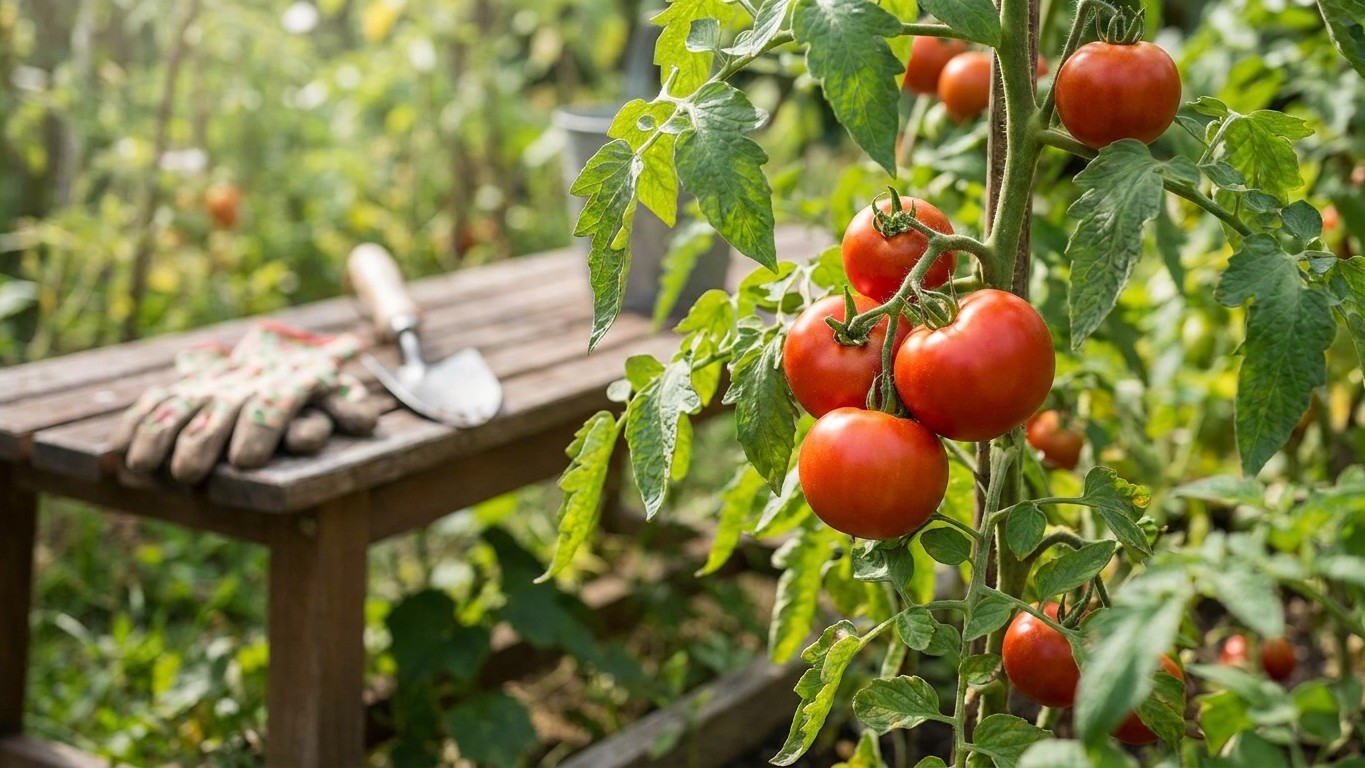

Count backward about 65 days from your first fall frost, and that’s the day this tomato needs to already be red on the vine — so the real question isn’t whether summer is long enough, it’s whether you got the seedling in the ground early enough to use it. Walk out to where you’re thinking of planting and check how many weeks of frost-free growing you actually have left once the soil has warmed enough for roots to take hold. That’s the number to work backward from before you buy a single seedling.
What Celebrity actually is

Celebrity is a full-size slicing tomato, not a paste type and not a cherry, bred to hit a heavy main flush of fruit rather than trickle out tomatoes all season. Catalogue listings put it at about 65 days from transplant to first ripe fruit, and that count starts the day a hardened-off seedling goes into the ground. Sowing typically happens five to seven weeks before that transplant date, so the seed-to-harvest total runs closer to four months, but the transplant-to-harvest figure is the one that matters for planning a garden against a frost date.
The plant is graded semi-determinate. It grows more sprawling and taller than a true determinate bush like a paste tomato, but it still sets a defined number of fruit clusters and stops extending the way an indeterminate vine does. In practice that means Celebrity needs a real cage or stake, not the low wire ring that suits a compact patio variety, and it rewards more spacing than a dwarf bush would need. Because the plant caps its own growth, the crop arrives over a few concentrated weeks rather than dribbling out until frost, which is exactly the trait that makes the timing question worth answering carefully.
Fruit is round, red-skinned, and averages around 7 to 8 ounces, big enough to slice for a sandwich and firm enough to hold together on a cutting board. It is an all-purpose tomato: good fresh, good in a sauce pot if you grow enough plants, but not bred for the dense flesh of a paste type.
What Celebrity is good for
Celebrity’s flesh is built the way most slicing tomatoes are: loose internal structure, open seed cavities, and a high proportion of water compared to a paste tomato. Cut one open and juice runs rather than clings, which is exactly why this type is eaten raw more often than cooked. On a sandwich, in a salad, or sliced onto a plate with salt, that juiciness is the point — it’s what makes a slice taste like a tomato instead of like tomato paste. Put the same fruit in a saucepan and the water has to go somewhere before the sauce thickens, so a batch of Celebrity will simmer down for a long stretch and lose a good share of its volume to steam. A paste tomato skips that step because it never had the water to begin with.
That doesn’t rule out cooking with it, it just changes what kind of cooking makes sense. Because the plant caps its growth and delivers most of its crop in a concentrated few weeks rather than a slow trickle, a home cook ends up with a lot of ripe tomatoes at once — which suits a weekend of making salsa, roasting a tray for a quick pan sauce, or canning in a single push, all of which either use the water on purpose or don’t mind boiling it off in a shorter batch. It suits that concentrated-harvest style of cooking better than it suits an all-season simmered sauce project, simply because the fruit and the free time to process it arrive together rather than in a trickle to match a slow-cooking schedule.
Celebrity sets large, meaty fruit, and that is what decides where it belongs in a kitchen: sandwiches, thick slices and bruschetta, rather than a sauce simmered down over an afternoon.
Where it ripens in time, and where it is a gamble
The arithmetic behind this section is the same wherever you garden. Start with the average date of the last spring freeze and the first fall freeze in your area, both tracked by NOAA for stations across the country. Subtract the two weeks or so that tomato roots need the soil to warm before transplant shock stops costing growth. Subtract Celebrity’s roughly 65 days to maturity. Whatever is left is the picking margin: the number of days between the first ripe fruit and the average first frost. A margin under about thirty days means a single flush, and a cool year can erase it before the fruit finishes.
That margin runs razor-thin at the edges of the map. In Yukon, working from the Whitehorse station, transplants go out in mid June and the first fruit ripens in late August, leaving only about 2 days of margin before the average frost. In Nunavut, using the Rankin Inlet record, the window is barely wider: transplant in early July, first ripe fruit in early September, and about 7 days before frost closes the season. Neither region is a place to plant Celebrity in open ground and hope. Both need a greenhouse or a high tunnel, because even where the frost-free stretch is technically long enough, the accumulated summer heat is not. Whitehorse logs roughly 600 growing-degree-days across the year, and Rankin Inlet fewer still, nowhere near what a full-size slicer needs to fill out fruit regardless of how many frost-free days sit on the calendar.
Reading the margin across contrasting states
The table below lines up the tightest and widest margins side by side, using each territory’s reference station and the transplant window that follows from it.
| Territory | Reference station | Transplant window | First ripe | Margin before frost |
|---|---|---|---|---|
| Yukon | Whitehorse | mid June | late August | 2 days |
| Nunavut | Rankin Inlet | early July | early September | 7 days |
| Saskatchewan | Saskatoon | early June | early August | 44 days |
| Nevada | Las Vegas | late January to mid February | late April | 231 days |
| Louisiana | New Orleans | early to late February | late April | 233 days |
Move into the prairie provinces and the frost window opens without the heat problem fully going away. Northwest Territories, measured at Yellowknife, gives about 37 days of margin with a June transplant and a mid-August first harvest, but the growing-degree-day total there still lands under 1,000, short of what Celebrity wants. Alberta, at the Calgary station, does a little better at 39 days of margin, and Manitoba and Saskatchewan push into the low forties, but the Winnipeg and Saskatoon degree-day totals still sit in the range where an early plant and black plastic mulch to trap extra soil heat can decide the difference between a full crop and a partial one.
At the widest end of the map, margin stops being the limiting factor at all. Louisiana and Nevada both clear 230 days of margin, and Texas, at Houston, and Florida, at Jacksonville, both clear 180. In every one of these places the question is not whether Celebrity has time to ripen. It is whether the plant can set fruit at all through the hottest stretch of summer, which is a different limit covered next.
The two ways a season goes wrong
A long frost-free window is not the same thing as a good tomato season, and two limits explain why. The first is accumulated warmth. Degree-days measure how much useful heat a plant actually banks over a season, and a place can have a technically wide gap between frost dates while still running cool most days, the way Northwest Territories and Alberta do. Celebrity flowers will drop without setting fruit when night temperatures sit below 50 F, so a stretch of chilly nights in early summer can cost a grower an entire flush even with weeks of frost-free days still ahead.
The second limit runs the other way. Once daytime temperatures push past 86 F, tomato pollen turns sterile and blossoms fall without setting fruit, no matter how healthy the plant looks. That is why growers in the deep South and the desert Southwest, places like Texas, Florida, Louisiana and Nevada, plant two separate tomato crops rather than one long one: a spring crop that finishes before mid-summer heat locks in, and a fall crop started once nights cool back down. The margin numbers for those states look enormous on paper, well past 150 days, but a large chunk of that window is dead time for fruit set.
Celebrity’s 70-day maturity works in its favor here. It matures fast enough to dodge the hot middle of summer if a grower in one of those southern climates transplants at the early edge of the recommended window and again after the worst heat breaks, getting two real harvests where a slower 85 or 90-day slicer would only manage one. In the short-season territories, though, the heat-accumulation limit is the one to watch, since a 70-day plant still needs those days to be warm ones, not just frost-free ones.
What it resists, and what it does not
Celebrity carries one of the more heavily loaded disease-resistance codes among common slicers, usually printed on the seed packet as VFFNTA. That breaks down to Verticillium wilt, Fusarium wilt races 1 and 2, root-knot nematodes, tobacco mosaic virus, and Alternaria alternata stem canker. All five are catalogue-graded resistances, not marketing shorthand, and they matter most in gardens where tomatoes have grown in the same soil for years, since Verticillium and Fusarium both persist in soil and build up under repeated planting.
The Alternaria letter is worth pausing on because it gets confused with a different disease. The “A” in VFFNTA covers Alternaria alternata, the fungus behind stem canker, not Alternaria solani, the fungus behind common early blight. Those are two different pathogens in the same genus, and resistance to one says nothing about the other. A gardener who reads “Alternaria resistant” and assumes the plant is covered against early blight is exactly the gardener who gets caught by it in a wet July.
Celebrity carries no listed resistance against several diseases that show up regularly in home gardens:
- Late blight (Phytophthora infestans)
- Septoria leaf spot
- Bacterial spot and bacterial speck
- Tomato spotted wilt virus
In a humid climate or a wet season, those are the diseases actually worth watching for on this variety, and a resistance code that looks impressive on paper does nothing to stop them. Good airflow, mulch to keep soil off the lowest leaves, and a fungicide program timed to local blight forecasts still matter on Celebrity exactly as they would on a variety with no resistance listed at all.
Growing it without the usual mistakes
Celebrity’s semi-determinate habit is the detail most gardeners get wrong, usually by treating it like either a small determinate bush or a sprawling indeterminate vine. It is neither. Give it a sturdy cage or a stake tied every twelve inches or so as it climbs, and space plants with real room between them, since a mature Celebrity plant fills more ground than a compact bush type but stops well short of the six-foot sprawl of an indeterminate slicer covered in a general look at tomato varieties and their habits.
Feeding and the split-flush problem
Because the plant sets most of its fruit in a defined window rather than continuously, heavy nitrogen feeding late in the season buys leaf growth the plant does not need and can thin the skin right when the crop is ripening, raising the risk of cracking after a rain. Feed at transplant and again once fruit is set, then taper off. A plant still being pushed hard with nitrogen when the main flush ripens is a plant more likely to split its fruit.
Planning for a concentrated harvest
Because Celebrity ripens most of its crop over a few weeks rather than trickling fruit out until frost, plan for that flush before it arrives. Line up canning jars, sauce recipes, or neighbors willing to take extra tomatoes, since a handful of plants can turn out more ripe fruit in a short stretch than one household eats fresh. Gardeners weighing Celebrity against other timed varieties should compare it with Legend, a slicer bred for a similarly concentrated harvest but with cold tolerance Celebrity does not carry, or with Cherry Bomb, an indeterminate cherry type built for the opposite strategy: small fruit produced continuously until frost rather than one defined main crop.
Common questions
Is Celebrity a hybrid, and can I save the seed?
Yes, Celebrity is an F1 hybrid, not an heirloom, so seed saved from its fruit will not grow into a plant true to the parent. Buy fresh seed or transplants each season if you want the same disease resistance and fruit size the catalogue describes.
Can I grow Celebrity in a container?
It can be done, but its semi-determinate habit wants more root room and a taller cage than a container tomato usually gets, so choose a large pot and stake it as firmly as you would in the ground. A dedicated compact patio variety will generally do better in a small pot than Celebrity will.
How many plants do I actually need for a family?
Because Celebrity delivers most of its crop in one concentrated flush rather than spreading it across the season, two or three well-grown plants usually produce more ripe fruit in a short window than a household of four can eat fresh, once you count slicing, sandwiches, and the occasional batch of sauce. Gardeners who want tomatoes for the whole season alongside Celebrity often add an indeterminate variety to keep fruit coming after the main flush ends.
Will Celebrity keep producing after the first big flush?
It will set a smaller secondary flush if the plant stays healthy, but nothing close to the steady trickle of an indeterminate variety. Once the main crop is picked, expect a lighter second wave rather than continuous production until frost.