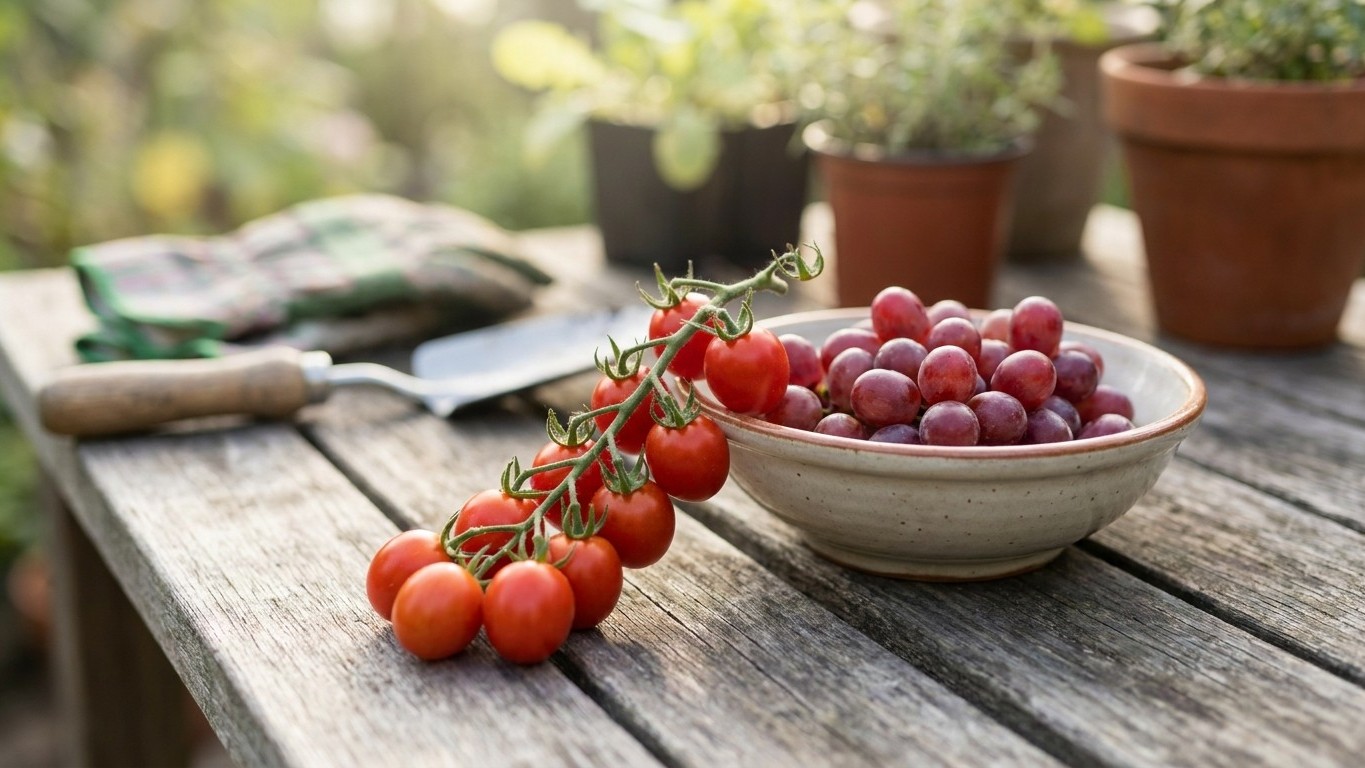

Nova’s vine never stops. It’s indeterminate, which means it keeps throwing new flower trusses and new clusters of small oblong fruit right up until frost or disease shuts it down, and that single fact decides almost everything else about growing it — how early you stake it, how much space you give it, how fast wet foliage dries after rain. Left to sprawl past midsummer, it turns into a tangle that invites the fungal trouble unstaked vines always get. The fruit itself stays firm enough for lunchboxes, not slicing, so plant accordingly.
What Nova actually is

Nova grows as an indeterminate vine. That means it keeps producing new flower trusses and new fruit clusters right up until frost or disease stops it, unlike a determinate variety that sets one flush and quits. Practically, this decides how you stake it and how much room it needs: a Nova plant left unsupported past midsummer will sprawl into a tangle that is hard to harvest and slow to dry out after rain, which invites the fungal problems that thrive on wet foliage.
The fruit itself is small, oblong, and red at full ripeness, the classic grape shape rather than the round cherry shape. Skin holds firm enough for lunchbox use and salads without the fruit going mushy on the vine, which is the main reason growers choose a grape type over a round cherry tomato like Black Cherry Tomato when the goal is snacking fruit that survives a little handling. Nova is not bred for slicing weight or beefsteak size, so if you want both a snacking crop and a sandwich tomato, plan for two different plants rather than expecting one to do both jobs. That distinction, along with the 60-day figure, is the whole basis for the arithmetic in the next section, and it is worth reading Tomato Varieties first if you have not already settled on your other picks for the bed.
What Nova is good for
A grape tomato is built the opposite way from a paste tomato, and that shapes what happens when Nova goes into a pot. Paste types like Roma carry thick walls and little internal moisture, so a pan of them reduces to sauce on its own heat, with no water to boil off first. Nova’s flesh, like any grape tomato, holds more moisture relative to its size. Cooked down for sauce, it takes longer at the stove to drive off that water before the mixture thickens, and it will need reducing rather than simmering briefly and calling it done.
Where Nova earns the sauce-and-canning use despite that is in what happens to the skin. Grape tomato skin is thin enough to slip off cleanly after a quick blanch, which matters for canning: skins that won’t shed leave grit in a jar, and skins that split unevenly during processing leave torn fruit. Small, uniform grape-sized fruit also packs a jar more evenly than large slicing fruit cut into pieces, so a batch cans with less waste and fewer awkward gaps than one built from big fruit hacked to fit.
The indeterminate habit reinforces this rather than working against it. Because the vine keeps setting new trusses through the season instead of ripening one flush and stopping, a canning or sauce project built around Nova gets repeated small harvests rather than one giant one-time glut, which suits batch canning better
Where it ripens in time, and where it is a gamble
A fast tomato does not automatically mean an easy tomato everywhere. What decides the outcome is the margin, the number of days left between the date the first fruit turns red and the date the first fall frost is expected to hit. A margin under thirty days means one flush of fruit, and a single cool year takes the harvest before it ripens. The table below shows the spread across some of the most contrasted growing windows in the country, from the tightest margin to the widest.
| Territory | Reference station | Verdict | Set out | First ripe | Margin |
|---|---|---|---|---|---|
| Yukon | Whitehorse | Risky | Mid June | Mid August | 7 days |
| Nunavut | Rankin Inlet | Risky | Early July | Early September | 12 days |
| Saskatchewan | Saskatoon | Needs a tunnel | Early June | Late July | 49 days |
| Washington | Seattle | Comfortable | Mid March to early April | Late May | 166 days |
| Florida | Jacksonville | Comfortable | Early to late March | Mid May | 190 days |
| Louisiana | New Orleans | Comfortable | Early to late February | Late April | 238 days |
Work the arithmetic yourself with local numbers rather than trusting a single date. Start with the frost-free window your reference station reports, subtract the fortnight or so the soil needs to warm before it is safe to set out a tomato transplant, then subtract Nova’s roughly 60 days to first ripe fruit. What is left over is your picking season, and that number is the one that tells you whether you get a real harvest or a single frost-shortened flush. In Yukon, Whitehorse’s numbers leave only seven days after the first ripe fruit before frost typically returns, which is why the verdict there calls for a greenhouse or high tunnel rather than an open bed. In Saskatchewan, Saskatoon’s window is workable but tight enough that a plastic mulch to warm the soil, paired with an early transplant date, changes the outcome from marginal to reliable. Once you cross into growing windows like Washington‘s Seattle figures or the Gulf Coast stations, the margin stops being the limiting factor at all, and the next section explains what takes over instead.
The two ways a season goes wrong
Cold that never quite becomes frost
A long frost-free window is not the same as a warm one. Tomato flowers will not set fruit once night temperatures drop below 50F, and in the far north the accumulated warmth across the whole growing season can run short even where the calendar shows months of frost-free days. Whitehorse in the Yukon accumulates only around 600 growing-degree-days across its season, and Rankin Inlet in Nunavut around 159, both well short of what a tomato plant needs regardless of how many frost-free days sit on either end. That is a heat-total problem, not a calendar problem, and no amount of extra margin fixes it. A greenhouse or an unheated high tunnel raises daytime and nighttime temperatures enough to close most of that gap.
Heat that shuts pollen down
The opposite failure shows up in the deep south. Above roughly 86F, tomato pollen goes sterile and flowers drop without setting fruit, which is why stations like Charleston, Jacksonville, Houston, Las Vegas and New Orleans effectively run two tomato seasons rather than one long one, a spring crop that finishes before the worst heat and a second planting for autumn. For a variety with Nova’s roughly 60-day maturity, that pattern actually works in the grower’s favor, since a fast plant can be set out early enough to finish its first flush before the heat shuts pollination down, then replanted for a second round once temperatures ease.
Given Nova’s short timeline, the accumulated-warmth limit matters more in the far north, where the season is simply too cool for too much of the year no matter how the frost dates fall, while the heat-sterility limit matters more in the deep south, where the fix is scheduling around it rather than avoiding the crop altogether.
What it resists, and what it does not
Nova carries High resistance to Fusarium Wilt races 1, according to catalogue disease-resistance codes. A high grade means the plant is bred to largely escape infection from that specific race under normal pressure, which is meaningfully different from an intermediate grade, where a variety only slows the disease down and can still show symptoms under heavy soil pressure or a wet season.
The catalogue adds one more rating and then stops: an intermediate nematode resistance, which slows root-knot nematodes rather than stopping them. Nothing else is listed for Nova, no Verticillium wilt code, no listed tolerance to early blight, late blight, or the tobacco mosaic and tomato spotted wilt viruses that show up on the resistance codes of many modern hybrids. That is worth stating plainly rather than letting a reader assume broad protection from one good result. Growers in regions where Verticillium wilt or root-knot nematodes are a known problem should plan on crop rotation, resistant rootstock if grafting, or soil solarization rather than counting on the variety to handle it, and should watch foliage for the leaf-spotting and defoliation patterns typical of early and late blight through a wet season regardless of how well the roots are holding up.
Growing it without the usual mistakes
Support and spacing for an indeterminate vine
Because Nova keeps growing and setting fruit all season, it needs the same commitment as a full-size indeterminate slicer such as Better Boy Tomato, not the lighter stake a determinate bush gets away with. A single stake tied every foot or two, or a sturdy cage set at planting time before the vine gets away from you, keeps the fruit off the ground and the foliage open enough to dry after rain. Give each plant real room, since a crowded indeterminate row shades its own lower leaves and slows ripening even when the days-to-maturity clock says the fruit should be ready.
Feeding and the harvest rhythm
Ease off nitrogen once the first clusters have set fruit. Extra nitrogen this late pushes leafy growth at the expense of the fruit set you actually want, and grape tomatoes in particular are prone to splitting when a heavy feed is followed by an uneven watering schedule. Because Nova ripens in clusters rather than one big flush, plan to harvest every few days once the first fruit colors up rather than waiting for a single big picking, since ripe grape tomatoes left too long on the vine crack after the next rain and draw wasps.
The mistake its timing invites most often is treating the short days-to-maturity figure as license to rush the transplant date. A 60-day tomato set out into cold, wet soil does not ripen 60 days after that date, it stalls until the soil and night air actually warm up, then starts its clock. Wait for the same soil and night-temperature conditions you would use for any tomato transplant, and let the fast maturity work as a safety margin against an early fall frost instead of an excuse to jump the spring one.
Common questions
Can I grow Nova tomatoes in a pot?
Yes, but size the container to an indeterminate vine, not to the small fruit. A five-gallon pot is too small for season-long root growth. A larger container with a stake or cage sunk in at planting time works better, and container soil dries faster than a garden bed, so check moisture more often than you would in the ground.
Why did my Nova tomatoes split after a rain?
Splitting on grape tomatoes usually follows a dry stretch that suddenly gets a heavy rain or a big watering. The roots take up water faster than the skin can stretch to hold it. Even, regular watering through the season reduces the problem more reliably than anything you do after the fact.
Is Nova a hybrid or an open-pollinated variety?
Check the listing on your specific seed packet or catalogue source, since that detail determines whether saved seed will grow true to the parent plant. Hybrid status varies enough between suppliers using similar names that it is worth verifying before you save seed to replant.
How many tomatoes will one Nova plant actually produce?
Yield depends heavily on your local season length, heat, and how well the plant is supported and fed, so there is no single reliable number to quote nationwide. Your state extension office can usually give you a realistic per-plant yield range calibrated to your local growing conditions rather than a catalogue estimate written for an average season.