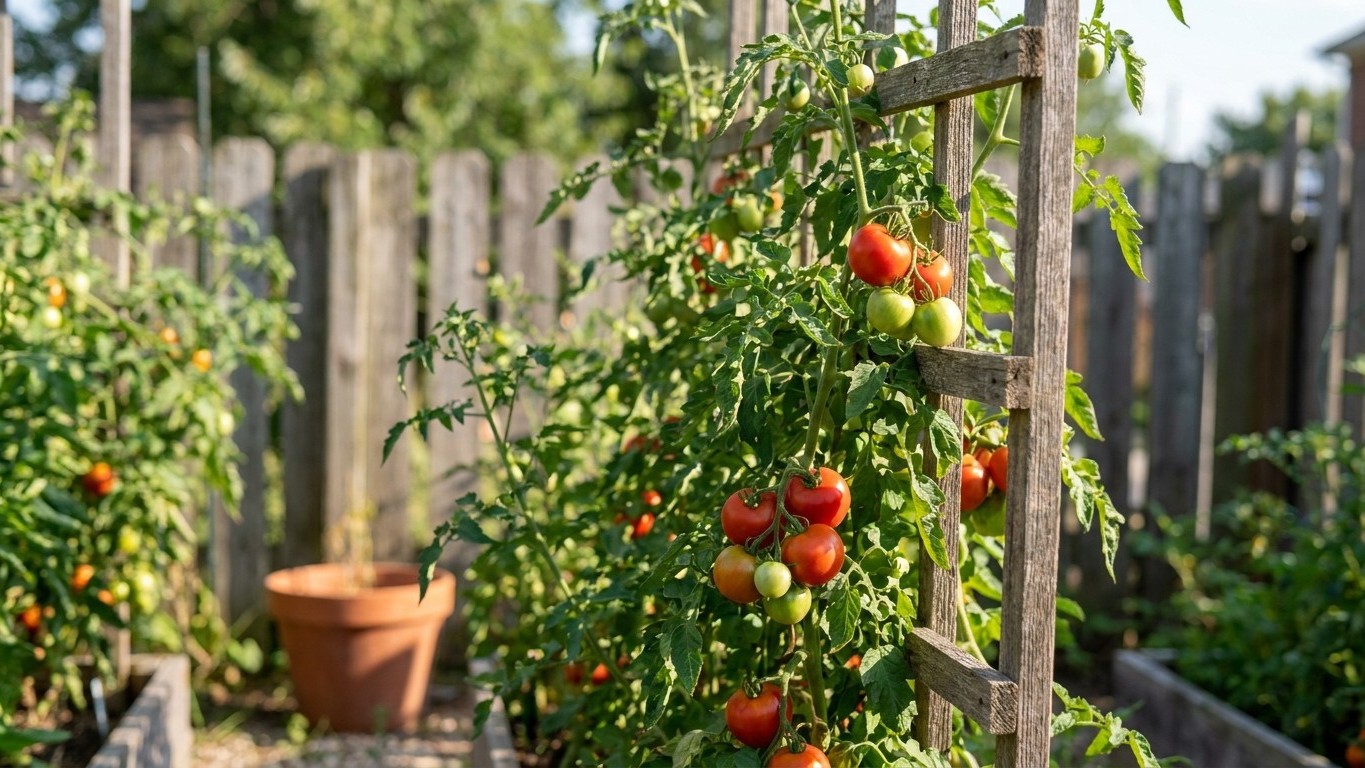

Better Boy is a large-fruited slicing tomato that reaches its first ripe fruit in roughly 75 days from transplant, not from seed, according to the days-to-maturity figure printed on its seed packet. That single number decides whether a given region’s frost-free window can absorb it, and whether the plant needs a greenhouse head start or can go straight into open ground. Check your local frost-free window against that 75-day figure before you decide where and when to set transplants out.
What Better Boy actually is

Better Boy is an indeterminate hybrid, which means the vine keeps growing and setting new flower clusters until frost or disease stops it, rather than stopping at a fixed height and ripening its fruit in one flush. That habit is the whole reason growers plant it: a long, staggered harvest instead of a single glut. It also means the plant needs a tall cage or a stake system built to carry a vine that can run several feet past what a determinate variety would ever reach, and it needs that support in place at planting, not added later once the vine has flopped.
The fruit is a classic round red beefsteak-type slicer, smooth-skinned and heavy, the kind of tomato bred for sandwiches and slicing rather than sauce or canning in bulk. Seed catalogues list its days-to-maturity figure as around 75 days from the day it goes into the ground as a transplant, and that figure moves by a week or so either way depending on how warm the season runs after planting. A cool, cloudy stretch right after transplant pushes first ripe fruit later than the catalogue number promises. That is the number to carry into the next section, because everything about where this variety succeeds comes from crossing it against a local frost calendar.
What Better Boy is good for
Better Boy’s fruit is a round, smooth-skinned beefsteak, and that shape and skin tell you what it does in the kitchen before any flavor note does. Beefsteaks carry a high ratio of water-filled gel and seed cavity to flesh, so when heat hits them they release liquid rather than reducing to anything thick. That works fine at the counter: slice one raw and the juice that runs out is exactly what makes a sandwich or a burger topping good, and a wedge dropped into a salad brings the same juiciness with no cooking involved at all. Put the same tomato in a saucepan, though, and that water has to boil off before the sauce concentrates, which means longer cook times and a thinner result than a paste tomato gives for the same effort.
Paste-type tomatoes solve that problem with dense flesh and comparatively little water, so they collapse into sauce on their own and are the standard choice for canning or cooking down in bulk. Better Boy was never bred for that job, and the article’s own description of it as a slicer is a description of its water content and cell structure as much as its size. Cherry tomatoes sit at the other end of the same spectrum: thin-skinned, sweet-leaning, and small enough that most of a harvest gets eaten standing at the plant rather than carried to a cutting board.
Better Boy is described as carrying a classic tomato flavor, balanced between acid and sugar, and it is grown as a slicer for exactly that reason: a tomato that has to hold its own raw, in a sandwich, cannot lean too far either way. What can be said is mechanical: expect a tomato suited to raw preparations where its juice is welcome, and expect a disappointing, watery result if the goal is a reduced sauce.
Where it ripens in time, and where it is a gamble
The arithmetic is simple once you have the pieces: take the local frost-free window, subtract the two or so weeks the soil typically needs to warm enough for tomato roots to establish after the last frost, then subtract Better Boy’s roughly 75-day run to first ripe fruit. What is left over is the harvest margin, the number of days between that first ripe tomato and the next frost. Under about thirty days of margin, a single flush is all a grower gets, and a cool year can erase even that.
Where the margin runs out
At the tight end, Whitehorse in the Yukon plants Better Boy transplants in mid June and would see first ripe fruit only in early September, which lands eight days after that station’s average first fall frost. The season simply is not long enough, and the region’s accumulated seasonal warmth falls far short of what a beefsteak tomato needs regardless of frost timing, so this variety is not a realistic open-ground crop there without a heated greenhouse or tunnel. Rankin Inlet in Nunavut is worse still, with transplants going in only in early July and first fruit expected mid September, about three days after frost typically arrives, and its cumulative warmth for the year is a small fraction of what the plant requires to bulk fruit at all.
Yellowknife in the Northwest Territories and Calgary in Alberta sit in the risky middle. Yellowknife’s transplants go out in early June, first ripe fruit arrives late August, and that leaves about 27 days before frost, enough for one wave of tomatoes if the season runs on schedule and nothing for a grower if it runs cool. Calgary’s numbers are close behind: transplant in early June, first ripe fruit by mid August, a 29-day margin to frost. Both regions also fall short on accumulated seasonal heat, which is a separate problem from frost timing and one a long, cool summer does not fix. Winnipeg in Manitoba and Saskatoon in Saskatchewan land in greenhouse territory for the same reason, with margins in the low thirties of days that a warm-season mulch and season-extending cover can still tip in the grower’s favor.
Where the margin is comfortable
The picture flips completely in the warmer half of the map. Houston in Texas sets transplants out from mid February to mid March and sees first ripe fruit by late May, a margin of roughly 186 days before frost, more time than Better Boy could use even across two full plantings. Jacksonville in Florida, New Orleans in Louisiana and Las Vegas in Nevada all post margins above 175 days, which is less a growing season than a growing year. In these places the limiting factor is never frost. It is summer heat, covered in the next section.
The two ways a season goes wrong
A wide frost-free window does not guarantee a good tomato season, and a narrow one is not the only way to fail. Two separate limits sit underneath the frost date, and a frost table alone will not show either one.
In cold-summer regions, accumulated seasonal warmth can run short even when the calendar gap between planting and frost looks workable on paper. Tomato flowers also will not set fruit reliably once nighttime temperatures fall consistently below 50°F, so a short cool snap in early summer can cost a grower an entire flush even with weeks of frost-free days still ahead. This is the failure mode behind the greenhouse verdicts for Winnipeg and Saskatoon above: the days exist, but the heat units to ripen a 75-day beefsteak inside them do not, at least not reliably in open ground.
In hot-summer regions the opposite limit applies. Once daytime temperatures climb past roughly 86°F, tomato pollen turns sterile and flowers drop without setting fruit, which stalls production through the hottest stretch of summer in Charleston, Jacksonville, Houston, Las Vegas and New Orleans. Growers in those places do not run one long season, they run a spring crop that finishes before the heat locks in and a second planting for autumn once temperatures ease. Given Better Boy’s 75-day run, the northern heat-unit limit is the one that actually decides whether this variety belongs in a given cold-climate garden, since its season length is generous almost everywhere else on the map.
What it resists, and what it does not
Better Boy carries resistance to two soil-borne diseases: Fusarium Wilt and Verticillium Wilt. Both are fungal pathogens that live in soil and enter through the roots, and both can otherwise wilt and kill a tomato plant from the bottom up over the course of a season, especially in ground where tomatoes or related crops have been grown repeatedly.
That resistance is a real, useful trait, but it is not a shield against everything a tomato plant can catch. Better Boy’s catalogue listing does not carry resistance to early blight, late blight, septoria leaf spot or root-knot nematodes, so a grower dealing with any of those pressures needs to manage them the same way they would with a non-resistant variety: crop rotation, mulch to stop soil splashing onto lower leaves, and fungicide where the pressure is heavy. Resistance to Fusarium and Verticillium does not mean the plant is immune to disease generally, it means those two specific named pathogens are the ones this variety is bred to hold off, and even there the protection works by slowing infection in soil that carries the pathogen, not by making the plant impossible to infect. A garden with a known history of either wilt is exactly where naming this variety, rather than a generic resistant type, actually matters.
Growing it without the usual mistakes
Because Better Boy is indeterminate, the plant needs a support system built for the long haul, not the light tomato cage sold for smaller determinate types. A stake driven deep at transplant time, or a cattle-panel trellis, holds the vine’s weight far better through a full season than a cage that was adequate in July but is buckling by September. Space plants with that mature size in mind. Crowding an indeterminate vine into determinate spacing invites the fungal leaf diseases that thrive in still, humid air between plants, which undercuts the wilt resistance bred into the variety by opening the door to problems it was never built to resist.
Feeding and the late-season habit
Better Boy keeps setting new fruit clusters as long as conditions allow it, which means it also keeps demanding nitrogen and potassium later into the season than a determinate variety does. Pull back on nitrogen once the plant is fruiting heavily. Too much late nitrogen pushes vine growth at the expense of ripening fruit, a mistake that is easy to make on an indeterminate specifically because the vine looks like it is still asking for more. A steady feed through midseason, then a taper as the days-to-frost count gets short, keeps the plant putting its energy into fruit it can actually finish.
The mistake its long season invites most often is planting too late in the belief that a 75-day tomato leaves plenty of room. In a marginal-margin region, every week transplanting is delayed comes straight off the harvest window calculated above, and there is no way to get it back once the season is running. Growers deciding between this variety and something faster for a short season are usually better served comparing it directly against a variety bred to finish in one tight flush, such as the Celebrity Tomato, or against a heat-tolerant beefsteak type like the STM 2255 tomato for regions where summer heat, not frost, is the limiting factor. For a broader look at how different types are bred to solve different season problems, the full rundown of tomato varieties lays out the tradeoffs by habit and maturity length.
Common questions
Is Better Boy the same as Big Boy?
No, they are separate hybrids with different breeding and different disease resistance packages, despite the similar name and similar beefsteak fruit. Check the specific packet or catalogue listing rather than assuming the two are interchangeable, since resistance claims that apply to one do not automatically apply to the other.
Can I grow Better Boy in a container?
You can, but its indeterminate vine gets large, so it needs a genuinely large container, on the order of a half-barrel or bigger, plus the same tall stake or cage support it would need in open ground. A small pot will stunt the roots long before the vine stops wanting to grow.
Why are my Better Boy tomatoes cracking?
Cracking is almost always a watering inconsistency problem rather than a variety fault. Irregular watering, especially a dry spell followed by heavy rain or a big drink, swells the fruit faster than the skin can stretch. Even, regular watering through fruit set and ripening is the fix, not a different variety.
How many tomatoes does one Better Boy plant actually produce?
It varies widely with season length, heat and care, and no single figure holds across regions, so the margin calculation matters more than a generic yield number. A plant with a comfortable 150-plus day margin, like those in Houston or Las Vegas, produces far more total fruit over a season than one in a 29-day-margin region getting a single flush before frost.