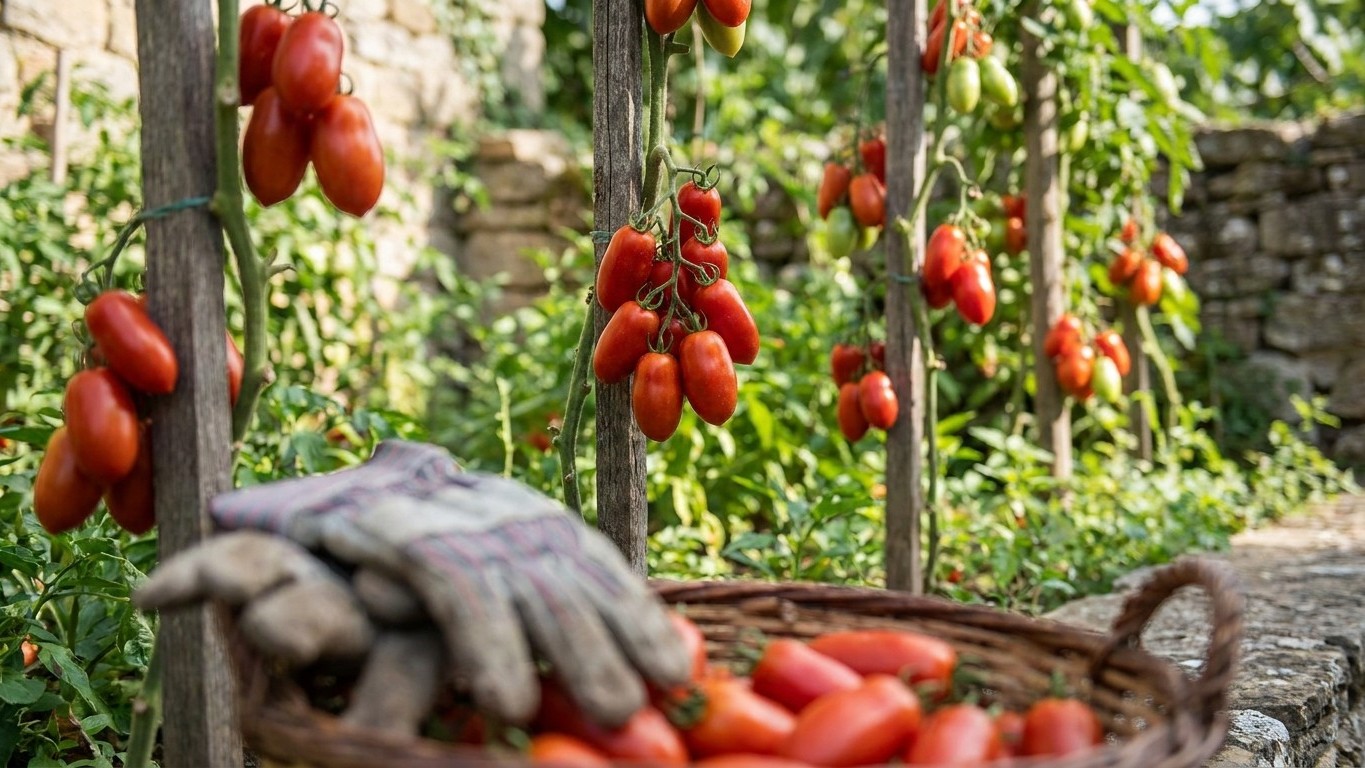

San Marzano’s seed packet says 80 to 85 days, and it’s tempting to read that like any other tomato’s clock, counting from the day the seed cracks open. It isn’t that clock. Those days start at transplant, after you’ve already spent three or four weeks raising the seedling indoors, and they run on an indeterminate vine that keeps climbing and flowering past what a determinate tomato would call finished — which is why the planting date matters more here than the variety’s easy reputation suggests.
What San Marzano actually is

The catalog description that matters most is the days-to-maturity figure, and for San Marzano that is 80 to 85 days counted from the date you set transplants in the ground, not from germination. That count matters more here than for most tomatoes because San Marzano is a long-season variety competing against a short growing calendar in a lot of the country. Add three or four weeks for raising the transplant indoors before you even get to that 80-to-85-day clock.
It is an indeterminate grower, meaning the vine keeps extending and setting new flower clusters right up until frost or disease stops it, rather than stopping at a set height and ripening one flush like a determinate bush type. That habit is why San Marzano plants routinely reach five to six feet and need a sturdy stake, cattle-panel trellis or tall cage rather than the short ring cages sold for patio tomatoes. If your season can’t support that kind of vine for its full run, the broader Tomato Variety roundup lists shorter, faster options that fit a tighter calendar.
The fruit itself is the reason growers put up with the staking: elongated, blocky-shouldered, tapering to a point, thick-walled with a small seed cavity and comparatively little juice. That low-moisture flesh is exactly what makes it prized for canned whole tomatoes, paste and cooked sauce, and exactly why it is a poor choice if what you actually want is a slicer for sandwiches.
What San Marzano is good for
San Marzano is a paste tomato, and that classification describes the inside of the fruit as much as the outside. Paste types carry thick walls and less internal gel and juice than a slicing tomato, with seed cavities that are small relative to the amount of flesh. Put that fruit in a pot and it breaks down into sauce quickly, because there is comparatively little water that needs to cook off first. A slicing tomato, by contrast, is built mostly of juice-filled locules, which is exactly what you want under a knife on a sandwich but means a pan of them spends a long time reducing before it thickens into anything you’d call sauce.
That same dense, low-moisture flesh is why paste tomatoes are the standard choice for canning, jarring, and freezing in bulk: they hold their shape better under heat and yield more finished product per pound than a watery slicer would. If your kitchen goal is a pot of tomato sauce, canned whole tomatoes for winter, or a thick tomato paste, San Marzano’s category fits that use directly. If your goal is a raw tomato on a burger or in a salad, the same density and lower juice content will read as dry and firm rather than juicy, which is the tradeoff paste types make in exchange for cooking down well.
The indeterminate habit adds a practical dimension for cooks rather than eaters: because the vine keeps flowering and setting new fruit through the season instead of ripening in one flush, harvest comes in a rolling series of smaller pickings rather than one large batch, which suits people who want to make sauce in installments as fruit ripens.
San Marzano runs high in sugars and pectin, and the pectin is the part that matters at the stove: it is what lets the fruit set into a sauce instead of staying watery, which is why this one goes to sauce, paste and soup rather than onto a burger.
Where it ripens in time, and where it is a gamble
The arithmetic behind every verdict is the same three steps: start with your area’s frost-free window, subtract the two or three weeks the soil needs to warm before a tomato transplant will even grow rather than sulk, then subtract San Marzano’s 80-to-85-day count. What’s left over is the picking window, and because this variety is indeterminate, that leftover time is what lets it ripen a second and third flush instead of one.
Where the margin runs out
At the tight end, Yukon, using the Whitehorse station, works out to transplants going out in mid June and a first ripe fruit expected in early September, which lands 11 days after the area’s first frost. There is no margin left at all, and the deficit isn’t the only problem: Whitehorse accumulates only around 600 degree-days across the year, well short of what a paste tomato needs to build fruit regardless of how the frost dates fall. A greenhouse or high tunnel is not optional there, it is the only way this variety runs at all.
Nunavut, at the Rankin Inlet station, is closer but still short: transplant in early July, first ripe fruit expected mid September, six days after frost. Its annual heat accumulation of roughly 159 degree-days makes the frost date almost beside the point.
Move to Northwest Territories and Alberta and the frost math turns positive but thin. Yellowknife gives a transplant date of early June, first ripe fruit late August, and a margin of 24 days, while Calgary runs almost identically at 26 days of margin on the same early-June-to-late-August timeline. Under thirty days of margin means one flush of ripe fruit, and a cool year takes even that, so both are rated a risk rather than a comfortable fit for an 80-to-85-day variety. Yellowknife’s 905 degree-days and Calgary’s 1,171 fall short of what the vine needs to push fruit through a full ripening cycle, which is why the frost margin alone overstates the odds.
Manitoba (Winnipeg) and Saskatchewan (Saskatoon) land in greenhouse territory: 30 and 31 days of margin respectively, both on an early-June transplant. Winnipeg’s 1,832 degree-days are described as just barely adequate, and Saskatoon’s 1,549 are tighter still. In both places a plastic mulch to warm the root zone, and row cover pulled early, change the outcome more than anything else a grower can do.
Where the season is generous
At the wide end of the range, the constraint stops being the calendar. Nevada‘s Las Vegas station gives 218 days of margin on a late-January-to-mid-February transplant, and Louisiana‘s New Orleans station gives 220 days on an early-to-late-February transplant. Texas (Houston) sits at 183 days of margin. None of those gardens will run out of season before San Marzano’s 80-to-85-day clock finishes, twice over if needed. The limit there isn’t frost. It’s heat, which the next section covers.
The two ways a season goes wrong
A long frost-free window is not the same thing as a good tomato season, and San Marzano exposes both of the gaps a simple frost table hides.
Too little heat, even with time
In the northern Territories above, the frost-free window can look adequate on paper while the accumulated warmth, measured in degree-days, still falls short. Fruit also stops setting when nighttime temperatures drop below roughly 50F, which happens well before the calendar frost date in places like Yellowknife or Calgary, quietly shortening the real season below what the frost dates suggest. For an 80-to-85-day variety, this is the bigger risk of the two, because that long a maturity window needs sustained warmth for its full run, not just a frost-free stretch long enough on a calendar page.
Too much heat, right in the middle
Further south, the opposite problem shows up. Above roughly 86F, tomato pollen turns sterile and flowers drop without setting fruit, which is why growers in Houston, New Orleans, Las Vegas and similar climates plant in late winter or early spring, harvest through early summer, then lose the hottest stretch entirely and plant again for a fall crop. It is two seasons stitched around a dead middle, not one long run. With 180 to 220 days of margin to work with in those territories, San Marzano has enough slack to fit both windows even after losing the summer gap, which is more forgiving than the tight northern margins where every lost week counts. If your season only supports one clean flush rather than two staggered ones, the Siletz tomato ripens its whole crop in a shorter, single window and carries far less risk.
What it resists, and what it does not
No disease-resistance letters on this one
Classic San Marzano is an open-pollinated heirloom, and seed packets for it carry no disease-resistance code at all, no V for verticillium, no F for fusarium, no N for nematodes. That is a plain gap, not a minor one: it means the plant has no bred-in defense against soil-borne wilts, and a garden with a known history of fusarium or verticillium wilt will hit this variety just as hard as any unprotected tomato.
In practice, the risks worth watching for are:
- Early blight, which shows first as dark rings on lower leaves and climbs the plant in wet years
- Fusarium and verticillium wilt in soil where tomatoes or related crops have grown repeatedly without rotation
- Blossom end rot, a watering and calcium-uptake problem rather than a disease, but common on paste types because their dense flesh is unforgiving of uneven watering
- Fruit cracking after a heavy rain follows a dry spell, splitting the thin-shouldered fruit near the stem
Crop rotation, at least three years out of the same bed for tomatoes and their relatives, does more for this variety than any spray, precisely because it has no genetic backup if the soil is already carrying wilt spores.
Growing it without the usual mistakes
Staking and pruning
Because San Marzano is indeterminate, it needs the kind of support you’d give a large slicer like Tasmanian Chocolate rather than a compact bush type. Plan on a stake driven deep at planting time, a cattle-panel trellis, or a cage built taller than the ones sold for determinate patio varieties. Prune to one or two main leaders and remove suckers regularly, both to keep the tall vine manageable and to push the plant’s energy into ripening fruit rather than growing more foliage it has no season left to support.
Feeding and the mistake its timing invites
Stop heavy nitrogen feeding once the first fruit clusters set. Continued nitrogen after that point buys you more vine, which an indeterminate plant will happily grow, at the direct cost of the fruit you actually need to finish before frost. The mistake this variety’s long maturity most often invites is delaying transplant to “play it safe” against a late cold snap. Every week that transplant slips is a week subtracted from an already tight margin in short-season gardens, so warming the soil with black or clear plastic mulch ahead of planting, rather than waiting out the calendar, is usually the better trade in a marginal climate.
Common questions
Is San Marzano the same thing as a Roma tomato?
No. Roma is a separate, usually determinate paste variety bred for a compact plant and one concentrated harvest, while San Marzano is indeterminate and keeps producing over a much longer window. They’re often shelved together because both are paste types, but the growing habit and the length of season they need are different.
Can I grow San Marzano in a container?
You can, but the container needs to be large, at least the size used for any large indeterminate tomato, and it still needs the same tall stake or cage as an in-ground plant. A small pot will stunt the root system long before the vine finishes its 80-to-85-day run to first fruit.
Why are my San Marzano tomatoes cracking on the vine?
Cracking usually follows a heavy rain or deep watering after the soil has been allowed to dry out, which swells the fruit faster than the skin can stretch. Even, consistent watering through the fruiting period reduces it, and mulch helps keep soil moisture from swinging as widely between rain events.
Can I save seed from San Marzano and replant it next year?
Yes, because it’s an open-pollinated heirloom rather than a hybrid, seed saved from a true San Marzano fruit will grow into a plant like the parent, as long as it wasn’t cross-pollinated by another tomato variety flowering nearby at the same time.