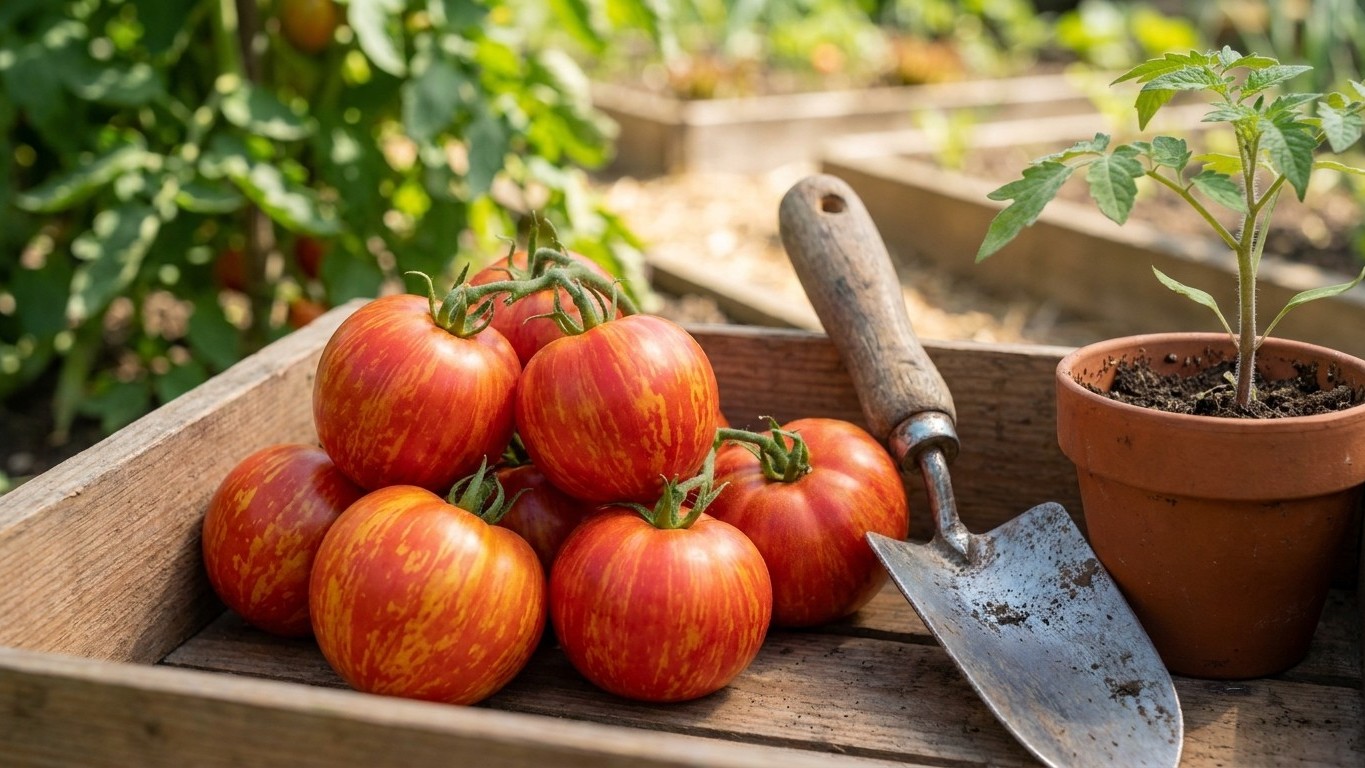

Striped German is a large heirloom beefsteak tomato grown for a fruit that stays mostly yellow-orange on the outside with red streaked through the flesh inside, offering a complex, fruity flavor and smooth texture, and it typically takes roughly 80 to 90 days to a ripe fruit counted from transplant, not from the day you sowed the seed. That is a long season for a tomato. Before you plant it, check your area’s frost-free window against that 80-to-90-day span, because the gap between the two decides everything else on this page.
What Striped German actually is

Striped German belongs to the beefsteak category: big, irregular, lobed fruit that can run well past a pound, grown for slicing rather than for sauce or paste because the flesh carries a lot of water and relatively little acid. The skin colors up yellow to orange with red blushing, and cut open, the interior shows the marbled red-and-gold pattern that gives the variety its name. It is low-acid and sweet by tomato standards, which is most of why people keep growing an heirloom that splits, cracks and demands more staking than a modern hybrid.
The plant itself is indeterminate: it keeps growing and setting new trusses all season instead of stopping at a set height and ripening one flush, the way a determinate variety does. That habit means it needs a tall cage or a stake system built to carry a heavy vine through a full season, not the short ring cages sold for patio types. Give it real room. A sprawled, unsupported Striped German plant puts fruit on the ground, where it splits and rots before it colors up.
The 80-to-90-day catalogue figure is a range, not a promise, and it moves by a week or two depending on how warm your particular season runs and how large a transplant you started with. Treat it as the number you cross against your local frost dates, which is the whole point of the next section.
What Striped German is good for
Slicing works here because the flesh is soft-textured and full of water, so a knife goes through a lobe cleanly and lays it flat on a plate or a bun without the tomato falling apart. That same water content is why the variety was never bred for sauce: cook it down and you spend an hour boiling off liquid before you get anything resembling a paste, and what’s left has little of the deep tomato flavor that a dense, low-water paste type reduces to in a fraction of the time. If you want sauce, this isn’t the plant for it; if you want a slab of tomato on a sandwich or under mozzarella, it is.
The bicolor flesh matters for the same reason. Cut a Striped German into a thick round and the red-and-gold marbling is on display, which is most of the point of eating it raw rather than cooking it into something uniform and red. Roasting or simmering it away would erase the exact thing that makes it worth growing over a plain red slicer.
The complex, fruity flavor and smooth texture are documented, and they line up with how the tomato is meant to be eaten: raw, in thick slices, where nothing masks the taste. Beyond that — how it performs dried, roasted, or reduced into a sauce base — nothing is published, and given the water content and low acidity already noted, none of those uses would play to its strengths anyway.
Because the plant is indeterminate, it won’t hand you a single large batch of ripe fruit for a weekend of processing the way a determinate paste variety does. It ripens a few tomatoes at a time over a long stretch, which suits a kitchen that wants fresh slicers steadily through the season rather than one big canning run.
Where it ripens in time, and where it is a gamble
The arithmetic is the same no matter where you garden. Start with your area’s frost-free window. Subtract the roughly two weeks that soil needs to warm before a tomato transplant tolerates it without stalling. Subtract Striped German’s own 80 to 90 days to first ripe fruit. What is left over is your margin, the number of days you actually get to pick before frost ends the plant. Under about thirty days of margin, you get one flush and a cool year takes even that.
Where the margin runs out
In Yukon, at the Whitehorse station, growers who set transplants out in mid June see a first ripe fruit only in early September, and by then the frost has already arrived about 11 days earlier. The math runs negative before the fruit is even close to ripe. On top of that, Whitehorse accumulates only around 600 growing degree-days across the year, so even stretching the frost-free window would not fix it. A vine this size needs more cumulative warmth than the season holds, full stop, and that means a greenhouse or a poly tunnel, not an earlier start date.
Nunavut, measured at Rankin Inlet, is the same story with different numbers: a first ripe fruit around mid September against a frost that has already landed, roughly 6 days short, and only about 159 growing degree-days in the whole year. Striped German does not ripen outdoors there under any planting schedule.
Move to Northwest Territories, at Yellowknife, and the picture improves but stays risky: about 24 days of margin between first ripe fruit and frost, which is a single wave of tomatoes and a cool August takes it. Alberta, measured at Calgary, sits close behind at around 26 days of margin, same risk. Saskatchewan, at Saskatoon, and Manitoba, at Winnipeg, both land around 30 to 31 days of margin, which is enough for a covered start or a season stretched with black plastic mulch, but the heat accumulation in both places runs tight enough that the extension recommendation there is effectively a greenhouse or high tunnel for a fruit this large.
Where the margin is not the limit
Washington, at Seattle, is a different climate entirely: transplants go out mid March to early April and the first ripe fruit shows up by mid June, leaving around 148 days of margin before frost, comfortable by any measure. Farther south and east, the margin gets wider still. South Carolina, at Charleston, and Louisiana, at New Orleans, both run margins well past 150 days. In those places the frost table stops being the constraint, and a different limit takes over, which the next section covers.
| Territory | Reference station | Margin | Verdict |
|---|---|---|---|
| Yukon | Whitehorse | -11 days | Impossible outdoors |
| Nunavut | Rankin Inlet | -6 days | Impossible outdoors |
| Alberta | Calgary | 26 days | Risky, single flush |
| Saskatchewan | Saskatoon | 31 days | Needs a tunnel or greenhouse |
| Washington | Seattle | 148 days | Comfortable |
| Louisiana | New Orleans | 220 days | Comfortable, but heat-limited midsummer |
If you garden anywhere near the impossible or risky end of that table, an earlier, shorter tomato does more for you than Striped German ever will. A fast cherry like Jasper finishes its crop in a fraction of the days this beefsteak needs, and in a short season that difference is the whole game.
The two ways a season goes wrong
A long frost-free window does not automatically mean a good tomato season, and Striped German exposes both failure modes that a simple frost table cannot show.
Going north, the problem is accumulated warmth, not just the count of frost-free days. A tomato plant needs a running total of warm days, not merely an absence of frost, to push a fruit this large from flower to ripe color. Whitehorse and Rankin Inlet both show long enough gaps in the calendar on paper, yet their growing-degree-day totals sit far below what a beefsteak needs, which is why the verdict there is impossible rather than merely risky. Nights that drop into the high 40s also stop pollen from setting fruit at all, regardless of the daytime high, so a cool high-latitude summer can look mild and still produce no tomatoes.
Going south, the limit flips to heat. Once daytime temperatures push past about 86°F, tomato pollen turns sterile and flowers drop without setting fruit. In South Carolina, Florida, Texas, Nevada and Louisiana, that stretch runs through most of the summer, which is why growers in those states run a spring crop and a separate autumn crop rather than one continuous season. The frost margin in those states looks enormous on the table above, but a big chunk of the middle of it is dead time for fruit set.
For Striped German specifically, the northern limit matters more. Its 80-to-90-day span is long even by beefsteak standards, and a short, cool season simply does not deliver enough cumulative warmth to finish it, no matter how you juggle the calendar. In the deep South, the same long maturity mostly costs you a second crop: fitting a full 80-to-90-day run into the narrow fall window between the heat easing off and the first frost is tight, so most growers there get one strong harvest rather than the two a shorter variety could manage.
What it resists, and what it does not
Striped German is an open-pollinated heirloom, and catalogues that list it generally carry no formal disease-resistance codes at all, unlike modern hybrids bred with letters such as V, F, N or T after the name. That is not a flaw specific to this variety. It is what you trade for the flavor and color of an heirloom, and it means you should plan around susceptibility rather than count on built-in protection.
In practice, that leaves Striped German exposed to the common ground-level problems every gardener already knows from other tomatoes: early blight and septoria leaf spot working up from the lowest leaves in humid weather, and soil-borne fusarium and verticillium wilt where tomatoes have been grown in the same bed for several years running. Its large, thin-skinned fruit also cracks readily after an irregular soaking following a dry spell, and its low acidity does nothing to slow rot once a crack lets moisture and bacteria in.
If disease pressure in your garden has been a real problem in past seasons, that is worth weighing before you commit a season to an heirloom with no resistance package. A hybrid such as Marbonne carries bred-in resistance and gives you a fallback plant with a similar growth habit if a wet year turns bad. Rotating Striped German out of any bed that grew tomatoes, peppers or eggplant the previous year does more for it than any spray, since none of the wilts it is exposed to have a reliable in-season cure once they take hold. Mulching under the plants also cuts down the soil-splash that spreads early blight up the stem, and it is cheap insurance for a variety carrying none of its own.
Growing it without the usual mistakes
Because Striped German is indeterminate, the plan for it looks nothing like the plan for a determinate variety that ripens in one short flush and finishes. It keeps producing new growth and new trusses all season, so the work is ongoing rather than front-loaded.
Support and spacing
Give each plant a tall stake, a sturdy cage built for a full-size indeterminate vine, or a trellis strong enough to carry a heavy load of large fruit through the whole season. Space plants generously; crowding an indeterminate this vigorous cuts airflow and invites the leaf diseases mentioned above. A few habits worth setting from the start:
- Prune to one or two main leaders rather than letting every sucker grow, or the vine outgrows any support you build.
- Tie the main stems as they grow instead of waiting until the plant is already leaning.
- Mulch immediately after transplant to hold moisture evenly, since cracking follows any dry-then-wet swing.
- Water on a set schedule once fruit is loaded rather than reacting to how the soil looks that day.
Feeding and the late-season mistake
Cut back on nitrogen once the plant is fruiting well. Too much late nitrogen pushes an already vigorous indeterminate vine into more leaf and more sucker growth instead of ripening the fruit it already has, and that is the single most common mistake growers make with a plant this size. The other mistake is timing: because the 80-to-90-day catalogue figure is long, gardeners in marginal areas sometimes start too late, assuming the whole frost-free window is available to them. As the crossing figures above show, the real number to plan against is the margin left over after transplant and maturity days are both subtracted, not the raw length of the season. For a full comparison of maturity ranges across other cultivars before you settle on this one, the Tomato Varieties page lays out the spread from early cherries to late Beefsteaks side by side.
Common questions
Is Striped German the same thing as Pineapple tomato?
No. They are separate heirloom varieties with a similar bicolor, marbled look and a similar beefsteak habit, but they are not the same seed line. If a seed packet does not name one or the other specifically, don’t assume they’re interchangeable in maturity or size.
Why do my Striped German tomatoes keep splitting?
Cracking on this variety is almost always a watering swing: a dry stretch followed by heavy rain or a deep soak pushes water into the fruit faster than the thin skin can stretch. Keeping the soil evenly moist with mulch and a fixed watering schedule cuts this down a lot, though a very heavy rain after a dry week will still split a few fruit no matter what you do.
Can I save seed from Striped German for next year?
Yes, since it is an open-pollinated heirloom rather than a hybrid, seed saved from a ripe fruit will grow true to type next season, provided the flowers were not cross-pollinated by another tomato variety blooming nearby at the same time. Isolate it by distance or by bagging a truss if you’re growing several varieties close together.
My plant looks healthy but has almost no fruit set. What’s wrong?
The most common cause is temperature, either too cool or too hot for pollen to set at the time the flowers were open, not a plant health problem at all. Check whether your nights have been running unusually cold or your days unusually hot for a stretch, since both stop fruit set on this variety the same way they do on any tomato.