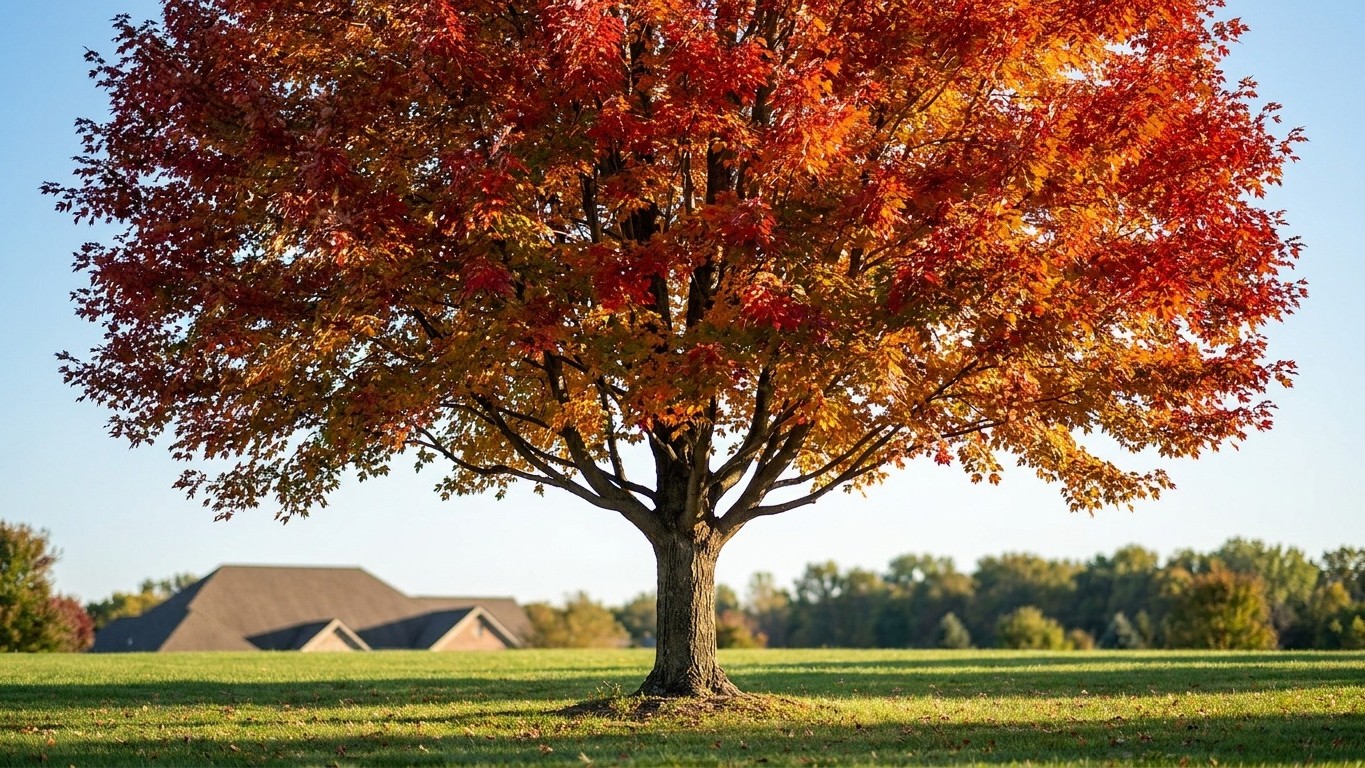

Acer saccharum, better known as Sugar Maple or Hard Maple, survives across USDA hardiness zones 3a to 8b, a band wide enough to cover most of the eastern half of the country. At maturity it needs 24 to 60 feet of clear space, sometimes more than 60, filling that space with a dense, oval canopy under full sun or partial shade. It’s a deciduous tree, classified by the extension source behind this data as native to the southeastern United States, and tapped each spring for sap that becomes maple syrup.
Where it will and will not survive

Sugar Maple survives across USDA hardiness zones 3a to 8b, but a hardiness range describes survival, not comfort. Sugar Maple is, at its core, a northern species. Pushed to zone 8b, it can hold on through a long hot summer without dying outright, but it may also thin out, color poorly in fall, and decline slowly over years. Below 3a, the opposite problem shows up: bark splitting, dieback on young growth, and root damage in winters with little snow cover for insulation.
Zone boundaries shift by county, elevation, and proximity to large bodies of water, so guessing from a state name alone is a bad habit worth breaking. Check your exact zone before planting anything long-lived, using a hardiness zone guide broken down by state rather than a national map alone.
Before locating this tree on a map, it’s worth being sure which tree the label actually refers to. Nurseries and catalogs use several common names for Acer saccharum interchangeably: Sugar Maple, Hard Maple, Northern Sugar Maple. One further name attached to it in some listings, Leucoderme, is worth a flag. That word properly belongs to Acer leucoderme, the chalk maple, a related but distinct species with its own smaller mature size and narrower native range. If a tag uses “Leucoderme” for a plant sold as Acer saccharum, ask the seller directly before buying.
The North Carolina Cooperative Extension source behind this data also classifies Sugar Maple as a Native Plant, meaning native to the southeastern United States in that source’s usage. That’s not the same claim as native to wherever a reader happens to be reading this from. A tree can be native to one region and still be a fine introduction elsewhere, as long as the hardiness zone lines up.
The mistake that costs the most: space
Sugar Maple needs 24 to 60 feet of space at maturity, and some specimens push past 60 entirely. That figure is the one most homeowners get wrong, because the consequence doesn’t show up on planting day. It shows up ten or fifteen years later, when a young tree that looked modest has grown into a canopy shading a roof, lifting a walkway, or crowding a foundation. At that point the fix isn’t a prune. It’s a removal, often an expensive one, undoing a decade of growth.
A tree with a mature spread in this range needs real distance from anything permanent: a house wall, driveway, septic field, underground utility line, overhead wires. A canopy that eventually reaches 40 or 50 feet across needs a root system spreading a comparable distance underground, competing with foundations and pipes for space and moisture as it matures.
Run these checks before digging
- Look up: note any overhead power or utility lines within the tree’s eventual height and spread, not just its current position.
- Look down: call for a utility locate so buried lines, pipes, and septic infrastructure are marked before the hole goes in.
- Measure the mature canopy spread from the planting spot in every direction, using the full range this tree is capable of, not the smallest figure.
- Track the sun path across the property and decide whether that future shade lands where it’s wanted, on a patio or south-facing wall, or where it isn’t, over a vegetable bed or solar panels.
- Check the distance to the foundation and any paved surface, since a root system that eventually matches the canopy’s spread will grow toward moisture wherever it finds it.
None of this requires guesswork. It requires treating the mature size as the real size of the tree, not the size it happens to be the day it comes home from the nursery. A sapling planted eight feet from a driveway looks reasonable for the first several seasons. It stops looking reasonable right around the time it stops being cheap to move.
The site it actually wants
Sugar Maple isn’t a fussy plant about site conditions, and the source data reads more like a list of what it tolerates than a single ideal setup.
| Condition | What Acer saccharum accepts |
|---|---|
| Light | Full sun (6 or more hours of direct sun) or partial shade (2 to 6 hours) |
| Soil texture | Clay, high organic matter, loam (silt), or sand |
| Soil pH | Acid (below 6.0) or neutral (6.0 to 8.0) |
| Drainage | Good drainage or consistently moist |
That spread across four textures and two pH bands is worth not flattening into a single line like “prefers rich loam.” A reader with heavy clay and a reader with sandy soil are both working with a texture this tree accepts, and neither needs to haul in different soil to make it work.
Checking your own site without equipment
Drainage is easy to test without buying anything: dig a hole about a foot deep, fill it with water, and see how long it takes to drain. Water still standing after several hours points to poor drainage, which matters most for a species that tolerates moist soil but still wants it to drain rather than sit stagnant around the roots. Soil pH is harder to eyeball, but a home test kit or a sample sent to a local extension office will place it in the acid or neutral range this tree accepts.
When a site doesn’t match, the fix usually isn’t amending the whole area, which rarely holds up over the decades a tree like this lives. It’s choosing the planting spot itself with more care, favoring the corner of the yard where drainage is already decent over the low spot where water pools every spring.
Planting it so it establishes
Getting a Sugar Maple past its first year or two is less about the species and more about a handful of steps that apply to any young tree. Skip one and the tree can look fine for a season before it doesn’t.
- Choose the planting window using frost timing for your area, following the frost guidance on this site rather than picking a calendar month by habit.
- Dig the hole wide, roughly two to three times the width of the root ball, but no deeper than the root ball itself.
- Find the root flare, the point where the trunk widens into roots, and keep it at or slightly above the surrounding grade.
- Tease out any roots that are circling the root ball before it goes into the hole, so they don’t keep growing in a circle and eventually girdle the trunk.
- Backfill with the same soil that came out of the hole rather than a different soil mix, so roots don’t hit an abrupt change in texture at the hole’s edge.
- Water deeply right after planting, then settle into a schedule of deep, infrequent watering rather than light daily sprinkling.
- Spread mulch in a wide, shallow ring around the base, keeping it several inches back from the trunk itself.
Two mistakes account for most of the young trees that fail to establish. The first is planting too deep, burying the root flare below grade, which slowly suffocates the roots and can take a year or more to show visible damage. The second is piling mulch against the trunk in a mound, sometimes called a mulch volcano, which traps moisture against the bark and invites rot at the base.
Sugar Maple’s tolerance for drought applies to an established tree with a root system that’s had years to spread. A tree in its first season hasn’t built that system yet, and it needs regular water through that first year regardless of what a plant label says about drought tolerance later in life.
What it resists, and what it does not
Resistance is a tendency, not immunity. A plant described as deer resistant is browsed less often than the plants deer prefer, not left completely alone. A hungry winter, a hungry local deer population, or simply a lack of better options nearby can turn a resistant plant into an occasional meal anyway.
| Challenge | What resistance means here | What you’d actually see |
|---|---|---|
| Deer | Browsed less often than preferred forage species | Occasional nibbling on low, young shoots, more likely in late winter when other food is scarce |
Growth rate for this species is listed as slow, which runs against the assumption some people carry about maples generally. A slow grower means a longer wait before the tree fills the space discussed earlier, but it also tends to build denser, sturdier wood along the way, which shows up later as fewer storm-snapped limbs compared with fast, weak-wooded growers. Maintenance is rated medium: routine cleanup of seed drop and leaf litter each fall, plus occasional pruning to keep the dense, oval habit in shape.
That canopy also does real work for wildlife. The source lists it as attracting butterflies, moths, pollinators, small mammals, and songbirds. Its samara fruit, the U-shaped, paper-winged seed pod familiar to anyone who’s watched maple seeds spin down in early summer, matures from green to brown and adds to that wildlife value. The sap is the part put to use, tapped and reduced into maple syrup, the one edible use the source records for this species.
Common questions
Is Acer saccharum the same tree as the one tapped for maple syrup?
Yes. The sap used for maple syrup comes from this species, and it’s the use the source data records for it directly.
Can Sugar Maple handle full shade?
The source lists its light tolerance as full sun or partial shade, meaning at least 2 hours of direct sun a day. Deep, all-day shade falls outside what the data supports.
Does “deer resistant” mean deer will never touch it?
No. It means deer browse it less often than plants they prefer, particularly young shoots. In a hard winter with little else available, that preference can change.
Why does mature size matter more than hardiness zone for most planting mistakes?
Because a tree outside its hardiness zone usually fails visibly and early, while a tree planted too close to a structure often looks fine for a decade before the space problem becomes impossible to ignore, and by then removal is the only real fix.