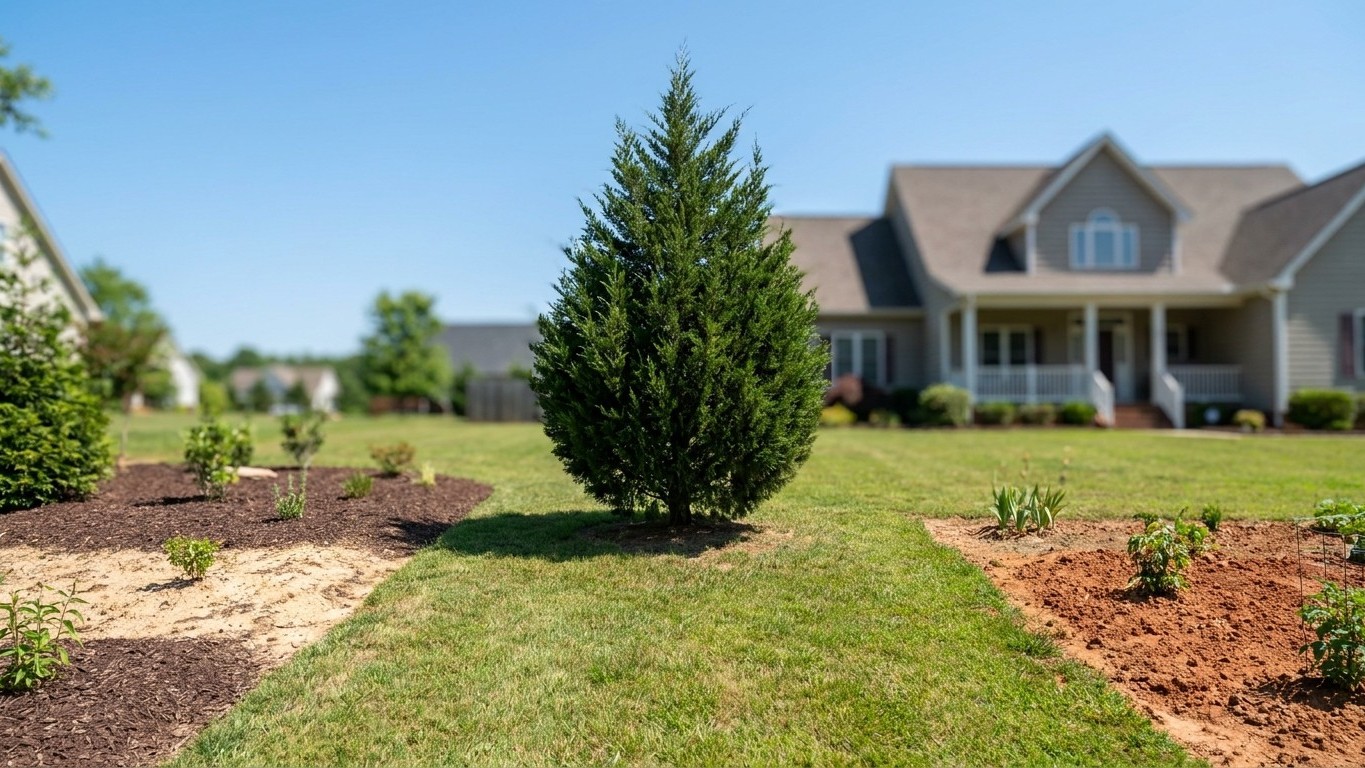

Juniperus virginiana, better known as Eastern Redcedar, survives across USDA hardiness zones 2a-9b, tolerates soils from heavy clay to pure sand, and grows into a dense, pyramidal evergreen that can range anywhere from a modest 12-foot windbreak shrub to a specimen well over 60 feet tall. It handles full sun or partial shade without complaint and asks almost nothing once established. What it does demand from whoever plants it is room, enough of it, before the trunk ever goes into the ground.
Where it will and will not survive

The USDA hardiness range for this species is 2a-9b, per the USDA Plant Hardiness Zone Map. That’s one of the widest ranges you’ll find on any landscape tree, and it tells you something specific. Below the bottom of this range, winter cold kills it outright. Above the top of it, the tree either doesn’t get the winter chill it needs or spends the growing season fighting heat stress that shows up as thin foliage and dieback rather than a clean failure in year one.
A range this wide is easy to misread as an invitation to plant it anywhere. It isn’t. Surviving a zone and thriving in it are two separate claims, and the USDA number only measures the first. A redcedar sitting at the very edge of 9b will likely make it through winter, but it may never fill out as densely as one planted in the middle of that span, where summers aren’t working against it on top of everything else.
Rather than guess where your property lands, check it. Zone lines shift with elevation, with nearby water, and sometimes within a single county, so a national map isn’t precise enough to bet a tree on. Hardiness zones break down by state and county, and matching your own number against 2a-9b is the first thing to settle.
The mistake that costs the most: space
The source lists three size classes this species can reach at maturity: 12-24 feet, 24-60 feet, or more than 60 feet. That spread isn’t sloppy data, it reflects how differently a redcedar develops depending on growing conditions over the decades. The practical takeaway is uncomfortable but simple: you can’t know in advance which class your tree will land in, so the only safe plan treats it as a candidate for the largest one.
This is also a dense, erect, pyramidal grower rather than an open, airy one. A tree that fills that shape solidly casts a heavier shadow and blocks more space than its trunk width suggests once the lower branches spread out. Ten or fifteen years in, a redcedar crowded against a wall isn’t a pruning problem anymore. Both the roots and the canopy are established by then, and cutting it back hard just leaves a lopsided tree instead of a smaller one. Removal, not a saw and a Saturday afternoon, becomes the fix.
Run this checklist before you dig
- Look up: note any wires or eaves within reach of a canopy that could eventually exceed 60 feet.
- Look down: have utility lines, septic fields, or irrigation piping marked before breaking ground.
- Measure out from the planting spot in every direction, using the largest size class as the space that canopy will eventually need.
- Track the sun’s path across the site to see which windows, beds, or neighboring plants fall into shade once the tree fills in.
The site it actually wants
This species isn’t picky, and the source’s data reads more like a list of what it tolerates than a single ideal setup. That’s genuinely useful, since most yards don’t offer the classic rich, loamy, full-sun combination other trees demand, and this one doesn’t need it.
| Condition | What it accepts |
|---|---|
| Light | Full sun (6+ hours direct) or partial shade (2-6 hours direct) |
| Soil texture | Clay, loam/silt, sand, or shallow rocky soil |
| Soil pH | Acid (below 6.0), neutral (6.0-8.0), or alkaline (above 8.0) |
| Drainage | Good drainage, moist, occasionally dry, or occasionally wet |
That table covers nearly every combination a residential lot is likely to offer, short of ground that stays waterlogged year-round. To get a rough read on your own site without lab equipment, dig a hole about a foot deep, fill it with water, and time the drainage. Gone within a few hours means good drainage; standing a full day later means the soil leans wet, something this species tolerates occasionally but not as a permanent condition. For pH, a basic home test kit through a county extension office will place your soil somewhere on that acid-to-alkaline scale, though given how wide a range this tree accepts, most residential soils won’t need amending before planting it at all.
Planting it so it establishes
Getting a young redcedar through its first year or two matters more than anything done afterward, and most failures trace back to two specific mistakes made at planting time.
- Choose the planting season using the frost timing guidance on this site rather than a fixed calendar month, since frost dates shift by zone.
- Dig the hole wide, roughly two to three times the width of the root ball, but no deeper than the root ball itself.
- Find the root flare, where the trunk widens at the top of the roots, and keep it level with or slightly above the surrounding grade.
- Loosen and tease out any roots circling the inside of the container before setting the tree in place.
- Backfill with the same soil that came out of the hole rather than swapping in amended soil, so roots don’t stall at the boundary between two textures.
- Water deeply right after planting, then settle into a schedule that soaks the root zone infrequently but thoroughly instead of a light daily sprinkle.
- Spread mulch two to three inches deep out to the edge of the canopy, keeping it pulled back several inches from the trunk itself.
The two mistakes that kill young trees
Planting too deep buries the root flare, and it can suffocate and rot quietly for a season or two before the tree fails to recover. Mulch mounded against the bark holds moisture where it doesn’t belong and does the same damage from a different angle, while also giving rodents cover to chew on the trunk over winter. Both are avoidable, and both are common.
The drought tolerance this species is known for applies to a plant that’s had a season or two to grow roots out into surrounding soil. A tree fresh out of a container hasn’t done that yet, and it needs regular deep watering through its first year no matter what the species label promises down the road.
What it resists, and what it does not
Resistance is a tendency, not a guarantee. Deer resistant means deer browse a plant less often than the ones next to it, not that they’ll never touch it, and a lean winter with little else available changes that math fast.
What the ratings actually mean
The source tracks four resistance categories for this species: deer, salt, drought, and poor soil. It doesn’t assign a specific rating to any of them for Eastern Redcedar. That’s worth stating plainly rather than guessing in either direction.
| Category | What’s known | What to expect |
|---|---|---|
| Deer | Not specified by the source | Watch for browsing, especially on young growth in winter |
| Salt | Not specified by the source | Don’t assume tolerance near roads treated with de-icing salt |
| Drought | Not specified by the source | Keep new plantings watered regardless of species reputation |
| Poor soil | Not specified by the source | The soil tolerance table above is the better guide here |
Growth rate and long-term size
Growth rate is listed as medium, maintenance as low, a pairing that tells you what the coming years look like without much guesswork. It won’t shoot up several feet a season, but it also won’t demand constant pruning or feeding to stay healthy. A medium grower with low upkeep still arrives at a large tree eventually, and that’s the same math from the space section coming back around: slow and steady still reaches 60-plus feet given enough time, gutters and power lines included.
The source also files this species under several labels at once: Native Plant, Perennial, Poisonous, and Tree. Native here refers to the southeastern United States specifically, not to wherever a reader happens to live, and Poisonous is worth knowing if pets or small children tend to sample the blue, frosted, berry-like cones the tree produces from September through February.
Common questions
What USDA zones is Eastern Redcedar hardy in?
It’s hardy across USDA zones 2a-9b, one of the broadest ranges given to any tree in this series. That range describes survival, not comfort throughout it, so check your own zone against this site’s hardiness zone guide before assuming it’s a fit.
How far from my house should I plant it?
The source gives mature size in three classes, topping out above 60 feet, without pairing that to a fixed setback distance. The safer approach is running the pre-planting checklist above and treating any spot near a wall, drive, or septic field as one to reconsider rather than a distance to measure precisely.
Is Eastern Redcedar deer resistant?
The source tracks deer resistance as a category for this species but doesn’t specify a rating either way. Don’t plant it assuming deer will leave it alone, especially where deer pressure is already heavy.
Can you make tea from the berries?
One historical field guide describes a method: placing a dozen young, berryless twigs in a quart of cold water, bringing it to a boil, then simmering for 10 minutes before straining and drinking in small quantities, as recorded in Angier’s 1974 Field Guide to Edible Wild Plants. That’s a specific historical use, not a general recommendation, and the plant data describes the cones only by appearance, not by taste or safety for eating raw.