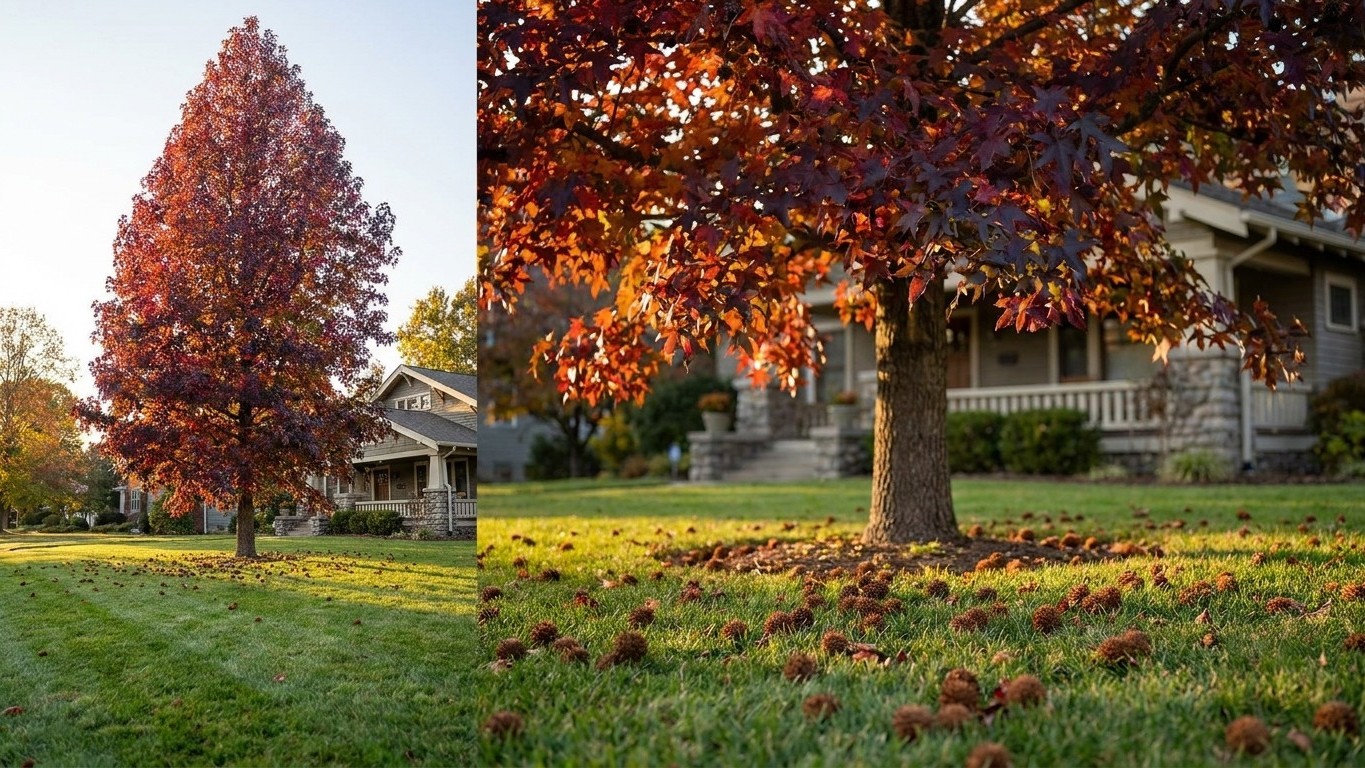

Sweetgum, also known as American Sweet Gum, Redgum, Red Sweet Gum, Sweetgum, Sweet Gum, or Sweetgum Tree, is a deciduous tree hardy in USDA zones 5a-9b. At maturity it needs more than 60 feet of space, grows at a rapid pace, and drops the spiky, hard “gum ball” capsules the species is known for. That combination, cold hardiness plus real size plus a fast growth rate, is what decides whether it belongs in a given yard. Here’s what each of those facts actually means once a spade is in the ground.
Where it will and will not survive

The USDA hardiness range for Liquidambar styraciflua is 5a-9b. That is a wide band as far as trees go, but a range is a survival window, not a comfort zone. A tree rated to the bottom of that scale is one that will live through a typical winter there, not necessarily thrive in every one of them, and the same caution applies at the top: 9b is the edge of what this species tolerates, not the middle of where it’s happiest.
What the range tells you plainly is what it rules out. Below the bottom of this range, in colder zones than 5a, this tree is not a reasonable bet; winter cold will kill it outright or cut it back so hard that “tree” stops being an accurate description. Above the top of it, past 9b, the opposite problem shows up, heat and winter chill requirements it doesn’t get, and a tree that struggles rather than settles in. Neither end is a judgment call worth guessing at from a map glanced at once.
The plant itself carries more than one label at the source that classified it: Native Plant, Perennial, Shrub, Tree. That’s an odd mix for a species that reaches well over 60 feet across, and it’s worth naming rather than smoothing over, since a “shrub” tag on a species this size is likely describing a different growth habit under cultivation or a labeling quirk rather than a second plant. Where the “Native” label applies is specific too: it means native to the southeastern United States, not native everywhere it happens to survive.
None of this replaces checking a real zone map for a real address. Hardiness zones shift by county, not by region, and the only way to know whether 5a-9b covers a specific property is to look it up rather than assume it from a state name. This site’s hardiness zone guide breaks zones down at that level, and it’s the more useful next step than any general description of “cold” or “warm” climates could be.
One more distinction matters here. The extension source behind these growing facts is based in North Carolina, and while the USDA hardiness figure it reports is a national standard, any regional planting advice tied to that state, coastal versus piedmont versus mountain guidance, is local to North Carolina conditions and doesn’t transfer to a different state’s soil, rainfall, or microclimate. The zone number travels. The regional advice does not.
The mistake that costs the most: space
The mature spread on this tree is listed plainly: more than 60 feet. Not “large for a tree,” not “give it room.” A specific number, and one that’s easy to underestimate when the tree in question is a two-foot whip from a nursery pot. Sixty feet of canopy width means a tree planted anywhere close to a house is going to touch that house eventually, and a tree planted under a utility line is going to grow into it.
This is the expensive mistake precisely because it doesn’t show up on day one. A sweetgum planted ten feet from a foundation looks perfectly reasonable for the first several years. The trouble arrives on a delay, once the crown has filled out and the roots have spread to match it, and by then the fix isn’t a prune, it’s a removal. Roots that started as a manageable spread near the trunk end up pressing on a foundation, a drive, or a septic line a decade or more after the fact, and a rapid grower (which this one is) gets there faster than a slow one would.
The tree’s own growth habit compounds the problem. It’s described as Pyramidal to Spreading, meaning the canopy doesn’t stay narrow and upright as it ages; it widens, and a spreading canopy at 60-plus feet casts a very different shadow than a narrow one would across a patio, a garden bed, or a neighbor’s yard.
Before digging, run through these checks in order:
- Look up: note any overhead utility lines and how far the mature canopy would reach toward them.
- Look down: identify septic fields, buried utility lines, or a foundation footing anywhere near the planting spot.
- Measure the radius: at more than 60 feet of mature spread, the tree needs roughly 30 feet of clearance in every direction from its trunk to avoid crowding structures.
- Track the sun: figure out which direction the canopy will eventually shade, and whether that shade will fall on a garden, a solar panel, or a neighbor’s window.
None of that is complicated math. It’s just math that has to happen before the shovel, not after the tree is thirty feet tall.
The site it actually wants
The growing conditions on record for this species read less like a single ideal spot and more like a range of what it tolerates. That’s a useful distinction: a plant that accepts several soil textures and both wet and dry spells isn’t a plant that “likes rich loam” in the way a fussier species might. Here’s what the source reports it will grow in.
| Condition | What it tolerates |
|---|---|
| Light | Full sun (6+ hours direct) or partial shade (2-6 hours direct) |
| Soil texture | Clay, loam/silt, or sand |
| Soil pH | Acid (below 6.0) or neutral (6.0-8.0) |
| Drainage | Good drainage, moist, occasionally dry, or occasionally wet |
That spread across four categories, clay to sand, acid to neutral, dry spells to wet spells, is wider tolerance than most ornamental trees get credit for. It doesn’t mean the site doesn’t matter; it means the tree isn’t picky about which of these conditions it lands in, as long as it lands in one of them rather than something outside the list, like standing water year-round or a strongly alkaline soil well above pH 8.
Checking a site without a lab
Soil texture is easy to gauge by hand: squeeze a moist handful into a ball. If it holds a tight ribbon shape, that’s clay-leaning; if it falls apart immediately and feels gritty, that’s sand; something in between that holds loosely is loam. Drainage is just as low-tech to test: dig a hole about a foot deep, fill it with water, and see how long it takes to empty. Water gone within a few hours points to good drainage; standing water after half a day points to a wetter site, which this tree can still handle on the “occasionally wet” end but which pushes toward the tolerant range rather than the ideal middle of it.
Soil pH is harder to eyeball, but a basic home soil test kit or a sample sent to a local extension office answers the question directly, and it’s worth doing once before planting rather than guessing. If a site falls outside acid-to-neutral, meaning strongly alkaline soil, that’s the one condition on this list the species isn’t reported to tolerate, and it’s worth reconsidering the spot or the species rather than the soil.
Planting it so it establishes
Getting a young sweetgum through its first year or two in the ground matters more than almost anything done afterward. Most of what kills a new tree happens at planting, not later, and it happens for the same two or three avoidable reasons every time.
- Pick the season using frost timing, not a calendar month. This site’s frost date guide gives the actual last and first frost windows for a given area; planting around those windows, rather than a fixed month that might apply three states away, gives roots time to settle before extreme heat or hard freeze.
- Dig the hole wide, not deep. A hole two to three times the width of the root ball, but no deeper than the root ball itself, encourages roots to spread outward into loosened soil rather than downward into a narrow shaft.
- Find the root flare before setting the tree. The point where the trunk widens into roots should sit at or slightly above the surrounding grade, not buried under it.
- Tease out any circling roots. Roots that have wrapped around the inside of a nursery pot will keep circling underground unless they’re gently loosened and spread outward before backfilling.
- Backfill with the same soil that came out of the hole. Heavily amended backfill can create a bowl effect that holds water against the roots or discourages roots from ever growing into the native soil beyond it.
- Water deeply and infrequently rather than a little every day. A slow, deep soak encourages roots to grow down and out searching for moisture; frequent shallow watering keeps roots near the surface.
- Mulch in a ring that stops well short of the trunk. A two- to three-inch layer over the root zone, with bare space right at the bark, holds moisture without inviting rot or pests at the trunk base.
The two mistakes worth naming outright, because they’re the ones that quietly kill young trees years after planting looks like it went fine: planting too deep, so the root flare sits buried and the trunk essentially suffocates below grade, and piling mulch up against the bark in a “mulch volcano,” which traps moisture against the trunk and invites decay. Both are completely avoidable and both are common.
One more point worth being blunt about: this species is reported to handle occasional dry spells once established, but that tolerance describes a mature root system, not a tree planted six months ago. A first-season sweetgum needs regular, deep watering regardless of what the established plant can shrug off later.
What it resists, and what it does not
Resistance, on any plant label, means a tendency to be bothered less often, not immunity. A “deer resistant” plant still gets nibbled in a hard winter when little else is green; a “drought resistant” plant still needs water as a young tree, as covered above. That distinction matters more here than usual, because several resistance categories are tracked for this species, deer, fire, heat, drought, rabbits, and soil compaction, but no rating is given for any of them. That’s worth stating plainly rather than guessing in either direction: no resistance claim on those fronts is confirmed for this species in the source, so none should be assumed.
| Category tracked | What the source specifies | What that means for a reader |
|---|---|---|
| Deer | Unspecified | No confirmed resistance rating; treat it as unknown rather than assuming either browsing or immunity |
| Fire | Unspecified | No confirmed rating available |
| Heat | Unspecified | No confirmed rating available |
| Drought | Unspecified | No confirmed rating available |
| Rabbits | Unspecified | No confirmed rating available |
| Compaction | Unspecified | No confirmed rating available |
What is confirmed is the growth rate and maintenance level, and those two facts together tell the more useful story for anyone planning years ahead. The rate is listed as Rapid, and maintenance as Low to Medium. A rapid grower reaches its footprint sooner than a slow one, which circles back to the space question: gutters, roof lines, and foundations feel the effects of a fast-growing 60-foot-plus canopy on a shorter timeline than they would with a slower species. Maintenance staying in the low-to-medium range mostly reflects pruning and general upkeep once established, but it doesn’t cover cleanup.
That cleanup is worth planning for directly. The tree’s fruit, the well-known “gum ball,” is a hard, spiky capsule one to three inches across that forms in late summer, matures to dark brown, and typically stays on the tree through winter before dropping in clusters roughly from December through April. Those capsules attract birds, and the tree overall is noted for drawing moths, pollinators, and small mammals as well, but the same fruit drop that feeds wildlife is also the seasonal cleanup job that shows up every year once the tree is old enough to fruit. It’s a fair trade for some yards and a genuine annoyance for others, worth weighing against the tree’s size before it’s fifteen years too late to change course.
Common questions
Is Liquidambar styraciflua the same as sweetgum?
Yes. Sweetgum, Sweet Gum, Sweetgum Tree, American Sweet Gum, Redgum, and Red Sweet Gum are all common names used for the same species, Liquidambar styraciflua; none of them is the single “official” name, they’re simply names different regions and sources use.
How far should a sweetgum be planted from a house?
The source gives a mature spread of more than 60 feet, which points to roughly 30 feet of clearance in every direction from the trunk to keep the canopy and root system away from a foundation, drive, or septic field as the tree matures.
Does sweetgum need full sun?
It accepts either full sun (six or more hours of direct light) or partial shade (two to six hours), according to the growing conditions on record, so a site doesn’t need all-day sun to work.
Why does sweetgum drop hard, spiky balls everywhere?
Those are the tree’s fruiting capsules, one to three inches across, which form in late summer, stay on the tree through winter, and fall in clusters mostly between December and April, a known seasonal cleanup task tied to an otherwise low-to-medium maintenance tree.