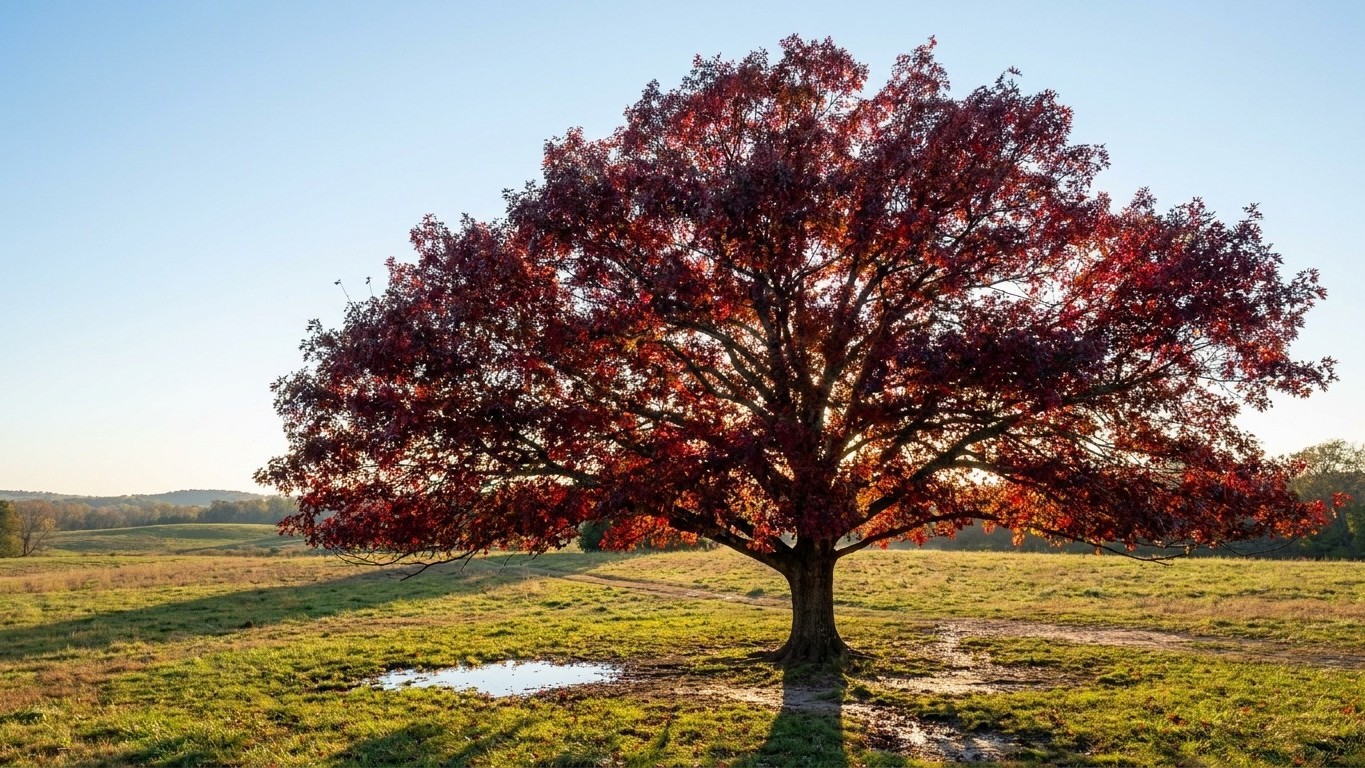

Nyssa sylvatica, sold under names like Blackgum, Black Tupelo, Sour Gum, or Pepperidge, survives USDA hardiness zones 4a through 9b, accepts clay, loam, and sand, and tolerates soil that floods on occasion or dries out between rains. At full size it spreads 24 to 60 feet, a footprint that rules out most foundation plantings and narrow side yards. It’s classified as a native tree of the southeastern United States, deciduous, slow to demand attention once established, and far better suited to open ground than to a spot ten feet from a driveway.
Where it will and Will Not Survive
The USDA range for this species is given as zones 4a-9b. Read that as a boundary, not an invitation. Below the bottom of this range, in colder zones than 4a, winter will kill it outright, no siting trick or wrap will change that. Above the top of it, past zone 9b, the summers run hotter and longer than the tree is built to handle, and it will decline even with regular water.
Inside 4a-9b, survival is not the same as comfort. A tree rated to the warm edge of its range can limp through a 9b summer rather than thrive in it, and one planted at the cold edge of 4a may survive most winters but get set back hard in the occasional brutal one. The range tells you the tree won’t necessarily die where you live. It doesn’t tell you it will look its best there.
This brief draws on data from the North Carolina Extension Gardener Plant Toolbox, and that source’s regional notes, when it gives them for its own coastal, piedmont, and mountain zones, apply to North Carolina alone. The USDA hardiness figure is the one piece that travels everywhere. Everything else about that source’s regional fit stays local to where it was written.
The practical step before planting anything is finding your own zone rather than assuming it from a map glanced at once. Zone lines shift block to block in hilly terrain, and a valley floor can run a full zone colder than a ridge a mile away. Check the hardiness zone guide on this site for your specific location before you decide this tree, or any tree, belongs in your yard.
The mistake that costs the most: space
The source lists space at maturity in two figures: 12 to 24 feet, and 24 to 60 feet. That’s not an error in the data, it reflects a tree with real variation in habit. This species grows columnar, irregular, open, pyramidal, rounded, or spreading, depending on the individual and the conditions it gets, and a columnar specimen simply doesn’t need the room a rounded, spreading one does. Plan for the wider number unless you know you’re getting a narrower form. Guessing low is the expensive guess.
Here’s why it costs so much: the mistake doesn’t show up on planting day. It shows up ten or fifteen years later, when a young tree that looked modest against the house has turned into a canopy pressing against the siding, lifting the walkway, or tangled in the service line. At that point the fix isn’t pruning, it’s removal, and removing a mature tree costs far more than the ten minutes it would have taken to measure the site correctly at the start.
Before digging, run through this in order:
- Look up: note any overhead wires or eaves the canopy could reach at 60 feet across.
- Call before you dig, to mark buried utility lines, septic fields, or irrigation piping under the planting area.
- Measure out the mature spread from the trunk in every direction, and check what sits inside that circle: a wall, a drive, a fence, a neighbor’s foundation.
- Track the sun’s path across that spot and decide whether the shade a 60-foot canopy casts will fall where you want it, or across a garden bed that needs the light.
None of this is complicated. It just has to happen before the shovel, not after the tree is thirty feet tall.
The site it actually wants
The source doesn’t describe a single ideal condition for this tree. It describes a range of what the plant tolerates, and that range is wider than most trees get credit for.
| Condition | What it accepts, per the source |
|---|---|
| Light | Full sun, 6 or more hours of direct sunlight a day |
| Soil texture | Clay, loam (silt), or sand |
| Soil pH | Acid (below 6.0) or neutral (6.0-8.0) |
| Drainage | Good drainage, moist, occasional flooding, occasionally dry, or occasionally wet |
That last row is the one worth sitting with. A plant that tolerates both occasional flooding and occasionally dry ground isn’t asking for a perfectly drained, evenly moist bed engineered around it. It’s asking for a spot that isn’t at either extreme all the time, and it has some room to forgive a wet spring or a dry August.
You can check your own site without lab equipment. For drainage, dig a hole about a foot deep, fill it with water, and see how long it takes to empty; standing water after several hours signals slow drainage, while water gone in under an hour signals fast, sandy drainage. For pH, a basic home soil test kit, available at most garden centers, gives a rough acid-to-neutral reading, which is all this species needs to fit the range above. If your spot runs outside acid-to-neutral pH, or sits in full shade rather than the six-plus hours of sun this tree wants, pick a different spot rather than fight the soil with amendments.
Planting it so it establishes
Getting a young tree through its first year or two matters more than almost anything you do afterward. Follow these steps in order:
- Choose the planting window using the frost guidance on this site for your area, rather than a fixed calendar month.
- Dig the planting hole wide, two to three times the width of the root ball, but no deeper than the root ball itself.
- Find the root flare, the point where the trunk widens into roots, before you set the tree in the hole.
- Keep that root flare at or slightly above grade. Planting too deep is one of the two mistakes that kills young trees, and it’s not obvious until the roots have already suffocated.
- Tease out any roots that are circling the root ball so they grow outward into the surrounding soil instead of strangling the trunk years later.
- Backfill with the same soil that came out of the hole, without swapping in imported topsoil that creates a soft-walled bathtub effect around the roots.
- Water deeply and infrequently rather than a light daily sprinkle, so moisture reaches the full depth of the root zone.
- Mulch two to three inches deep out to the edge of the canopy, keeping it pulled back from the trunk. Mulch piled against the bark is the second tree-killing mistake, trapping moisture against the trunk and inviting rot.
One more thing worth saying plainly: this tree is generally tolerant of dry soil once it’s established, but that tolerance doesn’t apply to a tree in its first season. A newly planted tree has almost no root system reaching beyond its original root ball, and it needs consistent water through that first year regardless of what the mature plant can handle later.
What it resists, and what it does not
Resistance, as used here, means a tendency, not a guarantee. “Deer resistant” means deer browse it less often than they browse a plant they favor, not that deer will never touch it, and a hard winter with little else to eat can change that math fast. The same logic applies to every entry below.
| Challenge | What resistance means here | What you’d actually see |
|---|---|---|
| Deer | Browsed less often than preferred species | Occasional nibbling, especially on young growth, more likely in a hard winter |
| Drought | Applies to an established tree only | Reduced watering need after the first year or two, not the first season |
| Wet or dry soil | Tolerates swings between the two | Handles an occasionally soggy or occasionally parched spot without major stress |
| Fire, heat, salt, wind, pollution | Listed as tolerated stresses | Fewer setbacks from roadside salt spray, urban air, or exposed windy sites than a less tolerant species |
| Black walnut | Tolerant of growing near it | Can be planted where juglone-sensitive species would struggle |
Growth rate is listed as medium, and maintenance as low. That combination predicts a fairly calm decade ahead: not the fast, weak growth of a tree racing to fill space and dropping limbs as it goes, and not much pruning or feeding demanded along the way. But medium growth over enough years still adds up to the full 24-to-60-foot spread eventually, so the low-maintenance label describes the tree’s needs, not the space it will eventually occupy.
Common questions
Is Nyssa sylvatica the same tree as Tupelo?
Tupelo, Black Tupelo, and Common Tupelo Tree are among the common names used for this same species, alongside Blackgum, Sour Gum, and Pepperidge. None of these names is more “official” than another; the botanical name is the one fixed point.
Does it produce edible fruit?
Female trees produce small bluish-black drupes, 3/8 to 1/2 inch long, with thin, bitter-smelling flesh around a ribbed seed. The source describes the fruit as edible but sour, eaten raw or cooked, and notes the tree’s flowers produce a honey that beekeepers prize highly.
Does it need a male and female tree to fruit?
Only female trees bear the drupes described above. Without a source detailing pollination requirements beyond that, plan on female trees for fruit and don’t count on a single tree of unknown sex to produce it.
What does “Native Plant” mean for this species?
In this source’s classification, native refers to the southeastern United States, not to every region where the tree can survive under its hardiness range. A tree can be perfectly hardy well outside that native area without being native there.