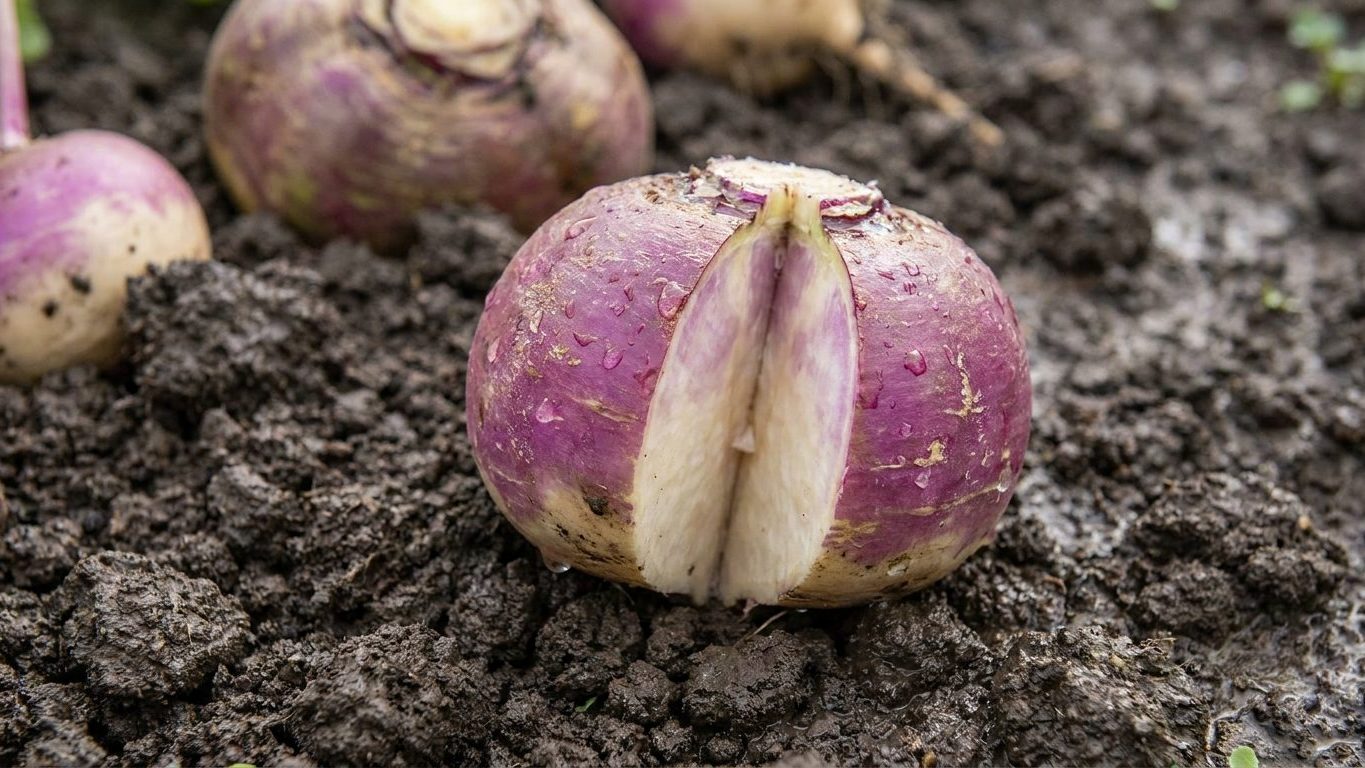

Split turnip and rutabaga roots almost always come down to water, not a pathogen. The skin stops stretching during a dry spell, growth resumes fast after rain or irrigation, and the root’s inside outpaces what the surface can hold. Most cracked roots are still fine to eat once you’ve checked them, but the crack itself is a warning sign worth reading correctly.
What is actually going on
The mechanism is turgor pressure, the same force that makes a stalk go limp when it’s thirsty and rigid when it’s not. A turnip or rutabaga root is mostly water held inside cell walls, and that water pressure is what gives the root its shape and firmness. When soil moisture is steady, the root grows at a pace where the outer skin keeps expanding right along with the flesh underneath it. Nothing tears.
Trouble starts when growth stalls. A stretch of dry weather, or a gardener who’s been busy and skipped watering for a week or two, slows the root down. The skin doesn’t just pause, it starts to toughen and set, the way a scab hardens over a wound. Then the rain comes back, or the hose gets picked up again, and the root takes in water fast. The inside swells. The outside, already stiffened, can’t keep up. It splits, usually along the shoulder or straight down the side where the growth pressure is highest.
This is why cracking shows up more in years with a wet spring, a dry midsummer, and then a wet fall than in years where the weather just stays consistently damp or consistently dry. It’s the swing that does the damage, not either extreme on its own. A root that’s been evenly moist all season, even if that season was on the dry side overall, is far less likely to split than one that bounced between drought and downpour.
Turnips and rutabaga are brassicas, in the same family as cabbage, kale, broccoli and mustard, and that matters here even though cracking itself isn’t a disease. A split root heals over with a callus in dry conditions, but in wet, humid conditions that opening is an entry point for rot organisms and for some of the same pests that trouble the rest of the cabbage family. That’s one more reason these roots need to sit in a rotation plan built around brassicas as a group, not planted wherever there happens to be open ground. If you’ve grown cabbage, kale or mustard in a bed recently, that bed is still carrying brassica-specific pressure, and a split root there is more exposed than one grown where no brassica has been for a few years. The crop rotation guide in this series lays out how to sequence brassica beds properly.
In the garden
The practical question for most gardeners isn’t why the crack happened, it’s what to do about the watering pattern that caused it, and whether the split root sitting in the ground right now is worth pulling. Both answers depend on the pattern, so it helps to look at the common ones side by side.
| Watering pattern | What happens to the root | What to do instead | What happens if you don’t fix it |
|---|---|---|---|
| Long dry stretch, then heavy rain or a deep soak | Skin toughens during the dry spell, then splits when growth resumes fast | Water on a set schedule rather than reacting to how the soil looks that day | Cracking repeats every time the weather swings, and splits deepen with each cycle |
| Light, frequent sprinkles that never reach the root zone | Surface stays damp, deeper soil dries out, root grows unevenly | Water less often but more deeply, enough to reach several inches down | Roots stay small and misshapen even without visible splitting |
| Overwatering right after a dry period, all at once | Same swelling problem as rainfall, just caused by the gardener instead of the weather | Ease back into a regular schedule gradually instead of one big catch-up soak | A single dramatic split can open the crown enough for rot to set in within days |
| Consistent moisture held by mulch | Skin and flesh expand together, little to no cracking | Keep a mulch layer in place through the swelling stage of root growth | Not applicable, this is the target pattern |
As for whether a cracked root is worth lifting, the answer is usually yes, with inspection first. A dry, shallow crack that’s calloused over with no discoloration is a cosmetic issue. Trim the split area, use the root promptly, and don’t count on it for long-term storage the way you would an intact root. What ends the conversation is anything soft to the touch, any spot that’s weeping or slimy, or a crown that shows mold. Those roots go to the compost pile, not the kitchen. Looking sound on the outside isn’t the same as being sound all the way through, especially once a crack has been open for a while in damp soil.
Because turnips and rutabaga share pest pressure with the rest of the brassica family, a cracked root sitting in wet ground is also more likely to attract root maggots or invite the same fungal issues that show up on cabbage and kale. Checking cracked roots more often than you check intact ones, and pulling them sooner rather than leaving them to size up further, cuts down on that risk.
What it depends on where you are
How much cracking a garden sees in a given year is only partly about watering habits. The rest is climate, and that part is genuinely local. Season length changes how long a root sits in the ground gaining size, and a longer window gives more opportunities for a dry-then-wet swing to happen at all. Gardens with a short, cool season often pull their roots before that kind of swing has time to do damage, while gardens with a long fall growing window are exposed to it for longer.
Summer heat plays its own role, mostly by drying soil out faster and making the gap between waterings feel shorter than it actually is. A schedule that keeps soil evenly moist in a cool, humid region can leave soil bone dry within days in a hot, low-humidity one, even with the same watering frequency. Summer rainfall patterns matter just as much. A region that gets brief, heavy downpours after dry stretches is set up for exactly the cracking pattern described above, while a region with steady, moderate rain through the season tends to see less of it, all else being equal.
None of that is something a single national page can pin down with any honesty. A statement like “water twice a week” means something different in a humid coastal climate than it does in a dry inland one, and a planting calendar that works in one growing zone can be off by weeks in another. This is where the state-level guides in this series come in, since they’re built around the season length and rainfall pattern of a specific place rather than a national average. For the underlying zone data those guides draw on, the USDA Plant Hardiness Zone Map is the standard reference. Beyond that, a local cooperative extension office is the best source for which varieties have actually been trialled in your area and how they’ve performed on cracking specifically, since that’s tested locally, year over year, in a way no general article can replicate.
The mistake that costs the most
The single costliest habit is letting soil dry out fully between waterings and then making up for it with one big soak, whether that soak comes from a hose or from the weather. It feels efficient. It’s the opposite. Every one of those catch-up cycles is a chance for the root to toughen its skin and then get hit with a growth spurt it can’t absorb gracefully, and repeated cycles don’t just cause one crack, they can cause several on the same root over a season.
The fix isn’t a different variety or a special feeding routine, and it isn’t a fixed number of days between waterings that a page like this could hand out without knowing your soil or your climate. It’s consistency, backed by something that buys you margin for error: a few inches of mulch over the root zone. Mulch slows evaporation enough that a missed watering day or two doesn’t tip the soil from moist to dry, which is exactly the swing that causes splitting in the first place. Pair that with a watering routine you follow on a schedule rather than one you improvise based on how dry the top inch of soil looks, since the top inch dries out long before the root zone does.
If cracking has already happened, the move isn’t to panic and start watering heavily to “fix” it, since that only repeats the same swelling problem that caused the split. Hold the current moisture level steady, inspect the roots regularly for softness or weeping, and lift anything that shows those signs before it has a chance to spread rot into neighboring roots. And because these are brassicas, keep the bed’s history in mind for next season. A bed that’s carried cabbage, kale, mustard or another turnip crop in the past year or two is already working against you before you’ve watered it once, regardless of how carefully you manage moisture from here.