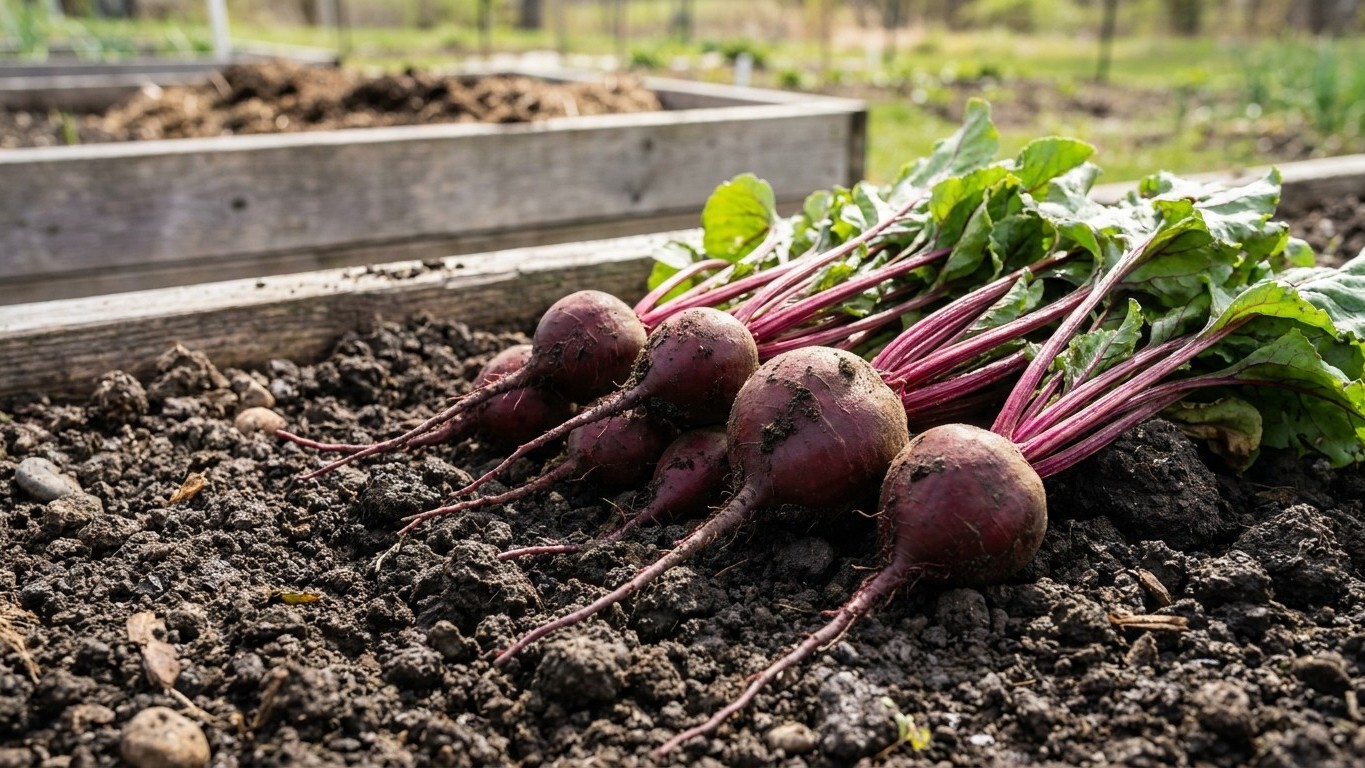

Count 60 to 80 days from the day the seed goes into the ground. Beets are sown in place and never transplanted, so the clock starts at seeding. At the Sioux Falls reference station, a spring sowing puts the first roots ready from early June into mid July. Pull on the early side of that window, then store the keepers at 33 to 36 F. Colder is not better. Beets held at 32 to 34 F develop more black spot and rot than beets held slightly warmer.
The short answer
Start with the ground. South Dakota’s official state soil is the Houdek series, a Mollisol: the deep, dark prairie soil of the kind that built the Corn Belt. USDA NRCS records its surface layer, across 90 mapped components, at 38 percent sand, 22 percent clay and 40 percent silt, which sits in the loam-to-silt range. Surface pH runs about 6.7, near neutral. Organic matter is about 3.0 percent. The drainage class is well drained.
Here is what that means for a beet. Utah State University Extension describes the crop’s wish list as deep, sandy, well-drained soil rich in organic matter. Houdek meets the drainage and depth parts and sits comfortably near neutral. It is siltier and less sandy than that ideal, but 22 percent clay is modest, so water moves through instead of pooling around the root. The flip side of good drainage is that thirst shows up on schedule when rain skips a week. Extension is specific about the cost: water stress in the first six weeks causes premature flowering. The same source caps compost at no more than 1 inch of composted organic matter per 100 sq ft, so a 3.0 percent soil needs a light top-up, not a deep fill.
A state spans hundreds of soil series, and this is a starting point, not a diagnosis. The figures are representative values for the surface horizon of the series as mapped, not a reading from a worked garden bed. River bottoms, hill country and any lot a builder has scraped or filled will behave differently. Treat the numbers as a picture of what the region’s ground tends to do, then get your own result from a soil test. The Beet Soil in South Dakota: What the Root Will Meet page walks through what to do with that number.
Heat is the second half of the answer, and it is a different problem from early thirst. The count of days a year the reference station passes 90 F is not published here, so I won’t guess at one. Your nearest station’s record will have it. What the source does give is the threshold: heat above 85 F combined with water stress makes the root woody. A 90 F day is already well past that line. Bolting from early thirst and woodiness from later heat are two separate failures, and a pulling date has to dodge both. For the wider picture on the crop, see Growing Beets in South Dakota.
The six weeks that decide it here
April 29 to May 9. That is the last-spring-frost range at the reference station, taken from NOAA NCEI Climate Normals for 32 F freeze probabilities (the 30 to 70 percent band). It comes from one airport weather station, not from your garden. Suburban and rural plots typically see the last spring frost one to two weeks later, and more at elevation, so check your own county before you lock in a date.
Sowing 2 to 3 weeks before that last frost puts seed in the ground from roughly April 8 to April 25 at the reference station. That is simple arithmetic on the frost range, and it means the first six weeks of a beet’s life run from mid-April to early June. Those weeks sit in the least settled stretch of a South Dakota spring. Warm spells give way to cold snaps, wind strips moisture from the top inch of soil faster than a calendar suggests, and rain tends to arrive in bursts instead of steady, soaking amounts. This page carries no rainfall figures, so treat that as the usual character of a Northern Plains spring, not a forecast.
That is where the bolting risk sits. A dry, breezy stretch in May, with the seedlings only a few weeks old, is the trigger. The Houdek-type soil drains well, which makes the problem sharper: the bed that never floods is also the bed that dries out between rains. A cold, wet April has its own cost, since seed sits in cold ground and germinates unevenly, but the premature flowering Extension warns about comes from thirst, not chill. Beets sown into a May that turns dry are the ones to watch.
Now run the clock forward. Seeds sown April 8 to April 25 and counted at 60 to 80 days point to pulling from early June to about mid July. The back half of that window overlaps the weeks when heat above 85 F becomes ordinary. A root left idle in the ground through a July run of 90 F days, with the soil drying out beneath it, is the one that turns woody. My read is that the early end of the window is the safer target: sow at the front of the 2-to-3-week range, water steadily through the first six weeks, and pull while the weather is still on your side.
Counting from seeding matters more than it sounds. A gardener who counts from the day seedlings “looked established” will add weeks and drift into the hot stretch. Mark the sowing date on the calendar and count from there. The page does not carry a fall freeze date for the reference station, so any later sowing needs a check against your own county’s records.
What goes wrong here
- Bolting after a dry spring. Water stress in the first six weeks causes premature flowering, and a windy May dries a well-drained silt loam fast. Keep the seedbed evenly moist from sowing through the sixth week, and check it after any drying wind instead of trusting last week’s rain.
- Woody roots in July. Heat above 85 F with water stress is the cause, and it is a separate failure from bolting. Pull at the early end of the 60-to-80-day range, and water deeply and regularly once summer heat arrives, so the root never sits stressed.
- A thirsty or crusted seedbed. The ground is siltier than the sandy ideal, so a hard rain followed by sun can leave a surface skin over the seed row. Work in no more than 1 inch of composted organic matter per 100 sq ft, and run a soil test, because your bed may not resemble the state soil at all.
- Tops chewed before the root is ready. Leaf loss can look like a weather problem when an insect is the cause. Before changing your watering, read What Eats Beet in South Dakota, and When to match the damage to the culprit and the season.
- Black spot and rot in storage. Colder is not better. USDA Handbook 66 says more black spot and rot occur at 32 to 34 F than at slightly higher temperatures, and sets topped roots at 33 to 36 F and 98% relative humidity. Cellars and pits should stay between 31 and 41 F. Check them with a thermometer, not a guess.
- Bunched beets going soft. Roots stored with their leaves last about 10 to 14 days at 32 F and above 98% relative humidity, and no longer. Top them first, and use any bunched beets within that fortnight.
- Small roots shriveling in the cellar. Handbook 66 notes that large roots keep much better than small ones because they lose water and shrivel more slowly. Save the big roots for storage and eat the small ones first.
Common questions
How many days do beets take in South Dakota?
The range is 60 to 80 days, counted from seeding, not from a transplant. Sown in place from roughly April 8 to April 25 at the reference station, that points to early June through about mid July. Cooler gardens and later last frosts push the dates back, so adjust for your own county.
Is a colder fridge or cellar better for storing beets?
No. USDA Handbook 66 puts topped beets at 33 to 36 F and 98% relative humidity, and reports more black spot and rot at 32 to 34 F than a little warmer. A pit or cellar should stay between 31 and 41 F. The handbook is free to read.
Which beets should I store, and which should I eat first?
Store the large roots and eat the small ones first, since small roots lose water and shrivel faster. Top the roots before storing. Bunched beets with leaves on keep only 10 to 14 days.
Does the state soil description apply to my garden?
Only as a starting point. The Houdek figures are USDA’s representative surface values for one series, and South Dakota has hundreds. River bottoms, hill country and builder-disturbed ground can differ completely. Get a soil test for your own pH, texture and organic matter before you amend anything.