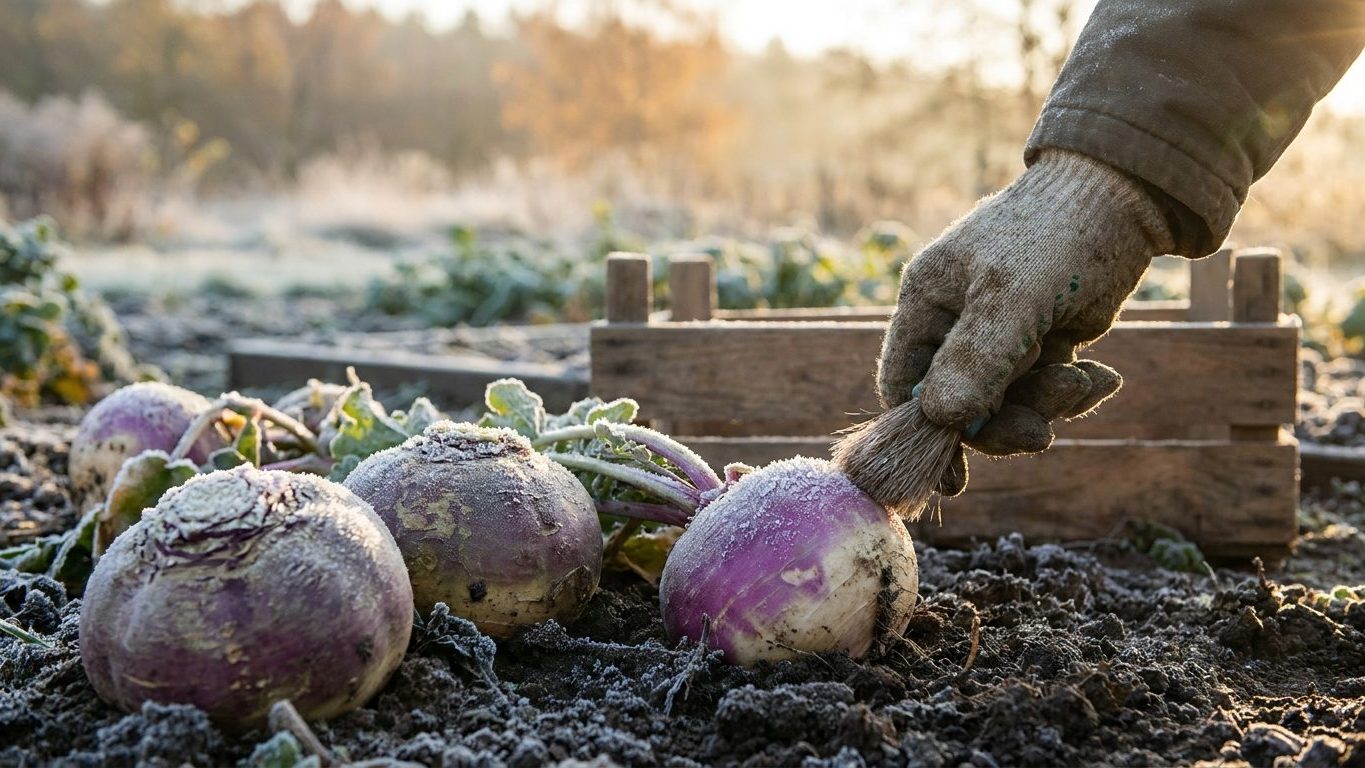

Leaving Turnips and Rutabaga in the ground through the season’s first frosts is not neglect. It is one of the best flavor moves a root grower can make. Cold nights push the plant to convert stored starch into sugars, turning a flat, watery root into something sweeter and more complex. The catch is timing: too little cold does nothing, too much does damage. The rest of this page is about finding that window.
What is actually going on
A turnip or rutabaga sitting in the soil in October is not just marking time. It is a living storage organ, and storage organs respond to cold the same way a car battery responds to a drop in temperature: chemistry slows down, but not all of it slows evenly. As soil temperatures fall toward the point where ice could form in plant tissue, the root starts breaking down some of its stored starch into simple sugars, mainly glucose, fructose, and sucrose. Sugar-rich cell fluid freezes at a lower temperature than plain water, so this conversion works like a natural antifreeze. The plant is not doing this for the cook’s benefit. It is trying to survive a freeze. The sweetness is a side effect that happens to be very good news on the plate.
This is why a rutabaga pulled in warm September weather tastes duller and more one-note than the same root left in the ground for a few weeks of cooling nights. The starch is still starch. Once several frosty nights have passed, a meaningful share of that starch has become sugar, and the flavor reads rounder, less bitter, with more of the nutty sweetness people associate with a good fall root.
None of this depends on a particular variety. Turnip and rutabaga types on the market today all carry this cold response, because it is a basic feature of the brassica family, not a trait bred into a handful of named cultivars. If you want to know which specific varieties perform best for flavor and storage in your region, that is a question for your state’s cooperative extension service, not for a general guide like this one, since regional trial results vary and naming a cultivar here without local data would be a guess dressed up as advice.
One thing this frost-sweetening story does not change: turnips and rutabaga are brassicas, in the same family as cabbage, kale, and mustard. They share the same soil-borne diseases and the same pest pressure, including root maggot and clubroot organisms that persist in soil for years. A gardener who lets these roots sit in the ground into late fall in a bed that grew cabbage or kale earlier the same season, or the season before, has not given the crop any rotation break at all. The extra weeks of frost exposure that build sweetness also mean extra weeks of exposure to whatever pest or disease pressure exists in that soil. See the rotation guide on this site for how to plan brassica beds so this crop isn’t quietly working against itself.
In the garden
The honest answer to “how much cold is enough” is that it depends on degree and duration, not a single magic night. A light frost, the kind that leaves a thin white coating on the leaves at dawn and melts within an hour, is generally where the sweetening process starts. A string of these over two or three weeks does more good than one hard freeze all at once. Here is how the main scenarios play out:
| Situation | What happens | What to do instead |
|---|---|---|
| Roots pulled before any frost | Starch content stays high, flavor is flatter and can taste more bitter, especially in rutabaga | Leave the crop in place once nights start dipping near freezing, and check back after the first few frosty mornings |
| A few light frosts, then harvest | Noticeable sweetening, texture holds up well, roots are still firm | This is the target window for most home gardens; harvest once you’ve had several cold nights but before a hard freeze |
| Repeated freeze-thaw cycles, roots left too long | Cell walls rupture from ice crystals, roots go soft or mealy, rot risk rises sharply | Get roots out of the ground once the soil itself starts to freeze, not just the air |
| Ground freezes solid around the roots | Roots become difficult to lift without breaking, and any damaged root will not store | Mulch heavily over the row in advance if you want more time, or harvest before that point |
Rutabaga tends to reward this waiting game more than turnip. It is a slower-growing, denser root with more stored starch to convert, and gardeners who grow both side by side often notice the rutabaga’s flavor shift is more dramatic. Turnip still improves, but the change is subtler, and turnip roots are also more delicate under repeated freezing, so the margin for leaving them too long is narrower.
Whichever root you’re pulling, this is also the point where pest and disease checks matter most, not less. Roots that sat through weeks of wet, cooling soil are exactly the kind that can be hiding early rot or maggot damage under an otherwise clean-looking top. Brush soil off gently rather than scrubbing, and set aside anything with a soft patch, a weeping spot, or a moldy crown before it ever reaches a storage bin. A root that looks sound at a glance is not the same thing as a root that is sound. When in doubt, use it in the kitchen right away instead of storing it.
What it depends on where you are
Everything above describes a mechanism that works the same way in a Vermont garden and a Georgia garden. What differs is when that mechanism gets triggered, and for how long the window stays open before winter shuts the whole operation down. Season length decides how many weeks of cool-but-not-frozen weather you get to work with. A short-season northern garden might have only a narrow stretch between first light frost and hard ground freeze, while a longer, milder fall in the mid-South can stretch that window out over a month or more.
Summer heat plays a role too, in a less obvious way. Turnip and rutabaga grown through a hot, dry summer often go into fall already stressed, and a stressed root doesn’t respond to cold the same way a root that grew steadily in cool, moist conditions does. Summer rainfall affects this as well, since inconsistent watering earlier in the season can leave roots with uneven texture that no amount of frost will fully correct. None of this is something a general page can pin down for you, because it depends on the particular soil, the particular summer, and the particular fall your garden actually had.
This is also where local timing becomes genuinely local, not national. The date of first frost, the typical number of frost-free growing weeks, and how quickly the ground itself freezes once air temperatures drop are all things your state’s climate and soil determine, not a general gardening guide. Check the state-specific growing guides elsewhere on this site for the region you’re in, and treat your local cooperative extension service as the better source for actual dates and zone-specific advice, since they track frost data and variety trial results for your area specifically. What this page can tell you is the mechanism and the general shape of the tradeoff. What it can’t tell you is your exact calendar.
The mistake that costs the most
The single most expensive mistake here isn’t harvesting too early, even though that does cost some flavor. It’s waiting too long out of enthusiasm for sweetness and letting the crop go through a hard, deep freeze instead of stopping at the light-frost stage. A gardener who has read that frost improves flavor sometimes treats that as a rule with no upper limit, reasoning that if a few frosts help, more must help more. That is where things go wrong.
Once soil temperatures drop far enough that water inside the root tissue actually freezes solid, ice crystals tear through cell walls. The root may still look intact when you pull it. The damage doesn’t always show up right away. It shows up two or three weeks into storage, when what looked like a sound rutabaga turns soft, weeps at a bruise point, or develops a moldy patch at the crown, and by then the rest of the batch stored next to it is at risk too. That delayed failure is what makes this mistake expensive: it doesn’t cost you at harvest, it costs you the whole shelf life of the crop.
The fix is straightforward. Track the difference between air frost and ground freeze, not just the morning frost on the leaves. Light, repeated frosts that leave the soil workable are the sweetening zone. Once the ground itself starts to stiffen and resist a fork, that window has closed, and the smart move is to get the roots out that same week rather than pushing for one more cold spell. Since turnip and rutabaga are brassicas sharing pest and disease pressure with cabbage and kale, this is also the moment to inspect closely rather than assume a good-looking root is a safe one, and to plan next year’s rotation so this bed doesn’t grow another brassica crop right behind it.