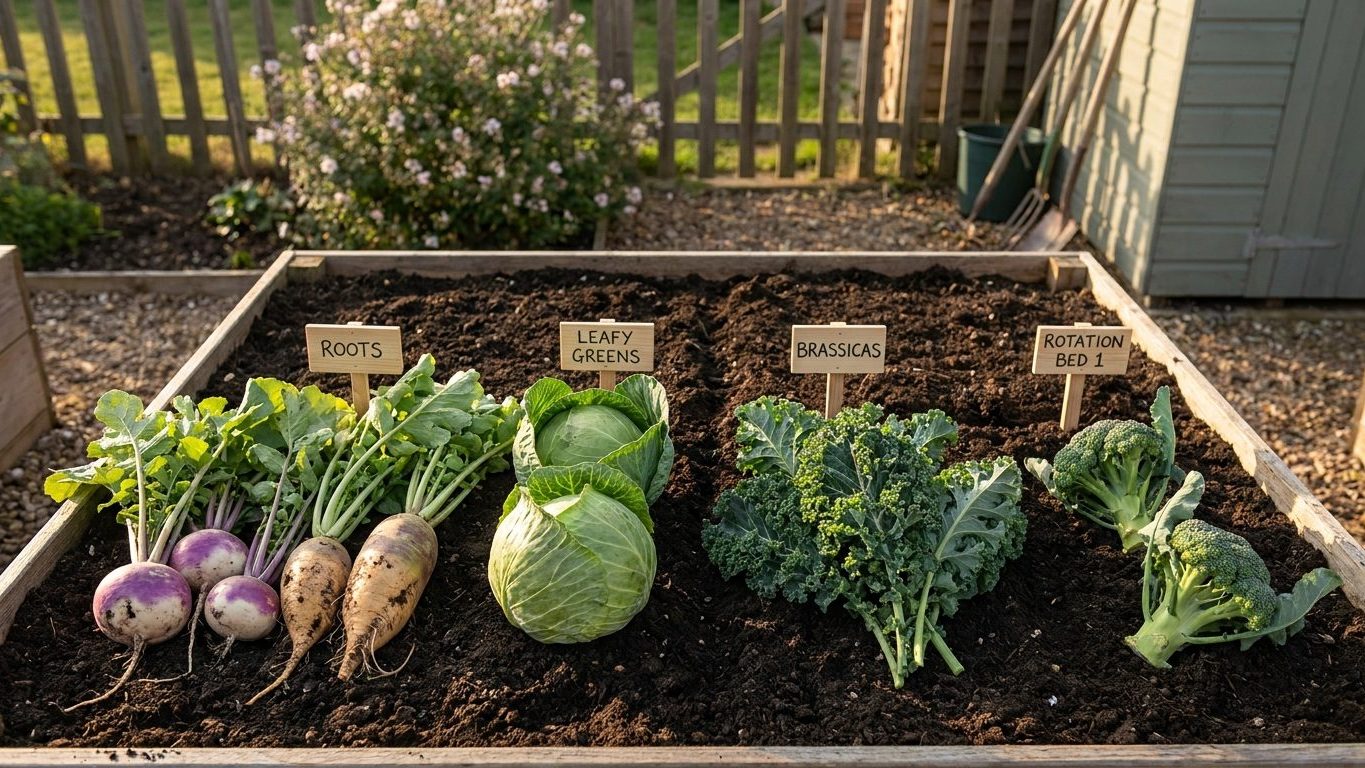

Turnips and Rutabaga belong to the same family as cabbage, kale, broccoli, and mustard: Brassicaceae. That single fact should drive every rotation decision you make. A “root crop” label is misleading. Rotate turnip and rutabaga as brassicas, alongside every other cole crop in the garden, and give that whole group three to four years away from any bed where a family member grew before.
What is actually going on
The commonest rotation mistake in a home garden is treating turnip as a root vegetable and cabbage as a leafy one, then rotating them separately as if they belonged to different worlds. They don’t. Botanically, turnip, rutabaga, cabbage, kale, broccoli, Brussels sprouts, mustard, arugula, and radish all sit inside the same plant family. A gardener who pulls turnips from one bed and plants kale there the following spring hasn’t rotated anything. The pests and pathogens waiting in that soil don’t care what the crop is called on a seed packet. They care what family it belongs to.
Two problems drive this more than any others. The first is clubroot, a soil-borne organism that infects brassica roots and causes swollen, distorted growths that choke off water and nutrient uptake. Its resting spores survive in soil for years, some sources say well over a decade under the right conditions, waiting for a host root to trigger germination. Plant any brassica into infected ground and the cycle restarts, regardless of whether last year’s crop was a cabbage head or a turnip root.
The second is root maggot, the larval stage of a small fly that lays eggs at the base of brassica stems. The larvae tunnel into roots and stems, and turnip and rutabaga are just as vulnerable as radish or cabbage. Adult flies find their host plants by scent, and a bed that smells like brassica draws them whether the crop is grown for its leaves or its swollen root.
This is why extension programs consistently frame rotation around plant families rather than plant parts. A rotation built on “roots one year, greens the next” leaves both clubroot spores and maggot populations undisturbed, because both target the family, not the shape of the harvest. A rotation built on “no brassica here for several years” actually interrupts the cycle, because the pest or pathogen runs out of a host to feed the next generation.
Understanding that mechanism matters more than memorizing a schedule. A gardener who knows why a rotation works can adapt the timing to a small yard, a raised bed system, or a plot with limited space, instead of following a rule that doesn’t fit the ground they actually have.
In the garden
A working brassica rotation groups turnip and rutabaga with every other cole crop and moves that whole group through the garden together, ideally on a three- to four-year cycle. The table below shows one common structure and, just as important, what happens when a step gets skipped.
| Year | Bed use | What goes wrong if skipped |
|---|---|---|
| Year 1 | Brassica family: turnip, rutabaga, cabbage, kale, radish, mustard | Fine as written, but marks this bed as off-limits to the whole family for several seasons after |
| Year 2 | Legumes: beans, peas | Skipping this step and planting a non-legume doesn’t rebuild soil nitrogen the way a legume year does, though it won’t reintroduce brassica pests either |
| Year 3 | Fruiting crops: tomato, pepper, squash | No direct brassica risk, but gardeners often use this year to sneak in a “quick” radish crop, which quietly restarts the clock |
| Year 4 | Alliums or leafy non-brassica greens: onion, lettuce, spinach | A gardener plants a mustard-family salad green here by mistake and undoes three years of rotation in one season |
The step that trips up the most home gardeners doesn’t show up on that table at all: cover crops. Forage radish and mustard are two of the most widely planted cover crops in home and small-farm gardens, prized for breaking up compacted soil and scavenging leftover nitrogen. Both are brassicas. Plant a mustard cover crop into a bed during what’s supposed to be a rest year, and that bed has just hosted a brassica again, whether or not anyone harvested anything from it. The clubroot spores and root maggot populations don’t distinguish a cover crop from a cash crop. If a rotation plan calls for a cover crop during the “off” years, choose a non-brassica option, such as a cereal rye, clover, or buckwheat cover, and save mustard or forage radish for a year when the bed is already scheduled for brassica use.
Interplanting causes a quieter version of the same problem. A gardener rotating the main turnip bed correctly but tucking a few radishes along the border of last year’s cabbage row has, in effect, restarted the brassica clock in that border, even if the main bed is on track. Rotation only works when it applies to the entire footprint a family occupied, not just the row that got labeled on a garden map.
One more practical note belongs here, even though it sits slightly outside rotation itself: harvested roots pulled from a bed with any history of clubroot or heavy maggot pressure deserve a closer look before they go into storage. Inspect each root for a soft patch, a weeping spot, or any sign of a moldy crown at the top where the leaves were cut. Any of those ends the question for that root, regardless of how sound the rest of it looks. Appearance alone isn’t a reliable test, and a compromised root stored alongside healthy ones can spread rot through the whole batch.
What it depends on where you are
How aggressive a brassica rotation needs to be depends heavily on regional conditions this page has no way of knowing for any individual reader. Clubroot favors moist, acidic soils, and it tends to persist longer and cause more damage in regions with cool, wet springs than in areas with dry, fast-draining ground. Root maggot pressure follows a similar regional logic: fly populations and the number of generations per season vary with local temperature patterns and how long the growing season runs.
Season length itself changes how a rotation gets scheduled in practice. A gardener in a region with a short growing window may only fit two brassica plantings into a given bed’s history over several calendar years, which naturally stretches the rotation gap without any extra planning. A gardener in a region with a long season and the option to grow both spring and fall brassica crops has to be more deliberate, since it’s easy to unintentionally plant two brassica crops in the same bed within a single year while thinking of them as separate rotations.
Summer heat and summer rainfall matter too, particularly for how long clubroot spores stay viable and how quickly a maggot-infested bed clears itself once brassicas are removed. None of that is something a general rotation guide can specify accurately for every reader, because it changes from one state, and often one county, to the next.
This is exactly the kind of detail worth checking against a state-level source rather than guessing. Many state extension services publish specific guidance on clubroot risk zones and root maggot timing for their region, along with the brassica varieties that have performed well in local trials. The state guides on this site are built to complement that local information, and pairing them with a call or visit to the state’s own extension service gives a far more precise answer than any single national guide can offer.
The mistake that costs the most
The single costliest mistake is thinking of turnip and rutabaga as roots first and brassicas second, and rotating them accordingly. A gardener who keeps a mental ledger of “roots here, greens there” will, sooner or later, plant a turnip crop into a bed that grew cabbage or kale the year before, convinced the rotation rule has been followed because the crop type changed. It hasn’t. Clubroot spores and root maggot flies don’t read seed packets. They respond to family, and turnip, rutabaga, cabbage, kale, and mustard are all the same family to them.
The fix costs nothing but attention: track every brassica planting under one heading, no matter how different the harvested part looks, and keep that heading, including any mustard or forage radish cover crop, out of a given bed for three to four years running. That means checking the cover crop bag before spreading seed, not just checking the vegetable transplant tray. It means resisting the urge to tuck a few extra radishes into a bed that’s supposed to be resting. And it means treating a “quick” fall turnip crop planted into last spring’s cabbage bed as a rotation violation, not a clever use of space.
None of this requires a cultivar-level decision. The variety of turnip or rutabaga planted has no bearing on whether the family-based rotation holds, so pick whichever type suits the kitchen and the season, and lean on the state extension service for which specific varieties have done well locally. What matters is the bed’s brassica history, tracked honestly and completely, not the label on the seed packet or the shape of what comes out of the ground.