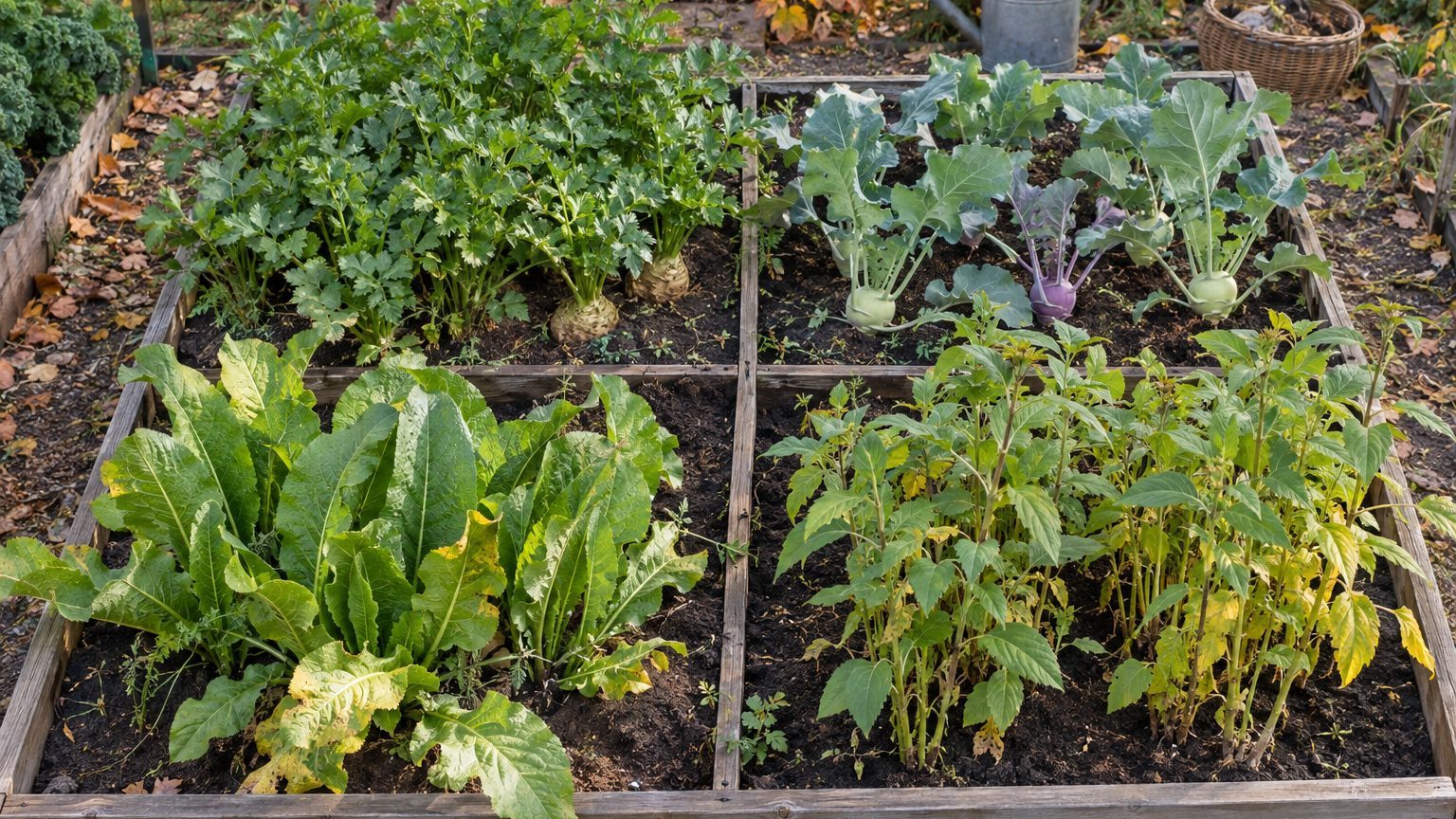

Four crops, four families? Not quite. Celeriac belongs to the carrot family (Apiaceae), kohlrabi and horseradish are both brassicas (Brassicaceae), and Jerusalem artichoke is a relative of sunflowers (Asteraceae). That makes three families, and the overlap matters more than the arithmetic. Kohlrabi and horseradish share pests and soil diseases, so they can’t be treated as strangers in the same bed. Two of the four are also perennials that don’t rotate the way an annual does. A workable plan for this group runs on two tracks: rotate the annuals on a four-year cycle, and give the perennials permanent homes.
This page covers the rotation logic. For crop profiles and growing basics, start with the parent guide, Celeriac, Kohlrabi, Horseradish and Jerusalem Artichokes.
Why the family tree decides the bed
Rotation exists because pests and pathogens are picky. A fungus that lives on cabbage roots doesn’t care about tomatoes. Move the host somewhere else for a few seasons and the population starves or dwindles. Plant the same family in the same spot, and you’ve left a standing buffet for whatever overwintered there.
Each of these crops has its own list of troublemakers. Celeriac shares carrot rust fly, celery leaf miner and leaf-spot diseases with carrots, parsnips, parsley and celery. Kohlrabi shares cabbage root maggot, flea beetles, cabbage worms and, worst of all, clubroot with every other brassica in the garden, including broccoli, kale, radishes, turnips and mustard. Jerusalem artichoke shares white mold (Sclerotinia) with sunflowers, lettuce and several other crops. The details of each are in What Attacks These Four Crops.
Clubroot sets the pace for the whole plan. Its resting spores can stay viable in soil for many years, commonly cited at up to 20 in extension literature. Once it’s established, a rotation won’t clear it. Rotation only prevents you from feeding it more. Raising soil pH to around 7.2 with lime makes conditions less friendly to the disease, but it’s a mitigation, not a cure. If you’ve seen swollen, club-shaped roots on any brassica in your garden, assume the spores are there.
The two annuals: celeriac and kohlrabi
These two fit a standard rotation, and they pair well because their needs and timing differ. Kohlrabi is quick, typically ready 45 to 60 days from transplanting or sowing, and it can be grown in spring or again in fall. Celeriac is the opposite: a long-season crop that needs roughly 100 to 120 days or more and occupies its bed from late spring until the fall harvest. Celeriac is also a heavy feeder, so it likes a bed that was enriched with compost or that grew a nitrogen-fixing legume the year before.
Aim for a minimum three-year gap before returning either crop to the same soil, and four where you can. Four is the better target for kohlrabi because of clubroot. For celeriac, three years is a reasonable floor, though four makes the arithmetic easier when you’re juggling beds.
One trap catches gardeners who think they’re being thorough. A cover crop of mustard or oilseed radish, popular for loosening soil and suppressing weeds, is a brassica. Sowing it in the bed where kohlrabi just finished, or where kohlrabi is due next, quietly counts as a brassica year. Oats, annual rye or buckwheat do the same job without the baggage. Likewise, a fall planting of kohlrabi counts toward the same clock as the spring one. It’s one bed, one visit per cycle.
A four-bed plan that actually works
Divide the annual part of the garden into four beds (they can be rows or raised boxes; it doesn’t matter). Run them in this order, shifting every bed one step forward each year:
- Bed 1: legumes such as beans or peas, which add nitrogen
- Bed 2: celeriac, which uses that nitrogen through a long season
- Bed 3: kohlrabi in spring, followed by oats or rye as a cover crop
- Bed 4: onions, squash or tomatoes, none of which share pests with the others
In year two, the old legume bed gets celeriac, the old celeriac bed gets kohlrabi, and so on around the circle. Each family gets a three-year rest from itself. The legumes feed the celeriac, celeriac leaves the soil in decent shape for a lighter feeder, and the fourth bed breaks the pattern for crops that don’t belong in any of the others. If you already rotate tomatoes, potatoes or carrots, slot them into the same logic: carrots are Apiaceae, so they count as celeriac years, and cabbage, broccoli and radishes count as kohlrabi years.
That last point is where most real-world plans fail. Gardeners rotate the exotic crop carefully and forget that the broccoli planted last year sits in the same family. Count the whole family, not just the root vegetable you’re tracking.
The two perennials: horseradish and Jerusalem artichoke
Trying to rotate these on a four-year schedule sets you up for frustration. Both regrow from fragments of root or tuber. Miss a piece the size of your thumb and it will sprout next season in whatever you planted there. Treat them as fixtures with boundaries, not as rotating members of the lineup.
Horseradish tolerates a wide range of conditions and is hardy across roughly USDA zones 3 through 9. A dedicated corner or deep container bed works best, since every harvest leaves fragments behind. Because it’s a brassica, it can host the same soil diseases and chewing insects as kohlrabi, which argues for keeping it away from the annual brassica beds rather than tucked beside them. Many gardeners lift the entire patch every two to four years, harvest the thick main roots, and replant a few pencil-thick side roots to restart the bed. Details on handling the roots after harvest, including why you’ll want fresh air moving while you grate, are in Grating Horseradish: Ventilate the Room.
Jerusalem artichoke, also sold as sunchoke, is the more assertive of the pair. It’s hardy in roughly zones 3 through 9, grows 6 to 10 feet tall, and spreads by knobby tubers that survive winters easily. Plant it where it can stay for years, such as a fence line, a back border or a bed bounded by a mowed path or a buried barrier. Harvest after the tops die back in fall, and take everything you can find. Tubers left behind will return. Keep it away from sunflowers and lettuce beds if white mold has ever shown up in your garden, since they share that disease.
Soil fertility is the quiet cost of keeping perennials in place. Jerusalem artichoke grows a tremendous amount of top growth, and a patch left unfed for years will gradually decline. A top-dressing of compost each spring, plus chopped stalks returned to the soil in fall, keeps it productive. If the stand thins out, dig it all up, amend the soil, and replant a handful of firm, healthy tubers.
Keeping a record, and what to do when space is tight
A rotation only works if you can remember it. Two years from now, you won’t recall which corner held kohlrabi. A sketch of the garden with the year and crop written in each bed takes ten minutes and saves guesswork. A phone photo of the layout after planting works nearly as well. Note any trouble too: leaf miner tracks on celeriac, swollen roots on a brassica, a patch of white fuzz on a sunchoke stem. A pattern shows up across seasons that a single summer hides.
Small yards can’t always fit four beds. In that case, shrink the cycle without breaking the rules. Two beds can hold a three-part rotation if you use containers for one of the crops, say celeriac in large pots filled with fresh mix each year, which sidesteps the soil-borne issues entirely. Fresh potting mix each spring isn’t a cheat. Kohlrabi works well in containers too, though clubroot spores can hitch a ride on reused soil or on tools, so don’t recycle mix from a brassica pot into the garden bed.
If clubroot is already on the property, the practical approach is to retire the affected beds from brassicas, which includes kohlrabi and horseradish, and shift them to containers or a different part of the yard. Boots and tools carry soil, so wash them before moving between affected and clean areas.
One more wrinkle: rotation guidance in books often assumes a large plot. A 4-by-8-foot raised bed can accommodate the cycle if you subdivide it into four 2-by-4 sections, though spacing and crop height matter. Celeriac wants about 6 to 8 inches between plants, and a sunchoke stand will shade everything within several feet, so the tall perennial belongs on the north side of the plot, where its shadow falls on the path instead of the beds.
Clubroot-resistant kohlrabi and other brassica varieties exist, and they offer insurance in infected soil, though resistance can break down when the same variety is planted year after year. Rotating still matters, even with resistant seed.