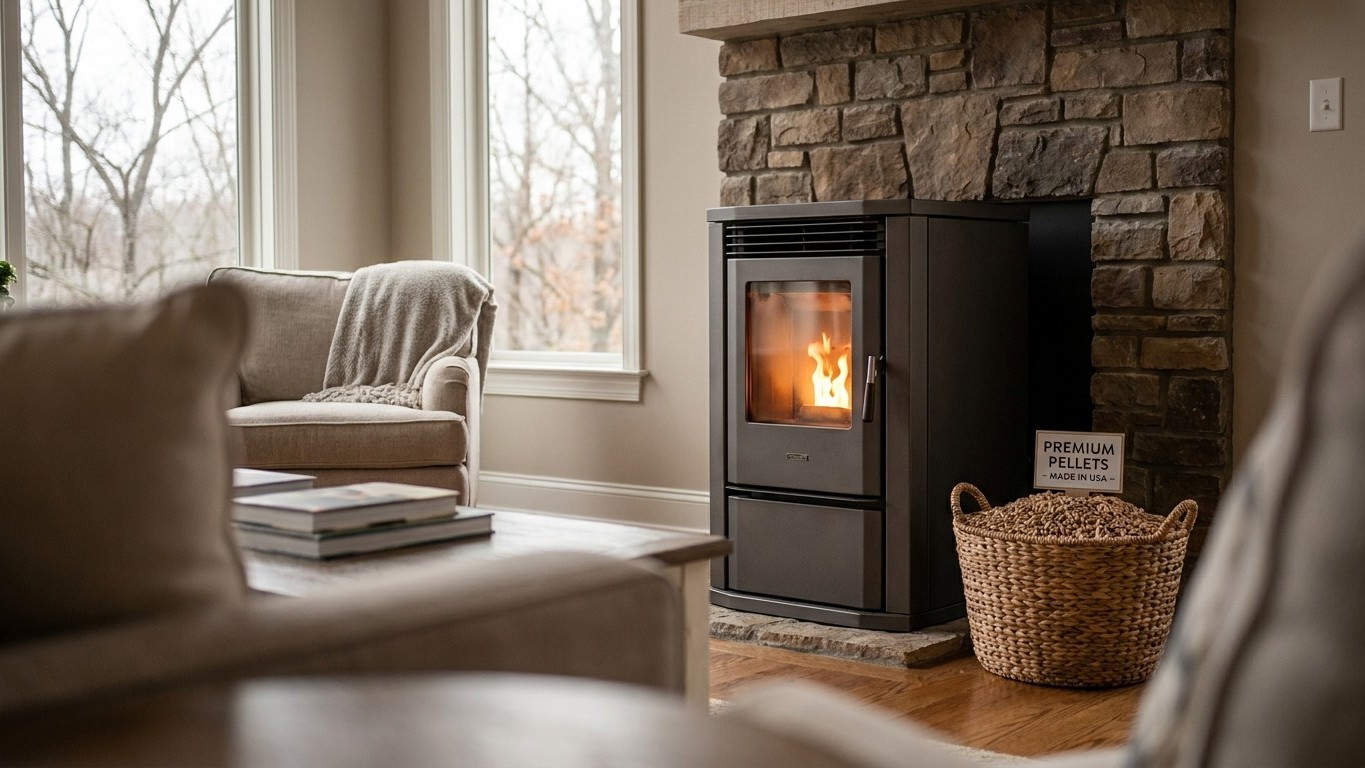

A Georgia winter doesn’t ask much of a pellet stove, at least by national standards. The state’s climate sits in the moderate range, which means most homes here run one as a supplement to a furnace or heat pump rather than as the only thing standing between the family and the cold. The real work is knowing your numbers, buying ahead of the right window, and keeping the fuel dry against a climate that’s more humid than harsh.
How hard the winter works here

At Atlanta Hartsfield International Airport, the reference station NOAA uses for Georgia’s climate normals, the annual tally comes to about 2,531 heating degree days (base 65°F), against roughly 2,051 cooling degree days. That single number is doing more work than it looks like. Heating degree days add up, day by day, how far the average temperature falls below 65°F, and they scale directly with fuel use. A house that needs 5,000 heating degree days worth of warmth burns roughly twice the pellets of one that needs 2,500, all else equal. At 2,531, Atlanta sits well below the northern tier of the country, where stations regularly clear 6,000 or 7,000.
That’s the depth of the winter. The length is a separate story, and it’s worth keeping the two apart. Heating demand in the Atlanta area starts in October, the first month whose normal mean temperature (64.7°F) dips under the 65°F threshold NOAA uses to count degree days, and it doesn’t fully let go until May. That’s about seven months where a stove could reasonably be lit on a cool evening. January carries the load, with 627 degree days on its own, more than a quarter of the year’s total packed into one month. So Georgia’s winter is long and mild, not short and brutal. A pellet stove owner here deals with more weeks of low-grade chill than one big deep freeze.
Because the degree-day figure sits on the lower end, it’s fair to say what a lot of Georgia buyers already sense: a pellet stove here is mostly about comfort, ambiance, and knocking the edge off a furnace’s workload, rather than carrying the house through winter on its own. That’s not a knock on the appliance. It just changes what “enough fuel” means and how much urgency belongs in the planning. The rest of this page is written for that reality.
One caution worth repeating: a state is not a station. Atlanta’s number describes north-central Georgia. A home in the mountains around Blairsville or Blue Ridge sees meaningfully colder normals and a longer season, while a home down toward Valdosta or the coastal plain runs milder than Atlanta’s figure suggests. Anyone outside the Atlanta metro area should treat 2,531 as a starting point, not a personal forecast, and check the normals for a station closer to home before budgeting fuel.
How many tons a winter takes here
Nobody can hand you a tons-per-winter figure that fits your house, and any source that claims to publish one for “Georgia” is guessing. What you can do is work the chain that actually determines consumption, using the degree-day figure above as the input. A standard bag of pellets weighs 40 pounds. Fifty bags make a ton. From there, how many tons you burn is a function of how much heat your house needs to stay comfortable through those roughly 2,531 degree days, which is exactly what that number measures.
Three things move the answer more than anything else, and they can shift it by a factor of two or more between two houses on the same street:
- How well the house holds heat — insulation, air sealing, window quality, and even how many stories the home has all change how much of the stove’s output leaks back outside.
- Whether the stove is the only heat source or a supplement — a household running the stove alongside a furnace or heat pump, as most do in Georgia, uses it on the coldest evenings and lets the central system handle the rest, which cuts pellet use sharply compared with a stove carrying the whole load.
- The setting it runs at — a stove left on a low or medium feed rate for ambiance burns a fraction of what the same unit uses on high through a January cold snap.
Put those three variables against Georgia’s relatively mild, long-but-shallow winter, and you can see why a firm number doesn’t exist: a well-sealed home running the stove as background warmth might burn under a ton across the whole season, while a drafty older house leaning on the stove as primary heat in the same city could burn three or four times that.
The honest method, and the one worth actually using, is to track your own first winter. Buy in modest increments, keep the receipts or a simple tally, and count total bags burned from October through the last cool night in spring. That measured number, taken from your own house, your own thermostat habits, and your own stove setting, will beat any estimate a website or a dealer can offer. Once you have one real season on record, you have a baseline you can trust for every winter after. For the national math behind bag counts and burn rates, see our guide on how many pellets a winter takes.
Buying and storing them in this climate
Timing matters more than most people expect. Since heating demand in the Atlanta area starts building in October, the window to buy ahead is late summer, before the first genuine cold snap sends everyone in the region to the same handful of retailers at once. Pellets, like a lot of seasonal goods, tend to run cheapest in the off-season and tightest right when a cold front actually arrives. A single hard freeze warning can empty shelves across a metro area within days, so buying a season’s worth (or at least a solid head start) in July or August avoids both the shortage and the price bump that follows it.
Storage against Georgia’s climate
Pellets are compressed sawdust, held together by the natural lignin in the wood rather than any glue or binder. That makes them efficient to burn but vulnerable to moisture. Georgia’s long, humid summers are exactly the conditions that cause trouble: pellets left in a garage or shed absorb ambient humidity over weeks, swell, and start crumbling into sawdust before they ever reach the hopper. A garage floor that sweats during a muggy August afternoon, which is common across much of the state, is a poor place to stack bags directly on the concrete. Keeping bags off the floor on a pallet or shelf, and inside sealed bins or the original heavy plastic packaging, does more to protect fuel quality here than in a drier climate where the same shortcuts might get away with it.
On cost, the only figure worth comparing between suppliers is the price per ton, not the price per bag, since bag counts and pallet sizes vary. Beyond that, this page won’t name a price or a dealer; those change too fast and too locally to be worth publishing here. For the full storage rundown and how to judge pellet quality before you buy, see our national guides on storing pellets properly and pellet quality basics.
What a winter outage means here
This is the line that separates a pellet stove from a wood stove, and it matters more the colder the stretch: a pellet stove needs electricity to run the auger that feeds fuel into the fire and the fan that pushes heat into the room. Cut the power, and the stove goes cold no matter how full the hopper is. A wood stove doesn’t care whether the grid is up. A pellet stove does.
Cross that constraint with Georgia’s degree-day profile and the stakes come into focus. During a shoulder month like October or April, an outage means an evening without the stove and not much else, since the mild low-degree-day stretch was going to need little heat anyway. During January, when the state’s monthly heating degree days peak at 627, an outage lines up with the coldest, longest nights of the year, and losing the stove alongside a grid failure turns into a real heating emergency rather than an inconvenience.
What households actually fall back on matters here too. Federal survey data for Georgia shows 60% of homes heat primarily with a furnace and 27% with a central heat pump, with natural gas (47%) and electricity (46%) as the leading fuels and propane at 5%. Boiler and fuel-oil shares weren’t published for the state, meaning the sample was too small to report reliably, not that no one uses them. The practical takeaway: a heat pump is entirely electric and goes down with the grid just like the pellet stove does, while a gas furnace’s burner keeps working but its blower motor still needs power to move warm air through the house. Neither fallback is guaranteed during an outage, which is exactly why backup planning matters in a state where most homes lean on electricity-dependent systems either way.
This page won’t recommend a generator size or a battery capacity, because that number depends on the exact stove’s power draw, which is printed on its rating label, not on a state average. Check that label, and see our national guide on handling a power cut with a pellet stove for how to plan around it.