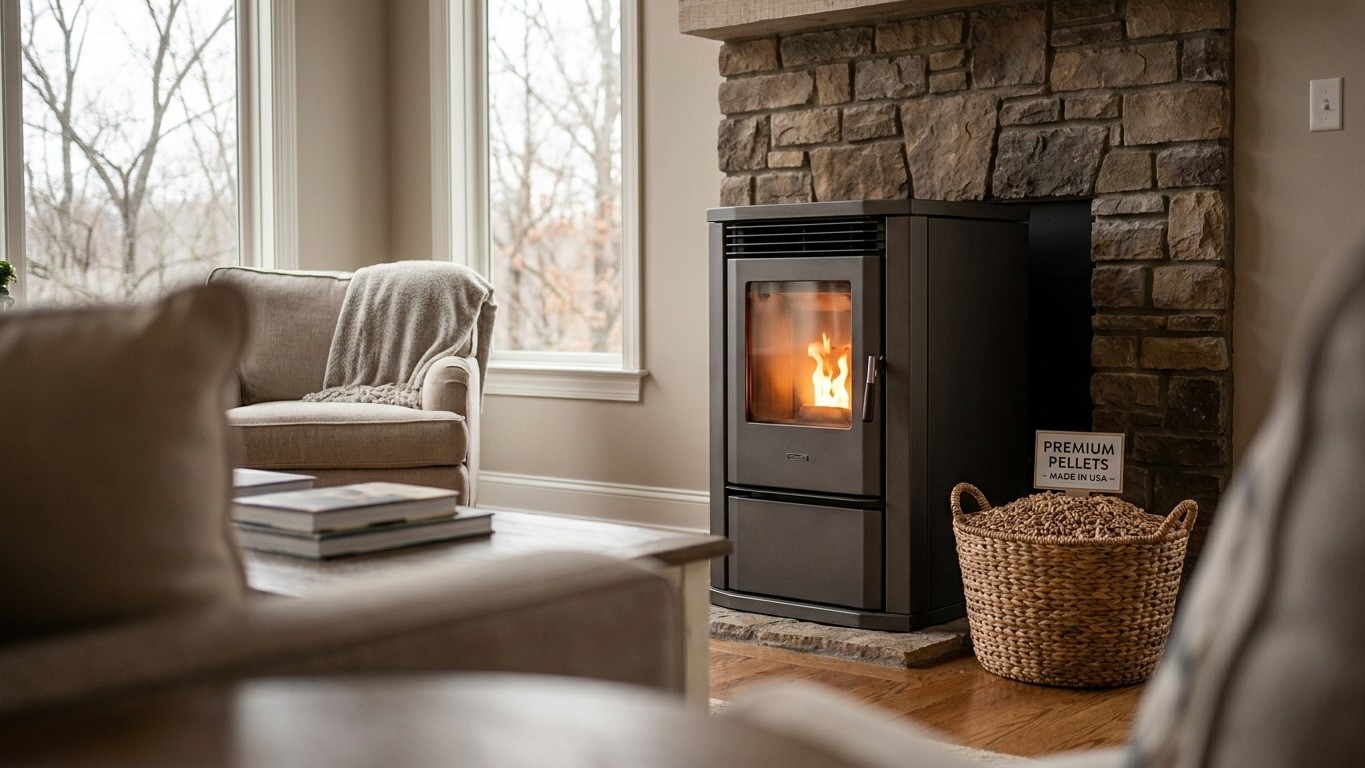

In Phoenix and most of the low desert, a pellet stove barely gets tested by winter. Just 874 heating degree days a year at Phoenix Sky Harbor mean the heat load here is a fraction of what a Midwest or mountain home carries. A winter’s worth of pellets in this climate is measured in a handful of bags, not pallets, and the stove itself functions more like a fireplace substitute than a furnace replacement.
How hard the winter works here

Phoenix Sky Harbor logs about 874 heating degree days a year on the 65 F base NOAA uses for these calculations, against 4,765 cooling degree days at the same station. That ratio tells the real story: this is a cooling climate that tolerates a short cold snap, not a heating climate that demands one. Compare it to a station in the Northeast or the Rockies running 5,000 or 6,000 heating degree days, and you’re looking at a fifth to a sixth of the fuel load for an equivalent house.
The heating season itself is short and shallow. Demand starts in December, the first month the normal mean temperature (55.8 F) dips below the 65 F threshold, peaks that same month at 288 degree days, and the mean climbs back above 65 F by March. That’s about three months of any heating need at all, and even within that window, only December and January carry real weight. November adds a light 85 degree days, and by April the load has dropped to essentially nothing.
Both numbers matter, and they’re not the same thing. The annual total tells you the season is mild. The three-month window tells you it’s also brief. A place could theoretically post a similar annual figure spread across six cold months, which is a different heating problem entirely, one where a stove has to hold steady output for half the year instead of a few sharp weeks around the holidays.
For a homeowner in the Phoenix metro, this means a pellet stove reads as comfort and atmosphere, not a heating system a household leans on to stay warm. It’s the appliance you light on a January evening when the desert air drops into the 40s after sunset, not the one keeping pipes from freezing. Write off any expectation that it needs to carry the house through winter, and the rest of the planning gets a lot simpler.
One caution worth repeating: Sky Harbor is a single station, sitting at about 1,100 feet in the valley floor. Arizona is not one climate. Flagstaff, the White Mountains, and other high-elevation counties see real snow and a heating season that starts weeks earlier and runs colder and longer than anything the Phoenix number describes. A reader in those areas should treat this page’s figures as a floor, not a match, and look up their own station’s normals before budgeting fuel.
How many tons a winter takes here
Nobody can hand you a tons-per-winter figure and have it mean anything for your specific house, because two homes on the same Phoenix street can burn twice as much or twice as little pellets depending on how they’re built and how the stove gets used. What you can do is work the math yourself, using numbers that don’t change: a bag of pellets weighs 40 pounds, and fifty bags make a ton. From there, consumption tracks the heat the house actually loses, which is exactly what the 874 heating degree days above is measuring.
Given how mild and short that heating season runs, a lot of low-desert Arizona households burn well under a ton across an entire winter, sometimes just a few bags kept on hand for cold evenings in December and January. That’s a rough directional read, not a number to bank on, because three things swing it hard in either direction.
- How well the house holds heat. An older Phoenix-area home with single-pane windows and thin attic insulation loses heat far faster than a newer build to code, even on the same cold night.
- Whether the stove is the only heat source or a supplement. Most Arizona households already run a furnace or heat pump as primary heat (more on that below), which means the pellet stove is filling in on the coldest evenings rather than carrying the whole load, and burns far less fuel as a result.
- The setting it runs at. A stove left on a low or medium setting for ambiance a few hours a night uses a fraction of what the same appliance burns wide open trying to heat a whole living area.
Given all that, the only number worth trusting is the one you measure yourself. Buy a modest first supply, track exactly how many bags you go through from the first cool evening through the last one in March, and that count becomes your household’s real baseline for every winter after. One measured season on your own thermostat and your own habits beats any estimate built from averages, including this one. For a broader breakdown of how the math works nationally, see our guide on how many pellets a winter takes.
Buying and storing them in this climate
Timing a purchase here is simple once you know the calendar. Heating demand doesn’t start climbing until December, so the smart window to buy is anytime before that, through the fall while dealers still have full stock and prices sit at their off-season low. A regional cold snap in December or January can clear shelves fast even in a mild-winter state, because supply doesn’t scale up locally to meet a short spike in demand. Buying in September or October avoids that scramble entirely.
Storage is where the Arizona climate cuts both ways. Pellets are compressed sawdust held together by nothing but pressure and the wood’s own lignin, no glue involved, which means any moisture that gets into a bag swells the pellets and breaks them down into sawdust again. The low desert’s dry winter air is actually an advantage here, one of the few climates in the country where pellets stacked in a garage or shed face little humidity risk from November through February.
The real exposure comes earlier in the year. Arizona’s monsoon season, roughly July through September, brings sudden humidity spikes even in the desert, and a garage floor or an uninsulated shed can sweat during that stretch the same way a basement does in a wetter state. If you’re buying pellets ahead of the winter, the safest window is after the monsoon humidity has broken but before shelves empty for the season, keeping bags off a concrete floor and away from any wall that takes direct sun heat during the day and cools fast at night.
Skip comparing sticker prices between bags or brands. The only number that means anything is price per ton, since bag sizes and packaging vary enough to make a per-bag comparison misleading. For the full mechanics of moisture, storage setups, and what separates a good pellet from a poor one, see our national pages on pellet storage and pellet quality rather than duplicating that ground here.
What a winter outage means here
A pellet stove is not a wood stove, and the difference shows up the moment the power goes out. Pellet appliances rely on an electric auger to feed fuel into the burn pot and an electric blower to push heat into the room; cut the power and the fire has no way to keep feeding itself, no matter how many bags are stacked in the garage. A wood stove keeps burning through a blackout. A pellet stove goes dark with it.
How much that matters depends entirely on where the 874 heating degree days above lands you. In a hard winter climate, an outage during a cold snap is a real emergency, the kind that puts pipes and pets at risk within hours. In the Phoenix area’s mild, three-month heating season, losing the stove for an evening is an inconvenience, not a crisis: the house won’t hit a dangerous temperature overnight in December the way it would in a Northern climate, since the load the stove was covering was modest to begin with.
What Arizona households actually fall back on matters here too. State survey data shows furnaces as the leading primary heating equipment at 55% of households, with central heat pumps at 25%; natural gas serves 36% of homes and electricity 51%, while propane covers a small 2% share. Fuel oil, kerosene, and boiler heating don’t show published figures for the state, meaning the survey found the sample too thin to report a reliable number, not that no household uses them. In practical terms, a furnace or heat pump, both of which also depend on grid power, is the primary system in most homes here, with the pellet stove sitting well down the backup list.
That electric dependency across nearly every heating option in Arizona is worth sitting with for a moment: a furnace, a heat pump, and a pellet stove all go quiet in the same blackout, unlike a wood stove or a propane space heater that doesn’t need a plug. Rather than guessing at a generator size or a battery capacity here, check the wattage draw printed on your specific stove’s rating label, since that number varies by model, and see our national guide on handling a pellet stove during a power outage for the fuller picture.