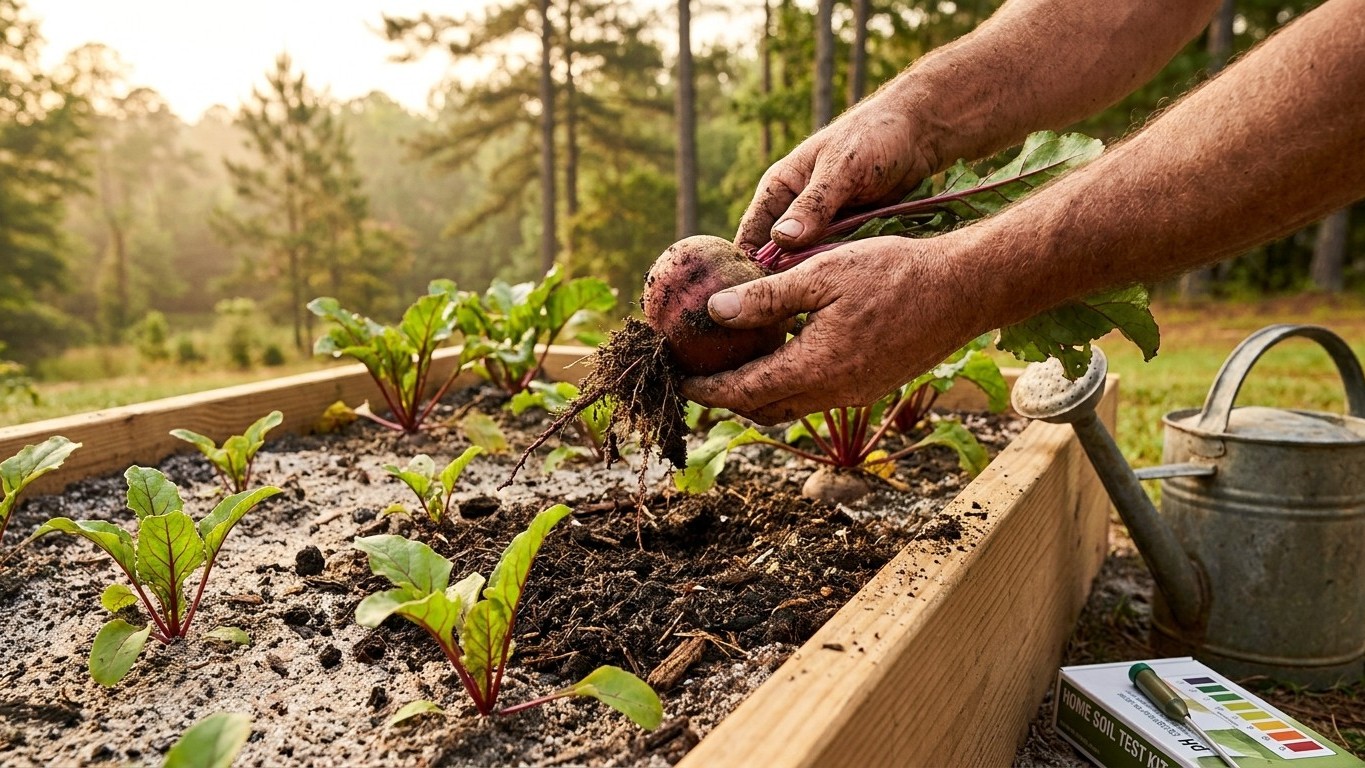

Georgia gardeners can grow beets successfully, but the state’s representative ground is sandy, acidic and low in organic matter, and its summers turn beets woody fast if water runs short. Sow 2 to 3 weeks before your last frost, keep the first six weeks consistently moist, and pull roots before the deep heat sets in. Get those three things wrong and you get a bolted plant or a root you can barely fork.
The short answer
The soil USDA lists as representative of Georgia is the Tifton series, an Ultisol, the kind of old, heavily weathered and leached ground that has been losing nutrients to rainfall for a very long time. The surface horizon runs 84 percent sand, 6 percent clay and 9 percent silt, with organic matter sitting around 0.8 percent and a surface pH near 5.5, slightly acid. It drains well, which beets need. Understanding Beet Soil in Georgia means recognizing it is short on the two things beets also need: organic matter and a pH closer to neutral.
Utah State University Extension’s guidance for beets calls for deep, sandy, well-drained soil rich in organic matter, amended with no more than 1 inch of composted organic matter per 100 square feet. Tifton-type ground gives you the sand and the drainage for free. The organic matter you have to add yourself, because 0.8 percent is thin for a crop that wants a root system pushing through loose, fertile ground rather than fighting compacted, nutrient-poor sand. The acidity matters too: beets sulk in soil that’s too sour, and a surface reading of 5.5 is on the acid side of what most root vegetables prefer.
On the heat side, the exact count of days Georgia’s reference climate station spends above 90 degrees isn’t published in the dataset behind this page, so no number appears here. What is documented is the mechanism: Utah State’s research ties heat above 85 degrees, combined with water stress, directly to woody roots. Georgia’s growing season runs long and hot by any gardener’s own experience, and that combination, heat plus a dry spell, is exactly what turns a tender beet into something closer to a turnip left too long in the ground.
None of this describes your particular yard. Georgia spans hundreds of mapped soil series, and the Tifton profile above is a representative benchmark, not a reading from any one garden. River bottoms, hill country, and any lot where a builder scraped and refilled the topsoil will behave differently, sometimes completely differently. Treat these numbers as a starting point for what the region’s ground tends to do, then confirm your own with a soil test.
The six weeks that decide it here
Beets are sown directly into the ground, never transplanted, and the 60 to 80 days to harvest count from that seeding date, not from anything started indoors. Knowing exactly When to Sow Beets in Georgia matters: sow 2 to 3 weeks before your last frost and the first six weeks of that root’s life land in a specific stretch of the Georgia calendar. NOAA’s climate normals put the last spring freeze at the reference Atlanta-area station between March 11 and March 29. Sowing 2 to 3 weeks ahead of that puts a typical planting date somewhere in late February to mid-March for that part of the state, with the first six critical weeks running into April.
That window matters because Georgia spring doesn’t hold steady. Warm stretches alternate with cool snaps, and dry runs can show up between rain events even in a season that averages out wet. A beet seed doesn’t care about the seasonal average. It cares whether the top few inches of soil stay damp through germination and root formation, and a week or two of dry wind in March or April, right when Tifton-type sand is already prone to drying out fast because of its low clay and organic matter content, is enough to trigger the stress response.
Utah State’s research is specific on this point: water stress in the first six weeks after seeding causes premature flowering, meaning the plant bolts instead of building a root. That’s a different failure from the woody-root problem tied to summer heat later on, and the two shouldn’t be treated as the same issue solved by the same fix. Early bolting is a germination-window problem. Woodiness is a mid-to-late-season heat problem. The remedy for one is steady moisture at planting; the remedy for the other is steady moisture straight through the hottest stretch, or simply getting the root out of the ground before that stretch arrives.
One more regional wrinkle: that March 11 to March 29 frost window comes from a single reference station, and Atlanta’s airport reading runs warmer than its surroundings because of the urban heat island effect. North Georgia and the mountains typically see their last frost later in spring than that window suggests, while the coastal plain tends to clear frost earlier. Adjust your sowing date accordingly rather than treating the reference window as fixed statewide.
What goes wrong here
- Bolting from a dry March or April. A cool snap followed by a dry spell in the first six weeks after seeding is the single most common trigger for premature flowering in this climate. Keep the top few inches of soil consistently damp from the day you sow through at least six weeks out, especially on sandy ground that drains and dries fast.
- Woody roots from a hot, dry summer stretch. Once temperatures push past 85 degrees, any water stress on top of that heat toughens the root. Plan your harvest to land before the hottest weeks arrive, or keep irrigation steady through that stretch if you’re pushing the season longer.
- Weak growth from acidic, low-fertility sand. Ground resembling the Tifton profile, at pH 5.5 and roughly 0.8 percent organic matter, is thinner in nutrients than beets want. Test your soil and lime it toward neutral if it comes back acidic, and work in up to 1 inch of composted organic matter per 100 square feet before sowing.
- Fast drainage outrunning your watering schedule. Sandy soil with only 6 percent clay holds far less water than loam, so a watering routine built for heavier ground will leave sandy beds dry between waterings. Water more often, in smaller amounts, rather than heavier and less frequent.
- Sowing too late and running straight into summer heat. Because beets count their 60 to 80 days from seeding, not transplant, a late sowing pushes the harvest window into the hottest part of the year automatically. Count backward from when you want to pull roots, not just forward from your last frost date.
Checking this against your own county
Everything above describes Georgia’s representative soil and a single reference climate station, not your specific address. The most reliable next step is a soil test through your local Cooperative Extension office, which will return your actual pH and fertility numbers rather than a statewide average. The University of Georgia Cooperative Extension, at extension.uga.edu, runs county offices across the state that handle soil testing, local frost date guidance, and planting calendars adjusted for your specific region, whether that’s the mountains, the Piedmont, or the coastal plain. Given how much variation exists between a mountain garden and a coastal plain garden in the same state, that local check is worth doing before you commit a season’s beet crop to a statewide figure.
Common questions
Can beets grow in sandy Georgia soil without amendment?
They’ll come up, but a profile resembling Tifton series ground, at roughly 0.8 percent organic matter and pH 5.5, is thinner and more acid than beets prefer. Working in up to 1 inch of composted organic matter per 100 square feet and correcting pH toward neutral gives noticeably better root development than planting into unamended sand.
Why did my beets bolt instead of forming roots?
The most likely cause is water stress during the first six weeks after seeding, often from a dry stretch in a swinging Georgia spring. This is a different problem from woody roots later in the season, and the fix is the same principle applied earlier: keep the soil consistently damp right from sowing.
How do I know when to sow beets for my part of Georgia?
Start from your local last frost date, not the statewide reference window, since mountain areas typically clear frost later and the coastal plain earlier than the March 11 to March 29 range recorded at the reference Atlanta-area station. Sow 2 to 3 weeks ahead of that local date, then count 60 to 80 days forward from seeding to estimate harvest.
Why are my beet roots woody even though I watered them?
Woodiness comes from heat above 85 degrees combined with water stress, and it can develop even with decent early-season watering if irrigation lapses later, during the hottest stretch of summer. Keeping moisture steady all the way to harvest, or timing the harvest to land before peak heat, addresses this separately from any early bolting issue.