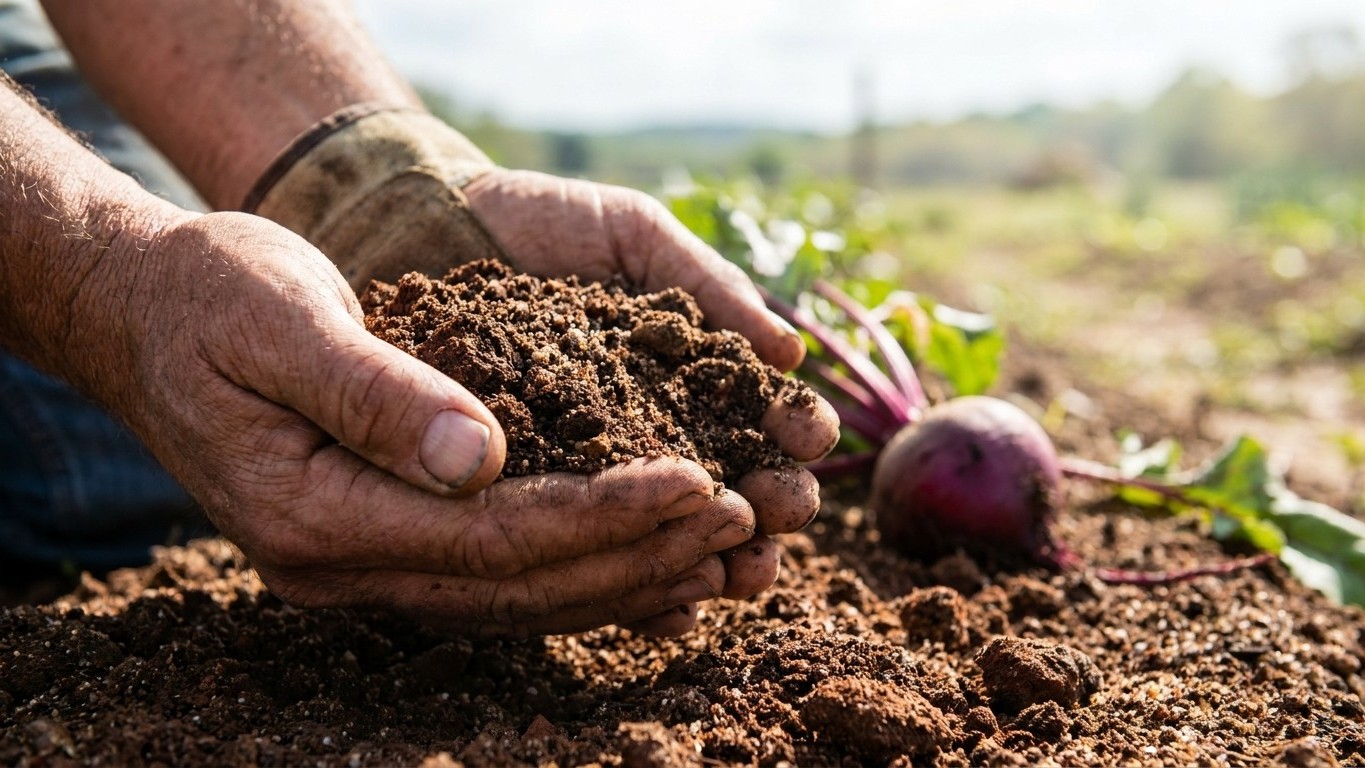

Georgia’s representative topsoil, the Tifton series, is 84 percent sand and only 6 percent clay, which drains fast and holds almost no water between waterings. Beets want deep, sandy, well-drained ground rich in organic matter, so the texture is right but the water-holding and nutrient reserve are thin. That single mismatch, not the sand itself, is what decides most beet crops in this state.
The short answer
The Tifton series is an Ultisol, an old and heavily weathered soil type that has been leached of nutrients over a long stretch of time. USDA’s Soil Survey Geographic Database puts its surface horizon at 84 percent sand, 6 percent clay and 9 percent silt, with organic matter around 0.8 percent and a surface pH near 5.5, slightly acid. It’s classed well drained. For a gardener, that combination reads two ways at once: water moves through fast, which is good news after a downpour, but it also means the root zone dries out fast between waterings, and there’s very little organic matter or clay in the mix to hold moisture or nutrients in reserve once the sand has drained.
Beets are not a crop that tolerates that kind of swing. Utah State University Extension is explicit that beets need soil rich in organic matter, and that a bed built on native sand this lean needs help before seed goes in the ground, typically compost worked in at no more than 1 inch per 100 square feet. Push much past that on a soil already low in structure and you risk overcorrecting into a bed that holds too much nitrogen and too little else, which beets don’t reward either.
Heat compounds the problem. Utah State’s research also ties heat above 85 degrees Fahrenheit, combined with water stress, directly to woody roots. Georgia summers routinely run past that mark for extended stretches, though the exact count of days a year any one Georgia city spends above 90 degrees isn’t a figure published here, so it shouldn’t be guessed at. What matters practically is that on a sandy, low-organic-matter soil that dries quickly, the water-stress half of that equation arrives faster and more often than it would on heavier ground, and that raises the odds of the heat side finishing the job.
None of this describes any one backyard. Georgia spans hundreds of mapped soil series, from heavy Piedmont clays in the north to sandy coastal flats in the south, and a builder’s fill dirt or a river-bottom garden can differ completely from the Tifton profile. Treat this series as the state’s representative starting point, the ground the state is known for, not a stand-in for a soil test on the actual bed a root will grow in.
The six weeks that decide it here
Beets are sown directly in the ground, and the standard timing is 2 to 3 weeks before the last expected frost. NOAA’s 1991-2020 climate normals put that last spring freeze, at the 32-degree probability band, somewhere between March 11 and March 29 for the reference station used here. Sow on that schedule and the first six weeks after seeding, the window Utah State ties most tightly to bolting risk from water stress, land squarely in late winter into mid-spring across most of the state.
That stretch of the Georgia calendar doesn’t behave the same way every year. Some springs come in wet, with cool fronts stacking up rain through March and into April. Others turn dry early, with warm, breezy stretches that pull moisture out of sandy topsoil fast, and a lot of years swing between the two within the same six weeks, a soaking week followed by ten dry, windy days. On a soil profile like Tifton’s, thin on clay and organic matter, that swing matters more than it would on heavier ground, because there’s little reserve moisture to buffer a dry spell once the surface has drained.
That’s the mechanism worth watching, not just the calendar date. A beet stand seeded on schedule and then hit by a dry, windy stretch in its first six weeks is under exactly the kind of early water stress Utah State links to premature flowering, bolting instead of building a root. The fix isn’t a different sowing date so much as attention during that specific window: checking soil moisture at the seed line through late winter and early spring, rather than assuming rain will keep pace, since on fast-draining sand it often won’t.
North Georgia and the mountains will run this same six-week window earlier and colder than the coastal plain, where frost eases off sooner and the ground warms faster. A gardener working from a single statewide frost date without adjusting for their own region is already off by a couple of weeks in either direction, which shifts exactly when that vulnerable early stretch falls.
What goes wrong here
Most Georgia beet failures trace back to one of two mismatches: the sandy, low-organic-matter ground drying out faster than expected, or heat finishing off a root that was already stressed for water. Here’s where that plays out in practice.
- Bolting from an early dry spell. A stand seeded on the standard 2-to-3-week-before-frost schedule hits a dry, windy stretch in its first six weeks, and the plant reads that stress as a signal to flower rather than bulk up a root. Remedy: check soil moisture at seed depth through that window rather than trusting rainfall, and water before the surface visibly dries, since fast-draining sand gives no early warning.
- Woody roots from late-season heat plus thirst. Once temperatures climb past 85 degrees and the bed is also running dry, the root toughens instead of staying tender. This is a separate failure from bolting, tied to later heat rather than early stress, and it shows up at harvest, not at germination. Remedy: keep watering consistent as the weather warms, and don’t let a sandy bed coast on infrequent deep soaks alone once summer heat sets in.
- Nutrient starvation on native sand. At roughly 0.8 percent organic matter and acid at pH 5.5, unamended Tifton-type ground simply doesn’t have much to feed a root crop on its own. Remedy: work in compost ahead of sowing, capped around 1 inch per 100 square feet, rather than assuming native soil will carry the crop.
- Water draining through before it’s used. A soil that’s 84 percent sand doesn’t hold a deep watering long, so a single weekly soak can leave the root zone dry again within days. Remedy: water more often in smaller amounts on sandy beds rather than relying on infrequent deep watering schedules built for clay soil.
- Treating the state soil as a garden’s soil. The Tifton figures describe a mapped representative series, not any one yard, and a builder-graded lot or a river-bottom garden can be entirely different ground. Remedy: run an actual soil test on the bed in question before amending, rather than amending to correct a problem the garden may not have.
Common questions
How many days does it take to grow beets from seed in Georgia?
Beets typically run 60 to 80 days from seeding to harvest, counted from direct sowing in the ground, since beets aren’t started as transplants. On sandy Georgia soil that dries quickly, consistent moisture across that full stretch matters more than it would on heavier ground, particularly through the first six weeks and again once summer heat arrives.
Does Georgia’s sandy soil mean I don’t need to water beets as often?
The opposite. Well-drained, sandy soil like the Tifton series moves water through quickly, which means less moisture stays available at the root zone between waterings. That calls for more frequent, lighter watering rather than less attention to irrigation.
Is bolting and woody root the same problem?
No. Bolting is premature flowering triggered by water stress in the first six weeks after seeding, and it happens early. Woodiness is a texture problem in the mature root, caused by heat above 85 degrees combined with water stress later in the season. They share water stress as a trigger but they’re separate failures at different points in the crop’s life.
Should I use the Tifton soil figures to plan my own garden bed?
Use them as a general picture of what Georgia ground tends to do, sandy, fast-draining, acid, low in organic matter, not as a measurement of any specific yard. Georgia has hundreds of mapped soil series, and a home garden, especially on fill dirt or near a river, can differ completely. A soil test on the actual bed is the only way to get real numbers for that spot.