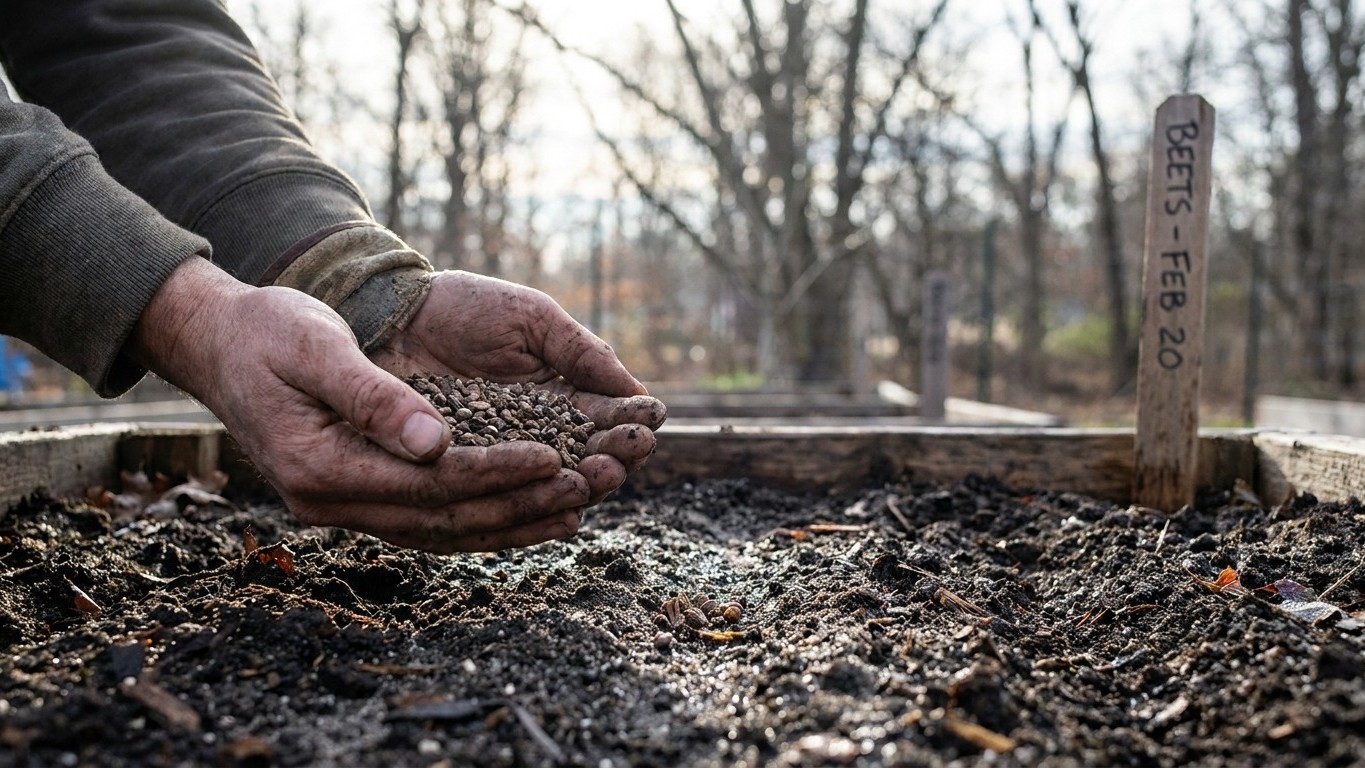

Sow beets in Georgia two to three weeks before your local last spring frost. For the Atlanta area, that frost date falls somewhere between March 11 and March 29, which usually puts seed in the ground from late February through mid-March. Farther north, in the mountains, push that later; on the coastal plain, earlier is often safe.
The short answer
Start with the ground itself. Georgia’s representative soil, the Tifton series, is an Ultisol, an old, heavily weathered and leached soil type that runs naturally acid and short on nutrients. USDA’s Soil Survey Geographic Database puts the surface horizon at 84 percent sand, 6 percent clay, and 9 percent silt, with organic matter around 0.8 percent and a surface pH near 5.5. It’s well drained, which is the one trait working in your favor from the start.
Beets, according to Utah State University Extension, want deep, sandy, well-drained soil rich in organic matter. Tifton-type ground gets the texture and drainage right but comes up short on the organic matter side by a wide margin. That 0.8 percent figure is nowhere near “rich,” so most Georgia gardens working this kind of soil need to build it up before beet seed ever goes in. Utah State’s guidance caps that amendment at no more than 1 inch of composted organic matter per 100 square feet, worked into the bed ahead of sowing rather than added later.
Heat is the other half of the equation, and here the published record for this page stops short of a number. No day-count above 90 F for the Atlanta reference station appears in the sourced climate data used here, so that figure simply isn’t published on this page. What the beet research does establish is a threshold: once temperatures climb past 85 F and the plant is also short on water, the root turns woody. Georgia summers get there reliably, which is exactly why timing the sowing window early enough to finish before that heat lands matters more than any single frost date.
None of this is a diagnosis for your particular yard. Georgia spans hundreds of mapped soil series, and Tifton is simply the one USDA lists as representative of the state under its State Soils program. A river-bottom garden, a scraped hillside lot, or a plot with decades of amendment behind it will read completely differently under a soil test. Treat the numbers above as a starting point for what the region’s ground tends to do, sandy and acid and short on organic matter, then confirm your own bed before you commit seed to it.
The six weeks that decide it here
Sowing two to three weeks ahead of the last frost means the first six weeks of a beet’s life land in a fairly predictable slice of the Georgia calendar, roughly late February through early May depending on where you garden inside that March 11 to March 29 frost band. That’s a meaningful stretch, eighteen days wide across the state, which is one reason a date that works in one county can be two or three weeks off in another.
This stretch of the Georgia spring doesn’t behave one single way. Some years bring a run of dry, mild weeks that let seedlings establish steadily. Other years swing hard, a soggy cold front followed by a sudden warm, dry stretch, and it’s that swing that puts young beets at risk. Utah State’s research is specific on the mechanism: water stress during the first six weeks after sowing is what triggers premature flowering, known as bolting, in beets. It isn’t the cold itself that causes it. It’s a seedling that gets thirsty during a critical early window.
On Tifton-type soil, that risk is sharper than it would be on a heavier ground. Sand drains fast and holds little water between rains, and with organic matter sitting near 0.8 percent, there isn’t much of a reservoir to buffer a dry week. A cold snap that also brings a dry spell, which Georgia sees in some springs and not others, is a worse combination for beets than a wet, mild cold snap would be. This is why watching soil moisture through those first six weeks matters as much as watching the calendar for frost.
Bolting from this early water stress is a separate problem from the woodiness that shows up later when heat arrives. They share a root cause, an underwatered plant, but they happen at different points in the season and show up in different ways: bolting means the plant flowers and stops putting energy into the root, while woodiness means the root itself turns fibrous and tough. Fixing one doesn’t automatically fix the other, which is the subject of the next section.
What goes wrong here
- Seedlings dry out between waterings on sandy ground. Tifton-type soil sheds water fast and its low organic matter gives it little to hold onto. A missed watering during the first six weeks after sowing is enough to trigger bolting. Water on a schedule through that window rather than waiting for the soil surface to look dry, since sand can look dry at the top while still damp lower down, or the reverse.
- Low organic matter starves young roots. At roughly 0.8 percent organic matter, the representative Georgia soil has little to feed a crop that wants rich, deep ground. Work in composted organic matter before sowing, capped at 1 inch per 100 square feet per Utah State’s guidance, rather than trying to correct it midseason with a top-dressing.
- Sowing dates get borrowed from the wrong part of the state. Using an Atlanta frost date for a mountain garden, or a mountain date for the coastal plain, misses the mark badly given how much the frost window shifts across Georgia. Check your own county’s frost pattern rather than defaulting to a single statewide date.
- Heat arrives before the beet finishes. A late sowing date can push the harvest window into weeks when temperatures regularly clear 85 F. Combined with any water stress, that’s when roots turn woody. Sow early enough within your local frost window that the crop has time to mature before sustained heat sets in, and keep watering even once the plant looks established.
- Garden soil doesn’t match the mapped series at all. A yard built on fill, a compacted new-construction lot, or a low spot that holds water can behave nothing like the well-drained Tifton profile. Get an actual soil test for your bed rather than assuming the state’s representative numbers apply to your ground.
Common questions
How long do beets take from sowing to harvest in Georgia?
Beets are direct-seeded, not transplanted, so the clock starts the day seed goes into the ground, not when seedlings first appear. Plan on roughly two months or a bit longer from that sowing date to harvest, and count backward from your local heat arrival rather than a fixed calendar date.
Can I sow beets before Georgia’s last frost date?
Yes, that’s actually the standard approach: sowing two to three weeks ahead of the last frost, which for the Atlanta area falls between March 11 and March 29, is the timing that puts the crop’s early growth in a manageable stretch of spring. Beet seed tolerates cool soil better than the seedlings tolerate drought, so the bigger risk in that window is a dry spell, not a light frost.
Does Georgia’s typical soil need amending before planting beets?
Almost certainly, if your ground resembles the state’s representative Tifton series. At around 0.8 percent organic matter and a surface pH near 5.5, that soil is sandy and well drained but nutrient-poor by beet standards. Utah State University Extension’s guidance calls for no more than 1 inch of composted organic matter per 100 square feet worked in ahead of sowing. A soil test on your own bed will tell you whether your garden actually matches this profile or not.
What causes beets to bolt or turn woody in Georgia gardens?
They’re two different failures with the same root cause. Bolting comes from water stress during the first six weeks after sowing, when the seedling is establishing. Woodiness comes later, when temperatures push past 85 F and the plant is also short on water. Keeping soil moisture even through both the early establishment period and the later heat is the only way to guard against both, since fixing one doesn’t prevent the other.