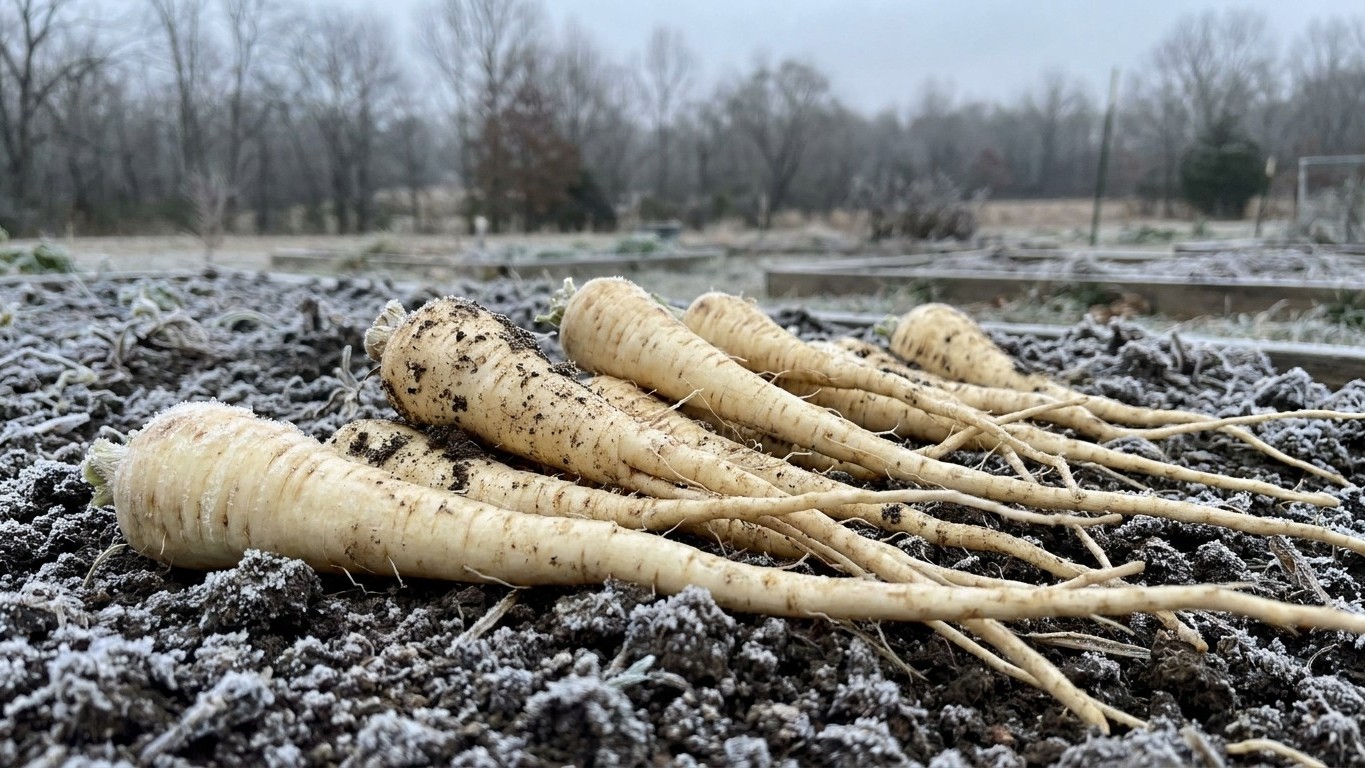

Georgia gardeners growing parsnip deal with a short list of pests: aphids, cutworms, and spider mites, all general feeders rather than parsnip specialists. Cutworms strike early, right after germination, while aphids and spider mites build through the warm months as the root sizes up. None of them follow the calendar. They follow soil temperature, plant age, and how long the parsnip has been in the ground.
Which pests attack parsnip in Georgia
UGA Cooperative Extension documents ten pests across Georgia’s vegetable garden crops: Aphids, Colorado potato beetle, Corn earworm, Cowpea curculio, Cutworms, Melonworm, Mexican bean beetle, Pickleworm, Spider mites, and Squash vine borer. That is the full list for this territory. Not all ten belong on a parsnip page, and pretending otherwise is how a gardener ends up scouting for the wrong bug.
Colorado potato beetle feeds on solanaceous plants, potatoes, eggplant, tomato, and has no reason to touch a root planted in the carrot family. Corn earworm targets corn ears and tomato fruit, structures a parsnip does not produce. Cowpea curculio is a pest of cowpeas and southern peas, a legume with nothing in common with parsnip roots or foliage. Melonworm, pickleworm, and squash vine borer are cucurbit specialists, tied to squash and melon vines, and a parsnip plant offers none of what they’re built to exploit. Mexican bean beetle needs bean foliage. None of these five insects have a documented reason to land on a parsnip bed, and none appear on this page beyond this explanation.
That leaves three: aphids, cutworms, and spider mites. All three are generalists, meaning they don’t specialize on any single crop family, and that’s exactly why they show up on parsnip even though the plant isn’t their primary host anywhere in the literature. Aphids cluster on new foliage and stems, feeding on sap and often leaving a sticky residue behind. Spider mites work the underside of leaves, especially during hot, dry stretches, and are easy to miss until damage is already visible. Cutworms operate at soil level, and the decisive fact here is timing: they do the most damage in the first two to three weeks after a seedling breaks ground, before the stem has toughened enough to resist being severed. Miss that window and the risk drops sharply on its own.
A short list isn’t a gap in reporting. It’s what the extension service has actually documented for Georgia gardens, and padding it with pests from other crop pages would only mislead anyone trying to match a real symptom to a real cause.
When each one shows up, and what it does first
Parsnip is sown directly in place, not transplanted, and germination alone takes 14 to 21 days, according to Utah State University Extension. That stretch of bare-looking soil is normal, not a failed planting, and it’s also the exact window when cutworms do their damage. A seedling that appears to vanish overnight, cut cleanly at the soil line, points to cutworms working after dark. Check for a grayish, curled larva just under the soil surface near the missing plant; that’s usually confirmation enough.
Georgia’s last spring frost falls between March 11 and March 29 in the Atlanta area, with north Georgia and the mountains freezing several weeks earlier and the coastal plain running milder. Parsnip seed goes in a couple of weeks before that date, so the cutworm-vulnerable window lands in late winter to early spring depending on where in the state a garden sits. Once seedlings clear that early stage and start producing true leaves, cutworm risk fades and aphids become the more likely visitor. Look for curled or puckered new growth, clusters of small soft-bodied insects on stems, and a faint stickiness on nearby leaves; that residue is aphid honeydew, and it often draws ants before a gardener ever spots the aphids themselves.
Spider mites tend to show up later in the season, as the parsnip works through its full 100 to 120 days to maturity and summer heat sets in. The first sign is usually a fine stippling or bronzing on leaf surfaces, sometimes with faint webbing on the undersides during heavier infestations. Because parsnip stays in the ground far longer than a typical summer crop, this window can stretch across most of the growing season, right up until the first fall frost, which lands between November 13 and December 1 around Atlanta. Cooler weather at that point tends to slow all three pests down at once, right as the roots start converting starch to sugar.
Telling the damage apart from everything else
Parsnip has a habit of producing symptoms that look like insect damage but aren’t, and the biggest offender is a forked or misshapen root. A forked root has two separate possible causes here, and they shouldn’t be merged into one explanation: heavy or stony ground that deflects the taproot as it grows, and inconsistent watering, particularly overwatering, that stresses the root during development. Neither has anything to do with the pests covered above, and no insect on the documented list feeds underground on the root itself.
Yellowed or bronzed foliage raises a similar question. Spider mite damage produces fine stippling and, in heavier cases, faint webbing on the leaf undersides, while a nutrient deficiency tends to spread more evenly across older leaves without any stippled texture. A quick look with a hand lens at the underside of a suspect leaf usually settles it: mites are visible as tiny moving specks, a deficiency shows nothing moving at all.
| Symptom | Possible cause | What distinguishes it |
|---|---|---|
| Seedling cut off at soil line | Cutworm | Larva visible just under soil near the base |
| Curled new growth, sticky residue | Aphids | Clusters of soft-bodied insects visible on stems |
| Stippled or bronzed leaves | Spider mites | Fine webbing on leaf undersides, tiny moving specks under a lens |
| Forked or misshapen root | Heavy/stony soil or overwatering | No insect present; check soil texture and watering routine separately |
None of this replaces a direct look by someone trained to tell these apart. If a symptom doesn’t clearly match one of the three documented pests or one of the two non-insect causes above, that’s exactly the kind of question a local extension office answers faster than any general description can.
What actually works here, and what is a waste of time
Given how short the cutworm window is, timing beats almost everything else. A physical collar around each seedling, pushed a couple of inches into the soil, placed at the moment of thinning blocks cutworms from reaching the stem during the only stretch when they’re a real threat. Once seedlings pass that early stage, the collar has done its job and cutworms stop mattering for the rest of the season.
Aphids and spider mites respond better to consistent monitoring than to any single fix. Checking the undersides of leaves every week or two during the warm months catches both early, before populations build to the point of visible leaf damage. A strong jet of water can knock aphid clusters down and buy time; letting the soil dry out completely between waterings tends to favor spider mites, so steady, even moisture works against both problems at once, and it happens to be the same watering discipline that helps prevent forked roots.
What doesn’t work is waiting until the root is already forked or already six weeks into cutworm season to look for a fix. A treatment can’t unfork a root that grew around a rock, and it can’t reattach a seedling that’s already been severed at the base. This site doesn’t recommend specific products or active ingredients, because what’s labeled and legal for use on parsnip changes by state and by season, and only the local extension service has that current list. Anyone considering a treatment beyond physical barriers and watering practice should confirm the specifics with that office before applying anything.
Where to check this for your own county
UGA Cooperative Extension is the authority for pest documentation across this state, and the local county office is where a specific garden’s situation gets checked against what’s actually present nearby. A pest list built for Georgia as a whole doesn’t guarantee any of the three pests are active in a particular yard this season, and it doesn’t rule out something the statewide list hasn’t flagged as a widespread concern either.
Georgia’s climate isn’t uniform enough to treat one part of the state as a stand-in for another. The mountains in the north freeze weeks earlier than the Atlanta area, and the coastal plain runs milder through both spring and fall. That spread affects when cutworm risk starts, how long aphids and spider mites stay active before cool weather slows them, and how many frosty weeks a parsnip crop actually gets before harvest, which matters directly for whether the roots turn sweet.
The next step for anyone with a suspect plant is straightforward: bring a sample, or a clear photo of the damage, to the county extension office rather than guessing from a general description. They can confirm whether it matches one of the three documented pests, point to a non-insect cause instead, and speak to what’s currently labeled for use in that county if a treatment is actually warranted.
Common questions
Do parsnip pests in Georgia include anything that attacks the root itself?
Not among the three documented here. Aphids and spider mites feed on foliage, cutworms attack seedling stems near the soil line, and none of them feed on a mature parsnip root underground.
Why does my parsnip taste bland even though the plants look healthy?
Sweetness comes from exposure to frost, not from a mild winter or a comfortable hardiness zone. A parsnip left in the ground through several frosty weeks after the first fall frost converts stored starch to sugar; one harvested before that exposure will taste starchy no matter how pest-free it grew.
My parsnip roots came up forked. Is that a pest?
No insect on the documented list feeds on the root itself. Forked roots trace back to heavy or stony soil deflecting the taproot, or to inconsistent watering, particularly overwatering, during development. Check soil texture and watering routine rather than looking for an insect.
How long after sowing should I expect seedlings to appear?
Germination takes 14 to 21 days according to Utah State University Extension. Bare-looking soil during that stretch is normal, not a failed sowing, and digging it up to re-seed usually does more harm than waiting it out.