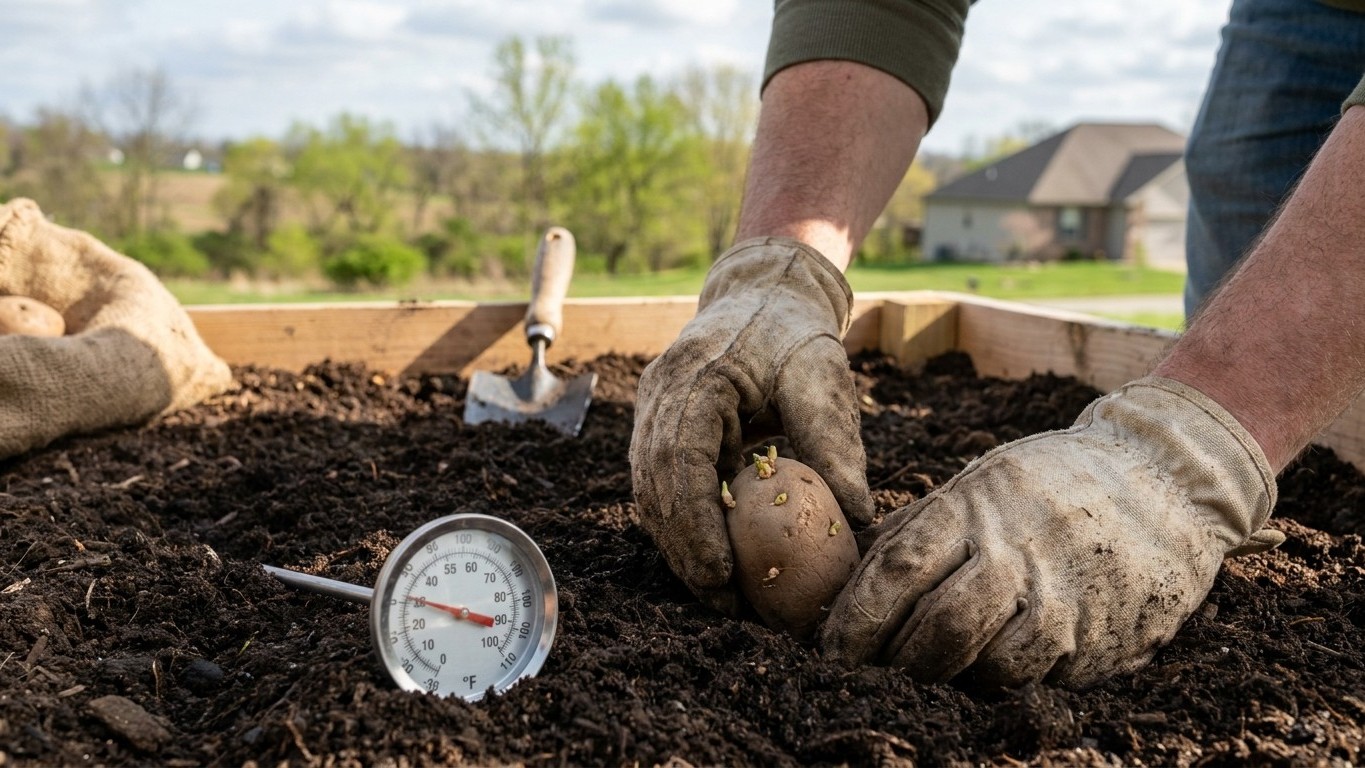

Ohio gardeners can count on a full potato season most years: Columbus averages just 15.3 days a year at 90 F or hotter, well under the threshold that halts tuber growth. Plant in mid-to-late April, timed to the May 5 to May 15 last frost window for zone 6a, and the bulk of tuber sizing happens before the hottest stretch of summer even arrives. Timing the planting, not the variety label, is what decides the harvest here.
The short answer

Two numbers govern whether a potato crop succeeds in Ohio, and neither of them is the variety you pick off the seed rack. The first is heat load: Columbus, the reference station for central Ohio climate data, logs a mean of 15.3 days a year at 90 F or above, according to NOAA NCEI Climate Normals covering 1991 to 2020. The second is the frost calendar: Ohio State University Extension’s Ohio Gardening Calendar puts the last spring frost for zone 6a between May 5 and May 15, which is why knowing When to Plant Potatoes in Ohio matters more than the variety label itself.
Put those two together and the picture is favorable. Utah State University Extension’s potato fact sheet is blunt about the mechanism that matters most: tuber set and fill are inhibited once soil temperatures climb above 90 F. That’s not an air temperature reading, it’s a soil reading, and it’s the ceiling every potato grower is really working against. In a state where 90 F air days are rare (barely more than two weeks a year on average), soil rarely stays hot enough long enough to shut the crop down completely. Ohio isn’t Arizona or inland Texas, where growers are forced into a narrow spring-only window before soil temperatures lock the plant out of bulking. Here, a potato planted on schedule has room to finish its season without racing the thermometer.
That doesn’t mean heat is irrelevant. Ohio still gets stretches of hot, humid weather in July and August, and soil under black plastic or in a south-facing raised bed can run hotter than the air above it. But with only about two weeks of 90-plus days spread across an entire summer, most Ohio gardens never sustain the soil heat long enough to stop tuber development outright. The bigger risk in this state isn’t heat killing the crop, it’s a grower planting too late and asking the plant to size tubers during the hottest weeks instead of before them.
Because Utah State and the University of Maine Cooperative Extension don’t publish days-to-maturity figures, the useful way to think about Potato Varieties That Suit Ohio is by season class rather than a specific calendar count, and that same timing logic carries through to Harvesting and Storing Potatoes in Ohio. Early-season potatoes finish their bulking earlier in the summer, before Ohio’s warmest stretch sets in, which is an advantage in a state where the frost-free window is generous but midsummer humidity can still stress plants. Mid-season varieties have more time to develop under Ohio’s normally mild summer ceiling, and because the state rarely holds sustained 90 F soil, they aren’t penalized the way they would be in a hotter climate. Late-season types are workable too, but they leave less margin if a given year runs hotter or wetter than normal.
When to plant here
The planting date isn’t picked from a calendar page, it’s calculated backward from the last frost window, and the arithmetic is the same one Utah State University Extension and the University of Maine Cooperative Extension both point to: potatoes go in the ground once soil temperature reaches 50 F, and that point typically falls 14 to 21 days before the last frost date.
- Start with the frost window. Ohio State University Extension lists the last spring frost for zone 6a as falling between May 5 and May 15.
- Count backward 14 to 21 days. Working from the early end of that window (May 5), 14 days back lands around April 21; 21 days back lands around April 14. Working from the later end (May 15), the same math lands between May 1 and May 8.
- That gives a planting range of roughly mid-April to early May for most of zone 6a Ohio, depending on where a given county falls inside that frost window and how quickly soil warms that particular spring.
- Check soil temperature directly rather than trusting the calendar alone. A simple soil thermometer pushed 4 inches deep, checked in the morning before the sun has warmed the surface, tells a grower whether the ground has actually hit 50 F, which matters more than the date on the wall.
This same backward-counting method works in any county, in any state, as long as a gardener knows the local last frost date. Swap in the local frost window, count back 14 to 21 days, and confirm with a soil thermometer before committing seed potatoes to the ground.
What the heat does to the crop
The mechanism is worth understanding because it explains why watering more doesn’t rescue a struggling potato patch in a hot stretch. Utah State University Extension’s fact sheet states plainly that tuber set and fill are inhibited by high temperatures, specifically once soils climb above 90 F. That’s not a matter of the plant wilting or looking stressed on the surface; it’s a physiological shutdown of the process that turns sunlight and stored starch into a growing tuber underground. Once the soil crosses that line, the plant can still be green and upright above ground while doing essentially nothing useful below it.
This is why irrigation isn’t the fix some gardeners assume it is. Extra water can cool soil somewhat and prevent outright plant collapse, but it does not lower soil temperature enough to restart tuber fill once that ceiling has been crossed for any sustained period. The plant needs the soil itself to cool, not just moisture at the roots.
In Ohio’s case, this mechanism matters less than it does in hotter states, precisely because of that 15.3-day average. With soil rarely holding above 90 F for extended stretches, most Ohio-grown potato crops complete their bulking without ever hitting the ceiling that stops the process. A potato planted in mid-to-late April, following the backward-counting method above, typically does the bulk of its tuber development in May and June, before Ohio’s hottest days of July and August even arrive. That’s the practical advantage of planting on schedule here: it isn’t just about avoiding frost, it’s about finishing the tuber-fill window before the calendar’s few 90 F days show up.
Gardeners who plant late, pushing seed potatoes into the ground in late May or June, are the ones who run into trouble in Ohio’s climate, not because the state is unusually hot but because a late-planted crop is still trying to size tubers right as whatever hot days the summer does produce arrive. The fix isn’t more water once that happens. The fix is planting early enough that tuber fill is largely finished before the heat shows up at all.
What goes wrong here
- Uncertified seed potatoes. Seed pulled from a grocery store bag or saved from a prior year’s uncertified stock often carries viruses invisible to the eye, and those viruses reduce yield season after season. Buying certified seed potatoes from a reputable supplier each year is the single most reliable way to avoid this failure.
- Planting into cold, wet soil before it reaches 50 F. Ohio springs can bring a warm stretch in early April that tempts an early planting, followed by cold, saturated soil that rots seed pieces before they sprout. Checking actual soil temperature with a thermometer, rather than trusting a warm afternoon, avoids this.
- Skipping the hilling and ending up with green tubers. Tubers that develop near the soil surface and get exposed to sunlight turn green and produce solanine, a compound that makes them unsafe to eat. Hilling soil up around the base of the plant as it grows keeps developing tubers covered and in the dark.
- Digging too early, before the plant has finished its work. Pulling potatoes as soon as they look big enough sacrifices yield and skin set. Letting the foliage die back naturally, rather than digging on a fixed date, lets the plant finish what the soil temperature allowed it to do.
Checking this against your own county
A statewide frost window is a starting point, not a fixed instruction, and Ohio’s geography moves it more than a quick glance at a calendar suggests. Elevation changes, proximity to Lake Erie, and the normal north-to-south gradient across the state all shift the last frost date by a week or more depending on where a garden actually sits. A county near the lakeshore can lag well behind a county in the state’s southern hills, even though both fall under the same general zone 6a label used above.
The most reliable next step is checking those specifics against a local source rather than assuming the statewide figure applies exactly to one particular yard. Ohio State University Extension maintains county-level offices and localized planting guidance that accounts for these regional differences, and that’s the resource worth consulting before finalizing a planting date for a specific address.
Common questions
Can Ohio gardeners grow a second, fall potato crop?
The facts used for this page don’t address fall planting specifically. What’s established is the mechanism: soil above 90 F halts tuber set and fill, and Ohio’s low count of 90 F days (15.3 a year on average in Columbus) means a spring-planted crop timed off the last frost date is the well-supported approach for this state.
Does mulching help keep soil cool enough for tuber fill?
Mulch is a common practice for moderating soil temperature, but neither Utah State University Extension nor the University of Maine Cooperative Extension source used here publishes a specific temperature benefit for mulch in relation to the 90 F tuber-fill ceiling. What is confirmed is that watering alone does not lower soil temperature enough once that ceiling is crossed for a sustained period.
Is there a difference between early and mid-season varieties for Ohio’s climate?
Both sources publish season class (early, mid-season, late) rather than specific day counts. In a state with a generous frost-free window and only about two weeks of 90 F days a year, both early and mid-season classes have enough time to complete tuber fill before summer heat becomes a factor, which isn’t the case in hotter states.
What soil temperature should I actually check for, and how deep?
The threshold cited by Utah State University Extension is 50 F soil temperature as the planting trigger, checked before the season begins, and 90 F as the ceiling that halts tuber set and fill later in the season. Neither source specifies a measurement depth in the facts used here, so following the thermometer manufacturer’s instructions and checking in the morning before surface warming skews the reading is the practical approach.