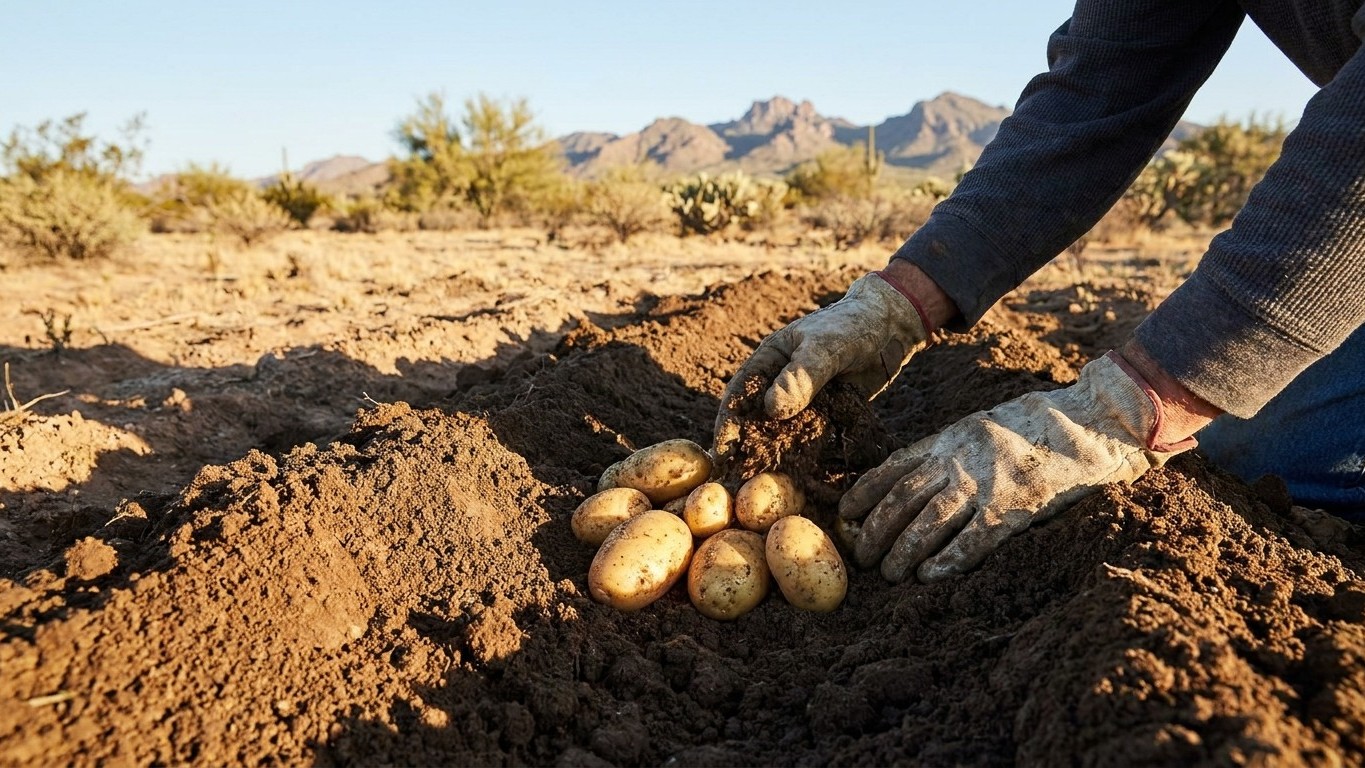

In low-desert Arizona, the deciding number isn’t the last frost date. It’s the count of days the soil bakes past 90 F, and at the reference station in Phoenix that’s 168.9 days a year on average, according to NOAA NCEI Climate Normals for 1991-2020. Frost barely registers here. Summer heat is what shuts a potato crop down, and the growing calendar has to be built around dodging it, not around a freeze that rarely comes.
The short answer

Potatoes can be grown in Arizona, but only as a spring crop that’s dug and done before the heat locks in. That’s the honest framing once you look at what 168.9 days above 90 F actually means for a plant whose tubers stop sizing once soil temperatures cross that same threshold. Utah State University Extension is explicit on this point: tuber set and fill is inhibited by high temperatures, specifically soils above 90 F. In a state where the reference city spends nearly half the year at or above that mark, there’s no version of a summer potato patch that works. The window that does work sits earlier, in the cooler months, when soil temperatures are still climbing rather than already parked in the 90s, and knowing exactly When to Plant Potatoes in Arizona is what makes that narrow window workable.
Frost, meanwhile, isn’t the obstacle gardeners in most of the country deal with. NOAA’s daily records for the Phoenix station show a 32 F reading in only 6 of the last 30 springs, and NOAA lists the frost-free season there as running all year. That’s not a typo-worthy exaggeration; it means the standard “count backward from last frost” planting logic, which works fine in Ohio or Minnesota, doesn’t apply to the low desert. The limiting factor flips: instead of waiting for the ground to warm up enough to plant, growers here are racing to get a crop planted and mostly finished before the ground gets too hot to let tubers keep sizing.
Where varieties fit into that window
Neither Utah State nor the University of Maine Cooperative Extension publishes a days-to-maturity number for potato varieties, and this page won’t invent one. What both sources do publish is season class, early, mid-season, or late, along with what a variety is best used for, baking or boiling. That’s useful in a short-window climate: an early-season variety gives the crop more room to finish sizing before soil temperatures climb, while a late-season variety asks for more of that cool window than the low desert reliably offers. A closer look at Potato Varieties That Suit Arizona breaks down which season classes actually match that constraint. Timing that window correctly also means knowing when to pull the crop, which is covered in detail in Harvesting and Storing Potatoes in Arizona.
| Season class | Typical use | Fit for a short cool window |
|---|---|---|
| Early | Boiling, all-purpose | Best match for a spring-only crop |
| Mid-season | All-purpose | Workable if planted at the very start of the cool window |
| Late | Baking | Riskiest choice; needs the most cool-soil time |
When to plant here
The backward-count method most gardening guides describe, work back 14 to 21 days from the last spring frost, doesn’t translate cleanly to low-desert Arizona, because there usually isn’t a last spring frost to count from. Here’s how the arithmetic actually works in a climate like this one.
- Set aside the frost calendar. NOAA’s daily records show Phoenix hit 32 F in only 6 of 30 recent springs, and the frost-free season is listed as 365 days. A “days before last frost” count simply doesn’t have a start date to work from in this climate.
- Watch a soil thermometer instead of a calendar date. Utah State University Extension’s rule holds regardless of region: potatoes go in once soil reaches 50 F, which normally falls 14 to 21 days before a last frost elsewhere. In the low desert, that 50 F reading is the trigger by itself.
- Plant as soon as that soil reading holds steady, not a week later. Every extra week spent waiting is a week shaved off the cool stretch before soil temperatures start climbing toward the 90s.
- Count forward from planting, not backward from frost. The target isn’t a frost date, it’s staying ahead of the point where soil crosses 90 F and tuber set and fill stop, per Utah State’s fact sheet.
- Treat high-elevation Arizona differently. Flagstaff-elevation ground does freeze hard, and the standard backward count from last frost applies there the way it would in a cold-winter state. Check county-level numbers before assuming the low-desert math applies statewide.
What the heat does to the crop
The mechanism is simple, and it’s the whole story for this state. Above 90 F in the soil, tuber set and fill stop, according to Utah State University Extension. That’s not a slowdown that recovers once temperatures drop for the evening. It’s a hard ceiling: the plant stays alive, foliage may keep growing, but the underground work of sizing tubers halts while soil sits above that mark.
Phoenix racks up 168.9 such days a year on average, per NOAA NCEI Climate Normals. Stretch that out and it covers most of late spring through early fall. A potato crop planted with any expectation of a full summer season runs straight into that wall within weeks of the soil warming past the threshold. What that means practically is that Arizona doesn’t get a summer potato crop the way a cooler state might. It gets a spring crop, planted as soon as soil hits 50 F, grown through the remaining cool weeks, and dug before the soil climbs into the 90s for good.
Watering doesn’t change any of this. It’s a common assumption, since heat stress in other crops often responds to extra irrigation, but tuber set and fill responding to soil temperature isn’t a moisture problem. A well-watered potato plant sitting in 95 F soil still isn’t sizing tubers, because the threshold that’s stopping the process is thermal, not related to drought stress. Extra water keeps the plant from wilting; it does nothing for the tubers underground. That’s worth knowing before sinking a summer’s worth of irrigation into a crop that’s already past the point where it can respond.
What goes wrong here
- Planting uncertified seed potatoes. Seed potatoes carry viruses invisibly, and an infected planting can look fine above ground while producing a weak, undersized harvest. Buying certified seed potatoes is the fix, and it’s the single easiest failure to prevent.
- Planting into soil that’s still cold and wet. Seed potatoes rot in cold, saturated ground before they ever sprout. The remedy is the soil thermometer check described above: wait for a steady 50 F reading rather than guessing off a calendar date, since a warm afternoon doesn’t mean the ground underneath has caught up.
- Skipping hilling and ending up with green tubers. Tubers that push up near the surface and catch sunlight turn green and develop solanine, which makes them unsafe to eat. Hilling soil up around the stems as the plant grows keeps tubers covered and prevents this outright.
- Digging too early, before the plant has finished its work. Digging as soon as the crop looks done can catch tubers before they’ve finished sizing, especially in a compressed spring window. Watching for foliage die-back before digging, rather than digging on a fixed date, gives the crop its full cool-season runway.
Checking this against your own county
A statewide figure like 168.9 days above 90 F is measured at one station, Phoenix, and it’s not the number for every county. Elevation moves these thresholds by weeks: a garden at higher elevation in northern Arizona sees a cooler soil profile and a real frost season, while low-desert counties further south may see the 90 F threshold arrive even earlier in spring than Phoenix does. North-south differences within the state matter just as much as elevation does.
The fix is straightforward: check current soil temperature and frost data for the specific county before planting, rather than relying on a statewide average. University of Arizona Cooperative Extension publishes county-level guidance and is the right first stop for anyone trying to pin down local numbers before committing seed potatoes to the ground.
Common questions
Can potatoes be grown through an Arizona summer?
Not in the low desert. Utah State University Extension’s threshold, soil above 90 F halting tuber set and fill, runs headlong into Phoenix’s 168.9 annual days at or above that mark. The workable approach is a spring crop planted early and dug before the heat arrives, not a season that carries through summer.
Does extra watering protect potatoes from the heat?
No. The mechanism that stops tuber set and fill above 90 F is thermal, tied to soil temperature, not to soil moisture. Irrigation keeps the plant from wilting but doesn’t restart tuber sizing once soil has crossed that threshold.
Why doesn’t a frost-based planting calendar work here?
Because NOAA’s daily records show Phoenix reached 32 F in only 6 of the last 30 springs, and NOAA lists the frost-free season there as 365 days. There’s rarely a last frost date to count backward from, so the planting trigger has to be soil temperature, watched with a thermometer, rather than a calendar date tied to frost.
Are all Arizona counties on the same planting schedule?
No. Elevation and north-south position shift both the frost picture and the arrival of 90 F soil by weeks between counties. High-elevation areas like Flagstaff have a real frost season and a different set of rules entirely. Checking with University of Arizona Cooperative Extension for county-specific numbers is the reliable way to adjust the statewide figures to a particular garden.