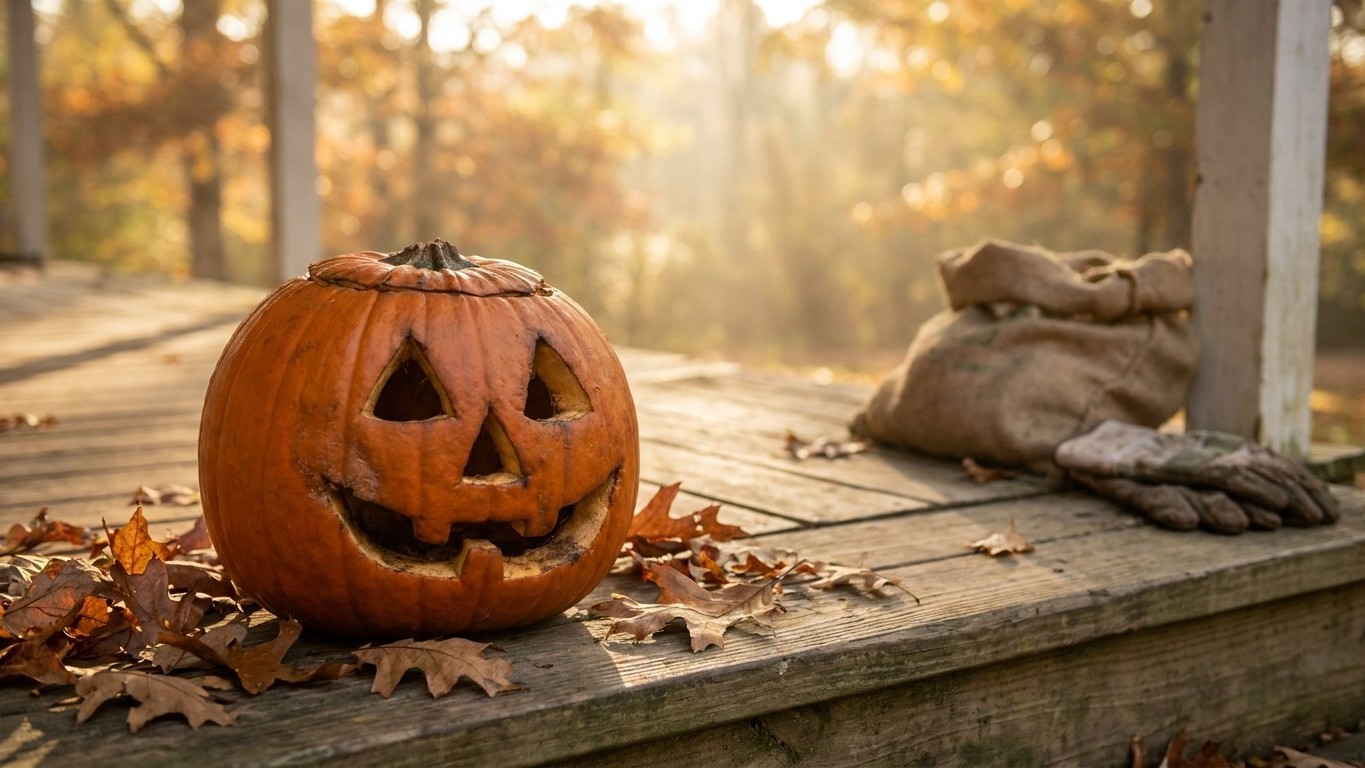

Georgia’s growing season runs long, and that changes the pumpkin math most Halloween guides assume. Frost here typically arrives weeks after trick-or-treating ends, so the real deadline for a jack-o’-lantern isn’t cold, it’s warmth working against a cut pumpkin sitting out in the mild Southern fall. Here’s what the numbers say about picking the right week, and the right day, to carve.
The short answer

Around the Atlanta area, the mean first fall frost falls somewhere between November 13 and December 1, based on 1991-2020 NOAA Climate Normals for that station. That’s an average across three decades, not a guarantee for any single year, so treat it as a rough marker rather than a date circled on the calendar.
What that means for Halloween: this window lands three to five weeks after October 31. Trick-or-treaters will have come and gone long before frost is even a possibility for most of the state. That flips the usual pumpkin-carving logic. In places where frost lands before Halloween, the frost date becomes the countdown clock, forcing an early carve before the vine or the porch pumpkin freezes. Georgia doesn’t have that constraint. A pumpkin left whole outside through late October in most of the state won’t see freezing temperatures at all.
That should be good news, except the absence of frost doesn’t remove the problem, it just moves it from cold to warmth. Without frost forcing an early harvest, the temptation is to buy a pumpkin in early October and carve it right away to enjoy it longer. In Georgia, that timing usually backfires. Warm days, even in late October, push air temperatures well above the 45-50 F range a pumpkin needs to stay firm, and a carved pumpkin exposed to that kind of warmth softens faster than it would in a colder climate.
The practical window: keep the pumpkin whole and uncarved for as long as possible, and save the actual carving for the last day or two before Halloween. That’s not a research-backed shelf life claim, it’s a matter of matching the cut to the state’s mild fall weather. The later the carve happens relative to Halloween night, the less time the pumpkin spends exposed to Georgia’s still-warm October air with an open cut surface inviting decay.
For north Georgia and the mountains, where fall arrives measurably earlier than at the Atlanta reference station, that window opens a little further from Halloween. For the coastal plain and south Georgia, where fall stays milder longer, the case for carving late is even stronger.
Frost or heat: which one gets it here
The cold end
Georgia’s coldest month, typically January, averages a mean daily minimum of 35.6 F at the Atlanta reference station. That figure, the mean minimum of the coldest month, is what decides whether a plant, or a stored pumpkin, faces meaningful freezing risk in an ordinary year, and it sits above freezing even at the depth of winter. October, the month most pumpkins actually get carved, runs considerably warmer than that.
Put those two facts together and cold simply isn’t the threat here. A pumpkin stored on a porch or in a garage through most of October in Georgia isn’t at real risk of freezing. The mean first frost window of November 13 to December 1 confirms it: freezing temperatures are a late-fall event in this state, not an October one. Anyone worried about a pumpkin freezing solid before Halloween in Georgia can set that worry aside.
The warm end
The other side of the 45-50 F storage band is where Georgia actually struggles. Daytime highs in late October frequently push well past that range across the Piedmont and south Georgia, and even overnight lows often stay above it on the coastal plain. A pumpkin sitting in a sunny spot, on a porch or in the yard, spends long stretches of the day at temperatures the whole-pumpkin storage guidance never anticipated.
That warmth speeds up softening and decay, especially once the skin is broken by a knife. It’s why storage location matters more here than storage duration: since frost won’t force the issue, keeping the pumpkin out of direct heat and sun becomes the main lever a Georgia homeowner actually controls. North Georgia and the mountains cool off measurably earlier than the Atlanta area, which eases this problem somewhat at higher elevations. The coastal plain, milder for longer, faces the heat side of this equation the hardest.
Where to keep it until you carve
Georgia’s late-October warmth means storage location matters more here than in colder states. The goal is a spot close to 45-50 F and dark, away from heat sources and away from anything ripening.
- A basement or cellar, if the house has one. These stay cooler and darker than any other part of a Georgia home through October, often landing close to the 45-50 F band even when the outside air runs warmer.
- An attached, unheated garage, kept out of direct sun. Garages run warmer than basements but still stay meaningfully cooler than a sunlit porch. Keep the pumpkin off the concrete floor, on cardboard or a shelf, to limit temperature swings.
- A north-facing porch or covered entryway, never one that faces south or west. Direct afternoon sun in Georgia in October pushes surface temperatures on a pumpkin well past 50 F, even on a mild day.
- Away from any ripening fruit or vegetables. Apples, tomatoes, and potatoes give off a gas as they ripen that ages a pumpkin faster. A table shared with a bowl of apples is one of the worst combinations for a pumpkin meant to last until Halloween.
- Off the ground and away from sprinkler or irrigation lines. Standing moisture against the rind, common in Georgia’s humid fall air, invites soft spots before the pumpkin ever meets a knife.
One more factor works alongside location: the stem. Look for 1 to 2 inches of stem left on the pumpkin at the store or patch, and handle it by the base, never by the stem itself. Once that stem snaps off, the exposed spot becomes an easy entry point for rot, undoing whatever good a cool, dark spot was doing. A pumpkin with a full stem and blemish-free skin, kept in one of the spots above, gives itself the best chance of looking sharp on Halloween night.
Checking this against your own county
Georgia stretches from the mountains near the Tennessee and North Carolina lines down to the coastal plain along the Atlantic and the Florida border, and fall arrives on a real gradient across that range. The November 13 to December 1 frost window reflects one reference station near Atlanta; a location in the north Georgia mountains likely sees frost measurably earlier, while a spot near the coast or Savannah likely sees it later still.
The University of Georgia Cooperative Extension keeps county-level data and staff who can answer exactly where a given address falls on that gradient. Reaching out to the local county extension office, through extension.uga.edu, is the fastest way to confirm frost timing for a specific address rather than relying on a single statewide reference point.
That local check matters most for anyone growing pumpkins directly, since a vine in the ground responds to the real local frost date, not the state average. For anyone storing a store-bought pumpkin on a porch, the bigger local variable is simply how warm that porch runs in late October, which county extension staff can also speak to from firsthand regional experience.
Common questions
Does Georgia ever get frost before Halloween?
Based on the mean first fall frost of November 13 to December 1 at the Atlanta reference station, frost typically arrives well after Halloween across most of the state. North Georgia’s mountains can see earlier frost in some years, but the 30-year average points to a late-fall arrival, not an October one.
How long does a carved pumpkin last in Georgia?
No extension service publishes a specific figure for how long a carved pumpkin lasts, in Georgia or anywhere else. What is published is how to store a whole pumpkin, three to six months in a cool, dark spot between 45-50 F, and how to choose one that resists spoiling in the first place. Carve close to Halloween and expect Georgia’s late-October warmth to shorten how long a cut pumpkin holds up compared to a colder climate.
Should I refrigerate a pumpkin to keep it cool in Georgia?
Extension guidance for whole pumpkins calls for a cool, dark location between 45-50 F, not a refrigerator, and a full-size pumpkin usually won’t fit in one anyway. In Georgia, that realistically means a basement or an unheated garage rather than a kitchen appliance built for food, not squash-sized produce.
Does the stem really matter that much?
Yes. University of Illinois Extension guidance calls for 1 to 2 inches of stem left on the pumpkin, since once it breaks off, that section becomes exposed and the pumpkin is more likely to spoil early. The stem is a seal, not a handle, so lift and carry the pumpkin by its base.