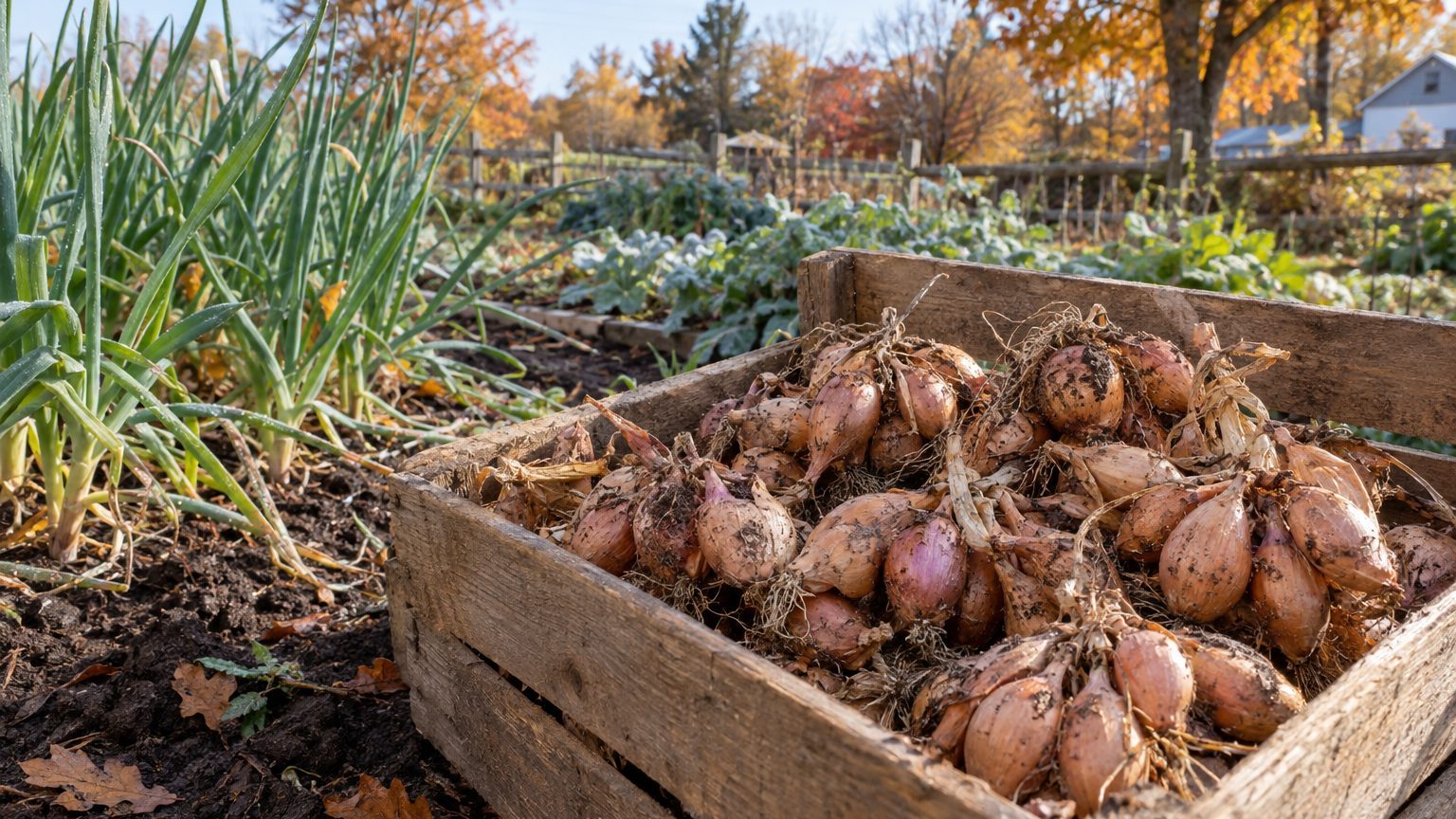

Plant multiplying shallots, the kind grown from small bulbs or sets, in fall and harvest them in late spring or early summer. That is the Georgia answer by type. Seed-grown shallots come second, and spring-planted sets rank last. Georgia’s long, mild season suits a crop that grows through winter, but the warm, humid early summer decides which types finish well. In this state, planting time and type matter more than the variety name on the packet.
The short answer for Georgia
The best shallots for Georgia are fall-planted multiplying types, grown from sets that split into a cluster of bulbs. Red, gray and yellow shallots all come in this form, and they share the same logic: roots and leaves grow in cool weather, and bulbs swell as days lengthen in spring.
Atlanta’s climate normals show why this works. The mean daily minimum of the coldest month is 35.6°F (NOAA NCEI Climate Normals 1991-2020, Atlanta reference station), just above freezing. Winter here slows shallots rather than stopping them. The 32°F freeze dates sit in a window: the last spring freeze falls between March 11 and March 29, and the first fall freeze between November 13 and December 1. Both ranges are the band where the chance of a 32°F freeze is between 30 and 70 percent (NOAA NCEI 1991-2020 normals, station USW00013874). They are probabilities, not guarantees, so a late freeze in April or an early one in early November can still happen. Shallot foliage handles a light freeze well, so these dates describe the season more than they set a deadline.
The season between those two windows is long. Shallots do not need all of it, but fall planting uses the cool half of it, when little else in the garden is competing for the bed.
The decision by type
| Type | When it goes in | Fit for Georgia |
|---|---|---|
| Multiplying shallots from sets (red, gray, yellow) | Fall | Best choice. Full cool season to build roots and foliage before bulbing. |
| Seed-grown shallots | Started early, set out while weather is cool | Workable. Cheap to grow, but seedlings must size up before the heat arrives. |
| Sets planted in spring | Late winter to early spring | Weakest. Little cool weather left, so bulbs run small. |
This page has no Georgia trial results for named cultivars, so it ranks types rather than naming a single winner. Exact fall dates are on the When to Plant Shallots in Georgia page, and the broader picture is in Growing Shallots in Georgia.
What will not work here
Waiting until spring to plant fails first. With the last spring freeze landing between March 11 and March 29 at the Atlanta reference station, the warm weather that follows arrives fast. Shallots bulb in response to lengthening days and rising temperatures, so a set planted in March has only a few cool weeks to build leaf area. Leaf area is what the bulb is made from. Small leaf canopy, small bulbs. Northern planting guides that say “plant as soon as the soil can be worked in spring” were written for places where summer holds off until July.
A short-season worry does not apply here, which is itself a point worth stating. Even the narrow end of the frost window leaves a long stretch between the last spring freeze and the first fall one. Slow, long-maturing shallots are not penalized by the calendar. What penalizes them is humidity. A variety that wants a dry, steady finish in July struggles in Georgia’s wet early summers, where bulbs sit in damp soil just as they should be curing.
Tight spacing is the second mistake. Multiplying shallots form clumps, and in humid air a crowded clump stays wet inside. Moisture trapped between stems and bulbs invites fungal disease and rot. Give each set room so air moves between plants, and skip the thick mulch that suits colder states. With the coldest-month average minimum at 35.6°F, a heavy winter blanket protects against a hard freeze Atlanta rarely delivers. Thick wet mulch in a mild winter mostly keeps crowns soggy.
Leaving mature bulbs in the ground also backfires. Once the tops yellow and fall over, the bulbs are done growing, and each additional rainy week raises the chance of rot. Pull them, then cure them somewhere shaded with moving air. A closed garage or humid porch is a poor curing spot in a Georgia June.
Last, a weekly-watering habit carries over badly from drier states. This page has no Georgia rainfall figure, so it cannot tell you how much to water. It can say that winter growth in mild weather often needs little added water, and that overwatering in late spring works against bulb curing.
What changes across Georgia
Georgia is not one garden. The USDA Plant Hardiness Zone Map (2023 edition, built on 1991-2020 normals) places the state in zones 6a through 9b, which is eight half-zone steps from the mountains to the coast. The map rates one thing only, the average annual extreme minimum temperature, so it says how cold the worst nights get, not how hot or wet summer runs. No single recommendation covers that whole spread.
The Atlanta figures on this page are a reference point, not a statewide average. Atlanta’s airport station is an urban heat island. North Georgia and the mountains freeze several weeks earlier in fall, and the coastal plain runs milder. Treat the March and November windows as Atlanta’s, and shift from there.
A reader in the north or at altitude should lean earlier. Planting sooner in fall gives roots time to establish before the ground gets properly cold, and a light mulch applied after the soil cools is reasonable there, unlike in Atlanta. Harvest will also come later than in the metro area, since spring warmth arrives later on a slope or ridge. Shallots are hardy plants, so the real risk is not the cold itself. It is a set that went in too late to root.
Down toward the coastal plain, the shift runs the other way. Fall planting can go later, winter growth is steadier, and harvest comes earlier. The weak point there is the heat and humidity of early summer, which makes early lifting and good air movement even more important. If your garden sits in a low pocket where cold air settles, expect frost later in spring than a neighbor on higher ground, whatever the regional dates say.
To find your own zone, use the USDA Plant Hardiness Zone Map and look up your ZIP code. Do not guess from the state’s range, because a reading near either end changes the planting date by weeks.
Where to check this for your own county
Your state extension service is the next stop. University of Georgia Extension runs county offices across the state, and agents there know the local soil, rainfall and disease pressure in a way no state-level page can.
Two things are worth looking for. First, a local planting calendar for onions and other alliums, since shallots often get listed alongside onions or garlic rather than on their own. A calendar tied to your county will carry dates that account for your elevation and your typical last and first freeze. Second, any list of varieties trialled or recommended for your county. A variety that performed in a university plot a few counties over has more weight than one praised in a catalog written for the whole country.
If you cannot find shallot-specific guidance, ask your county office directly. Agents field onion-family questions often, and they can tell you whether bulb rot or fungal leaf disease has been a problem in your area recently. This page has not confirmed that a dedicated UGA shallot publication exists, so ask rather than assume.
A county recommendation beats a state one. This page is the state one: it draws on a single reference station in Atlanta, a statewide hardiness range, and general behavior of the crop. It can tell you which type to favor and what tends to go wrong. It cannot tell you the best planting week for a clay yard in the Piedmont or a sandy lot near the coast.
Checking this against your own garden
Every date on this page is an average, and your bed has its own record. Three observations will tell you more than any calendar.
- Soil warmth by feel. In fall, push your fingers a few inches into the bed. If the soil still feels warm like bathwater, wait. If it feels cool and slightly damp, it is ready for sets. A bed that cools weeks before another in the same yard tells you which spot is shaded, low or exposed.
- First green shoots. Note how many days pass between planting and the first green tips. Fast emergence means a warm, sheltered spot. Slow emergence points to a cold pocket or heavy, wet soil.
- The tops. A tall flower stalk is a bolting signal and means that clump will not size up well. Yellowing, flopping tops mean harvest. If tops fall earlier in one corner than another, that corner runs hotter or drier, and next year’s planting there should go in earlier.
Write the dates down once. After a season you will have a local calendar that beats any regional one. Then save the biggest, firmest bulbs from the harvest for replanting, since multiplying shallots can be replanted from your own crop, which slowly selects for what thrives in your yard.
Common questions
Can I plant shallots in spring in Georgia?
You can, but results are weaker. Spring-planted sets get little cool weather before heat arrives, so bulbs tend to stay small. Fall planting is the better bet.
Are sets or seed better for Georgia?
Sets are the easier route and the better default. Seed-grown shallots can work if seedlings are started early enough to size up before summer heat.
Do shallots need heavy winter mulch in Georgia?
Not at the Atlanta reference station, where the coldest month averages a daily minimum of 35.6°F. Higher elevations in north Georgia may justify a light layer after the soil cools.
Which named variety is best for Georgia?
This page does not have county or state trial data for named cultivars, so it will not pick one. Check University of Georgia Extension for varieties trialled near you.