
Georgia gardeners dealing with damaged spinach are usually looking at one of three insects: aphids, cutworms, or spider mites. UGA Cooperative Extension documents a short list of vegetable pests for this territory, and only some of them ever touch a spinach leaf. The rest belong to squash, beans, corn, or potatoes growing in the same bed.
Which pests attack spinach in Georgia
UGA Cooperative Extension documents ten insect pests for vegetable gardens in this territory: Aphids, Colorado potato beetle, Corn earworm, Cowpea curculio, Cutworms, Melonworm, Mexican bean beetle, Pickleworm, Spider mites, and Squash vine borer. That’s the full list this office publishes for the state, and it’s short on purpose. It’s not a spinach-specific list, it’s a garden-wide one, which means most of the names on it have nothing to do with a bed of greens.
Start with what to cross off. Colorado potato beetle feeds on potato, tomato, and eggplant foliage, all members of the nightshade family, and has no business on a spinach leaf. Corn earworm targets corn ears and tomato fruit, not the tender leaves of a cool-season green. Cowpea curculio is a bean and pea specialist that punctures pods, something spinach doesn’t grow. Melonworm, pickleworm, and squash vine borer are all cucurbit pests, tied to squash, melons, and cucumbers, and Mexican bean beetle does exactly what its name says. None of these five are documented spinach feeders, and seeing one in a garden doesn’t mean spinach is next in line.
That leaves three generalists that actually matter here: aphids, cutworms, and spider mites. All three are broad feeders that don’t care much what leaf is in front of them, which is why they show up on beans, squash, and greens alike. The decisive fact for spinach is timing, not the pest itself: this crop only has a short cool window on each end of the year to grow before the plant bolts, so pest pressure that arrives during that window matters far more than pest pressure that shows up in the heat of summer, when spinach isn’t even in the ground.
That narrows the practical answer considerably. A Georgia gardener checking spinach for damage is really watching for three things, not ten, and the other seven names on the extension list belong to a different part of the vegetable patch.
When each one shows up, and what it does first
Spinach in this state grows in a narrow band of cool weather bookended by a last spring frost that falls between March 11 and March 29, and a first fall frost between November 13 and December 1. Everything a spinach grower deals with, pests included, happens inside or just around that window, because the plant itself won’t tolerate what comes before or after it.
Cutworms are usually the first problem, and they show up right at the start of the plant’s life. A gardener sowing spinach as soon as the soil can be worked near the last frost date may find seedlings clipped clean at the soil line within days of emergence, sometimes overnight. The plant simply isn’t there anymore, cut through rather than eaten from the edges. That’s the signature of a cutworm, and it happens early, before the plant has any size to spare.
Aphids come next, as the weather warms toward the season’s growth ceiling. Spinach grows best where temperatures stay under 75°F, and as the spring stretch pushes closer to that mark, aphid colonies build on the undersides of leaves and along new growth. The first sign isn’t usually the insect itself, since aphids are small and pale green, but curled or puckered leaf tissue and a faint stickiness on the foliage from the honeydew they leave behind.
Spider mites show up latest, and they’re a heat problem more than a spring problem. This part of the state averages 35.8 days a year at 90°F or above, and that heat load is exactly what spider mites thrive on. Once conditions turn hot and dry, whether that’s a late spring crop pushed past its comfort zone or a fall crop planted too early, mites cause fine stippling and a dusty, bronzed look on the leaf surface, usually starting on the older, lower foliage before spreading upward.
None of this runs on a calendar date fixed to a particular month, because Georgia’s frost dates and heat load shift depending on where in the state a garden sits. What stays constant is the order: cutworms at emergence, aphids as warmth builds, mites once real heat sets in.
Telling the damage apart from everything else
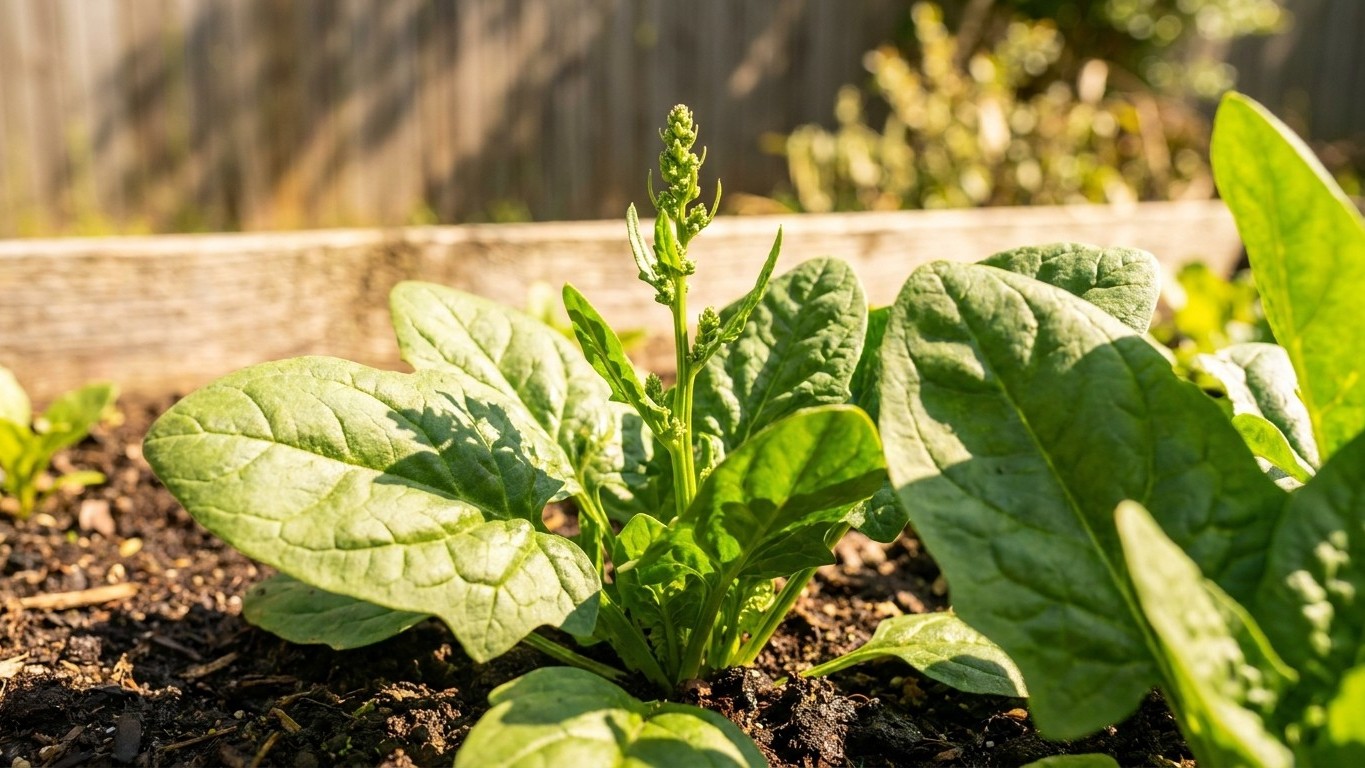
Spinach fails for plenty of reasons that have nothing to do with insects, and mixing those up wastes time treating a problem that isn’t there. The single most important line to know is 75°F, which is both the growth ceiling for this crop and the point past which it turns bitter and starts to bolt. A spinach plant that suddenly sends up a tall central stalk isn’t being eaten. It’s bolting, triggered by long days and warm temperatures, and no insect treatment will stop it.
| Symptom | Looks like a pest, but often isn’t | What distinguishes it |
|---|---|---|
| Yellowing leaves | Aphid feeding | Aphids cluster visibly on leaf undersides and stems; uniform yellowing without insects points to a nutrient issue |
| Seedling gone or toppled | Cutworm | A clean cut at the soil line means cutworm; a torn or bent stem often means mechanical or weather damage |
| Stippled, dusty leaves | Spider mites | Fine webbing on the underside confirms mites; scorched edges without webbing suggest heat or water stress |
| Tall central stalk, bitter leaves | Not a pest | This is bolting, driven by day length and the 75°F ceiling, not insect feeding |
Soil moisture problems and heat stress mimic mite damage closely, since both leave leaves looking dry and faded. Seed that fails to come up at all is often a soil temperature issue rather than a pest one, since spinach germination drops once soil climbs above 80°F. A gardener who isn’t sure which of these is happening is better off describing the symptom, and where on the plant it appears, to a local expert than guessing from a photo online.
What actually works here, and what is a waste of time
On a crop with this short a season, the calendar does more work than any treatment does. A physical barrier put in place at the moment of sowing, before cutworms or aphids ever find the bed, beats almost anything applied after damage appears. Once a stand of seedlings has already been clipped off, there’s nothing left to protect.
Timing also governs the fall crop, and it’s easy to get backwards. The autumn planting window doesn’t open because of cooler air, it opens once soil temperature drops, since spinach seed germinates poorly once soil runs above 80°F. Sowing too early into warm soil in late summer, chasing a head start on fall pest pressure, usually just means poor germination rather than an early harvest.
Broad treatments applied on a hunch are close to a waste of effort here. Spinach’s growing window is short enough that a treatment timed to the wrong stage does nothing useful, and treatments applied while a plant is already bolting from heat and day length won’t reverse that process, because bolting isn’t insect damage in the first place. The state’s extension service is the only reliable source for what’s actually approved for use on food crops in Georgia, and that’s a decision best made with a county agent rather than guessed from a label at a garden center.
What holds up across seasons is simple: protect seedlings physically right at sowing, watch soil temperature before an autumn planting rather than the thermometer for air, and treat bolting as a scheduling problem, not a pest one.
Where to check this for your own county
UGA Cooperative Extension is the authority for this state, and its county offices are where a garden-specific answer actually lives. The statewide list of ten pests says what’s been documented across Georgia as a whole. It doesn’t say what’s active in a particular backyard in a particular week, and pest pressure inside this state varies by region, soil, and even by neighborhood.
The next useful step is a call or visit to the county extension office, not another search online. A local agent can confirm whether a symptom on a spinach bed matches aphids, cutworms, or spider mites, or something else entirely that a statewide list wouldn’t capture. That’s the difference between a general pattern for Georgia and an answer for one specific garden.
Common questions
Does UGA Cooperative Extension list spider mites as a common spinach pest specifically?
The office documents spider mites as a vegetable garden pest for this territory generally. Spinach isn’t singled out, but mites are generalist feeders and the heat load in this state, with an average of 35.8 days a year above 90°F, creates conditions they favor.
Can spinach be replanted after cutworms take out a seedling stand?
That depends on how much of the growing window remains before the plant would hit the 75°F growth ceiling in spring, or before soil warms past 80°F heading into summer. A local extension office can help judge whether there’s enough season left.
Is bolting a sign of pest stress?
No. Bolting in spinach is triggered by long days and warm temperatures, not by insect feeding. A plant sending up a central stalk is responding to daylight and heat, and no pest treatment changes that.
Why doesn’t squash vine borer show up on a spinach pest list?
Because it’s a cucurbit-specific pest, tied to squash, melons, and cucumbers. It’s documented for this state’s gardens overall, but it has no documented connection to spinach.