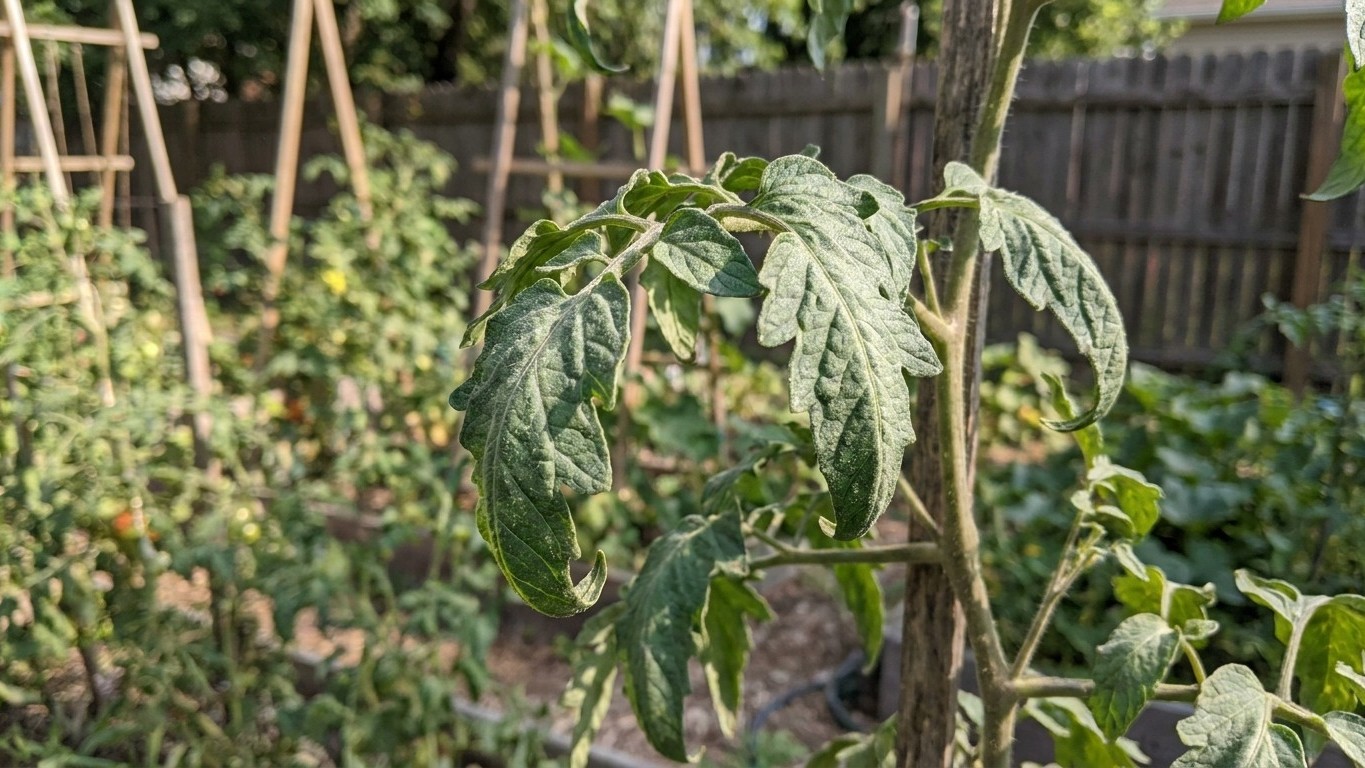

Curling tomato leaves are usually a sign of environmental stress like heat, drought, or uneven watering, and the plant grows out of it once conditions settle. Less often, the cause is herbicide drift or a viral infection, and those need a different response entirely. This page walks through how to tell the three apart, what to do for each one, and which habits keep it from coming back.
What you are looking at

The first thing to check is which leaves are curling and which direction they are moving. If it is the older, lower leaves rolling upward along the midrib so the leaflet looks like a canoe or a taco shell, and the leaf tissue is still uniformly green, you are almost certainly looking at physiological leaf curl. It is cosmetic, not a disease, and the plant keeps growing and fruiting normally around it.
Herbicide injury looks different and usually shows up on new growth first. Leaflets twist, cup downward instead of up, and often narrow into a strappy, fern-like shape. Stems on the newest growth may spiral or curve like a corkscrew, and the growing tip can look stunted or distorted within days of exposure. This is a fast, dramatic change, not a slow rolling over a week or two.
Viral curling tends to travel with company. Look for leaf distortion paired with yellowing, mottled or mosaic-patterned color, purplish leaf veins, or stunted new growth that never fills out normally. Unlike physiological curl, viral symptoms usually get worse over time rather than easing off, and they often show up on some plants in a row while neighboring plants stay completely clean.
What it is not
Do not confuse any of the above with pest feeding damage. Aphids, broad mites, and russet mites all cause distorted, curled new growth too, but you can usually find the insects themselves, or their shed skins and webbing, on the underside of affected leaves with a hand lens. If you see live pests, that is your answer before you go looking at soil moisture or spray records.
What actually causes it
Physiological leaf curl is the plant’s own response to stress, most commonly a swing between hot, dry conditions and a heavy watering, or root stress from being pot-bound or planted too deep in wet soil. The plant reduces the surface area of its leaves to cut water loss, rolling them inward. This gets blamed on disease or nutrient deficiency constantly, but there is no pathogen and no fix required beyond addressing the moisture swing. It is an adaptation, not a symptom of damage.
Herbicide damage works through a completely different mechanism. Growth-regulator herbicides, the phenoxy and pyridine types used widely on lawns and pastures, mimic the plant’s own auxin hormone. In broadleaf weeds this hormone overload is fatal; in tomatoes, which are also broadleaf, it triggers uneven cell growth called epinasty, twisting stems and leaflets in the characteristic corkscrew pattern. Exposure can come from spray drift on a windy day, from contaminated grass clippings or manure used as mulch or compost, or from herbicide residue left in a sprayer that was later used for something else on the tomato bed.
Viral curling is caused by an actual pathogen, and it typically arrives by insect vector rather than by chance. Whiteflies transmit some of the more aggressive curl viruses, while aphids and mechanical contact (hands, tools, even taking cuttings) spread others. The virus interferes with normal cell division in new tissue, which is why distortion, mottling, and stunting show up together on the newest leaves rather than as a clean, uniform curl.
The fastest way to sort these three apart in the field: check whether the whole plant or the whole row is affected uniformly, or just a few plants scattered among healthy ones. Uniform stress across the bed points to watering or heat. A sudden twist appearing after mowing or spraying nearby points to herbicide. A patchy, worsening pattern with yellow mottling points to virus.
| Cause | Where it shows first | Key tell | Recoverable? |
|---|---|---|---|
| Physiological stress | Older, lower leaves | Leaf color stays uniform green | Yes, on its own |
| Herbicide drift | New growth, growing tip | Corkscrew stems, strappy leaflets | Often, if exposure was mild |
| Viral infection | New growth | Mottling, yellowing, worsens over time | No, not for the infected plant |
What to do now

If the pattern points to physiological stress, there is nothing to treat. Even out your watering so the soil stays consistently moist rather than swinging between bone-dry and soaked, and the new growth that emerges should come in flat and normal. Fruit already on the vine is unaffected.
If it is herbicide drift and the exposure was light, a lot of plants pull through. New growth that emerges after the exposure stops is usually normal-looking, though the growing tip that was distorted at the time of contact may never fully straighten out. Fruit that had already set before exposure is generally fine, but if you suspect a heavier dose, or you are unsure what product drifted onto the bed, contact your local extension office for guidance on that specific herbicide and whether the fruit is safe to eat, since this varies by chemical and by how much contacted the plant.
If it is viral, be honest with yourself about what you are keeping. There is no treatment that cures a virus once a tomato plant is infected, and pruning off individual curled leaves will not stop it, because the virus is already systemic through the plant. The kindest and most useful move is often to remove and destroy the infected plant rather than let it sit as a reservoir for the insects that will carry the virus to its healthy neighbors. Do not compost it. A virus-infected plant will frequently stop setting new fruit altogether as it declines, which is a different but related problem covered in Tomato Plants Not Setting Fruit: Temperature, Pollination and Too Much Nitrogen. Put your energy into the rest of the row: control the whiteflies or aphids that spread the virus, and keep an eye on plants nearby for early symptoms so you can act before they get further along.
What does not work
Crushed eggshells, foliar calcium sprays, and dumping garden lime into the soil are the three remedies gardeners reach for first, and none of them touch leaf curl, because curling is not a calcium problem. That confusion mostly comes from blossom end rot, a different tomato issue where fruit tissue breaks down at the blossom end; that page goes deeper into why calcium is rarely the real problem even there. Most garden soils already hold plenty of calcium, and the actual bottleneck in blossom end rot is the plant’s ability to move that calcium to fruit fast enough, not a shortage in the ground. Leaf curl has nothing to do with calcium transport at all, so eggshells and lime are simply the wrong tool for this job.
Fungicide sprays are another common reach, especially once someone suspects virus. They do nothing, because fungicides target fungal pathogens and a virus is not a fungus. There is no spray-on cure for a plant virus in the home garden.
Misting the foliage to cool the plant down during a hot stretch, or piling on extra nitrogen fertilizer to “push through” the stress, both tend to make physiological curl worse rather than better. Wet foliage in heat invites fungal problems, and a flush of nitrogen pushes soft, fast growth that wilts and curls even more readily under water stress. The plant needs steadier moisture at the root, not more encouragement to grow faster than its roots can support.
Preventing it next time
Of everything on this list, consistent soil moisture matters more than any other single change for physiological curl. A deep, regular watering schedule that keeps the root zone evenly moist prevents the swing between drought stress and sudden saturation that triggers most of this rolling in the first place. A layer of mulch helps enormously here, since it buffers soil temperature and slows moisture loss between waterings.
- Water deeply and on a regular schedule rather than lightly and often
- Mulch around the base of the plant to even out soil moisture and temperature
- Know the source of any manure, compost, or grass clippings before they go near tomatoes
- Rinse or dedicate a sprayer used for herbicides so no residue reaches vegetable beds
- Scout regularly for whiteflies and aphids, and manage them early since they are the main path viruses take into a planting
For herbicide exposure, the fix is almost entirely about sourcing and timing: know what was sprayed nearby and when, avoid spraying broadleaf herbicides on windy days anywhere near a vegetable garden, and never assume clippings from an unknown lawn are safe mulch. For viruses, the strongest lever is vector control combined with choosing resistant varieties where a particular curl virus is a known problem in your area, information your local extension office can confirm since resistant options and regional risk vary by location. If you are still working out the basics of the crop itself, the full guide to growing tomatoes covers the spacing, watering, and mulching habits that head off a lot of this before it starts.
Common questions
Is curled leaves the same thing as blossom end rot?
No, they are unrelated problems that happen to get lumped together because both are sometimes blamed on calcium. Leaf curl affects the foliage and is driven by moisture stress, herbicide exposure, or virus; blossom end rot affects the fruit itself and comes down to how well the plant moves calcium internally, not how much calcium is in the soil.
My neighbor sprayed weed killer and now my tomatoes are curling, what do I do?
Move any water source or hose away from the treated area, and going forward keep tomatoes upwind and well away from where broadleaf herbicides get applied. Whether the plant recovers depends on how much it was exposed to, so watch the next flush of growth closely; if it comes in normal and untwisted, the plant is on its way back.
Can I save seed from a tomato with curly leaves?
If the cause was physiological stress or mild herbicide drift, saving seed from otherwise healthy fruit is not a problem, since neither condition affects the seed. If the plant had a virus, avoid saving seed from it, since some tomato viruses can be seed-borne and you do not want to carry the problem into next year’s planting.
Why is only one plant in my row curling and the rest look fine?
That pattern points away from broad environmental stress, which tends to hit a whole bed evenly, and toward either a localized virus infection or something specific to that one plant, like a damaged root system or a pot-bound transplant that never established well. Check that plant’s stem base and root flare before assuming it is the same issue as anything you’ve seen elsewhere in the garden.