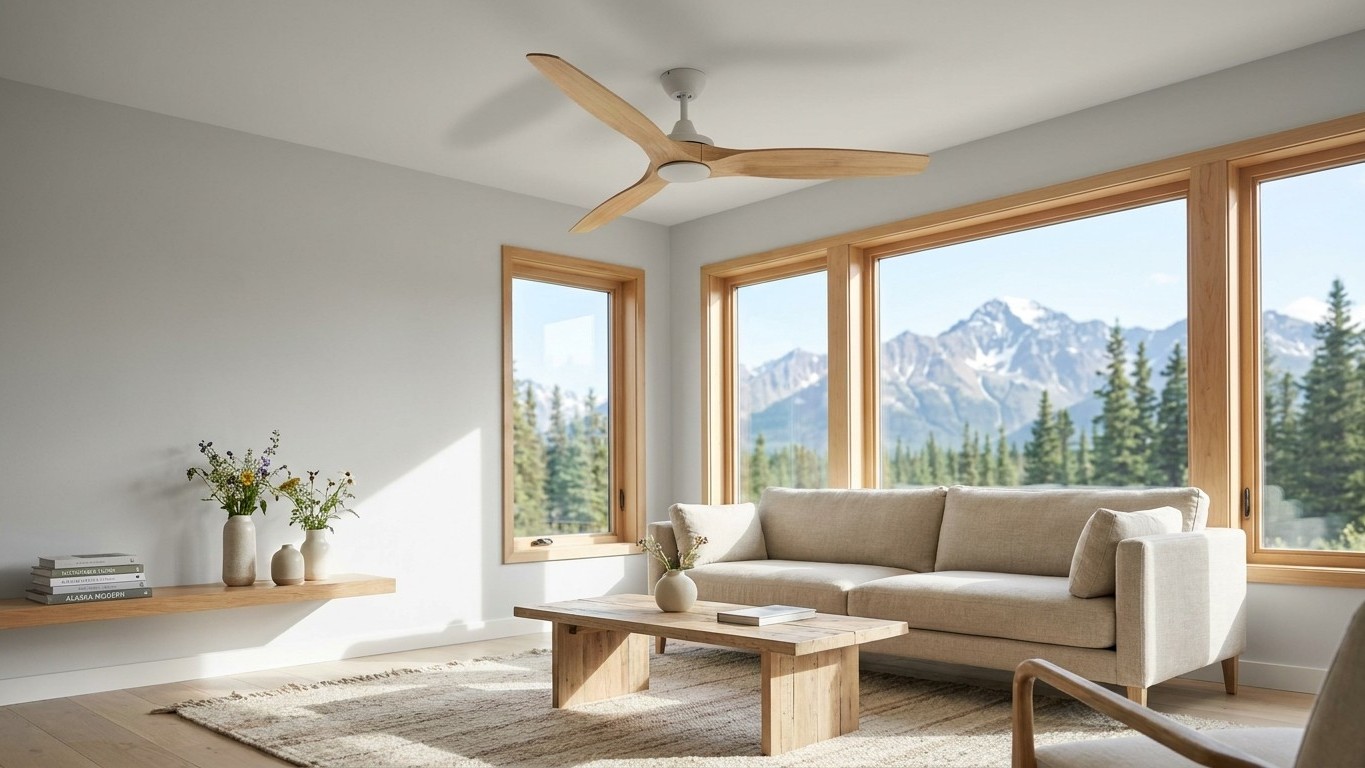

Most Hawaii homes cool with individual equipment, not a central system. A ductless mini-split, a window unit, or a portable unit does the job room by room in nearly half of all homes here, while true central air is the exception. Ceiling fans, running in most houses, do more of the daily work than any air conditioner does.
What homes in Hawaii actually cool with
According to the U.S. Energy Information Administration’s Residential Energy Consumption Survey, 57% of Hawaii homes report using air-conditioning equipment of some kind. Break that figure apart and the picture shifts: only 12% of homes run a central air-conditioning unit. The remaining 48% get by on an individual unit, a ductless mini-split, a window or wall unit, or a portable, set up wherever it’s needed. Ceiling fans show up in 65% of homes, ahead of air conditioning altogether.
That gap between “has air conditioning” and “has central air” is the whole story in some states. Connecticut, for instance, reports air conditioning in 90% of homes but central systems in only 34%; Alabama runs 94% and 81%. Hawaii sits at the far end of that pattern: central ductwork is genuinely rare here, and most cooling happens unit by unit rather than through a house-wide system.
None of this is a recommendation. A share like this reflects what got installed when the house was built, not what a homeowner should choose today. Hawaii’s housing stock leans older and was largely built without ducts, since trade-wind ventilation and ceiling fans were the standard cooling strategy for decades before mini-splits became a practical retrofit. Adding central air to a house with no ductwork means tearing into walls and ceilings, while a mini-split or window unit goes in without touching the structure. That’s a big part of why the 12% figure stays low even as air-conditioning ownership overall climbs.
How much cooling the year actually asks for
NOAA’s 1991-2020 climate normals for the Honolulu reference station put the average at 18.7 days a year reaching 90°F or higher. That’s a count of days at one weather station, not a statewide average temperature and not a measure of how hot the islands feel day to day. Less than three weeks a year hitting 90°F is a modest heat load, especially set against Hawaii’s reputation as a place that’s always warm.
Set that number next to the cooling mix from the first section and something doesn’t line up the way most people would guess. A state with under three weeks of genuinely hot days a year isn’t where you’d expect to find such heavy reliance on individual units and such thin central-air penetration. But the mismatch isn’t about heat at all. It’s about ductwork. Homes here were largely built before central cooling was standard practice anywhere in the country, when trade winds moving through open floor plans and a ceiling fan overhead handled most of the job. Mini-splits and window units arrived later as an add-on, not a full rebuild, so they spread fast while central systems never got a foothold. The heat load didn’t drive the equipment mix in Hawaii; the building stock did.
Wet heat or dry heat, and what it changes
Summers on Oahu run dry, at least by the rain gauge. NOAA’s monthly climate normals put total rainfall for June, July, and August at about 1.9 inches, a small fraction of the 16.4 inches that falls over a full year. June is the driest month at 0.5 inches, July close behind at 0.52, and August picks up slightly to 0.84. That’s a measure of precipitation, not humidity and not a dew point reading, but it tells you plainly that Hawaii’s wet season sits somewhere else on the calendar and summer is the dry stretch.
That distinction matters because an air conditioner does two jobs at once: it lowers temperature and it pulls moisture out of the air, and the second job takes run time. In a wet summer, a large share of the machine’s work is drying, which is why an oversized unit in a humid climate leaves a room cold and clammy, it satisfies the thermostat before it’s run long enough to clear the moisture. In a dry summer like Hawaii’s, the job is almost entirely temperature. There’s less moisture to remove, so a mismatched unit is more likely to just waste energy cycling on and off than to leave a room feeling damp.
What that means in practice, given a dry summer:
- Size for the room itself rather than assuming you need a margin for humidity control, since the latent load is light this time of year.
- Run the fan setting on auto instead of continuous during summer months; there’s little moisture load to keep clearing.
- Save any dehumidify or extended-run settings for the wetter months elsewhere on the calendar, rather than summer.
Sizing a room unit, from the published chart
For a room air conditioner, ENERGY STAR publishes a straightforward starting chart matched to square footage:
| Area to be cooled (square feet) | Capacity needed (BTU per hour) |
|---|---|
| 100 up to 150 | 5,000 |
| 150 up to 250 | 6,000 |
| 250 up to 300 | 7,000 |
| 300 up to 350 | 8,000 |
| 350 up to 400 | 9,000 |
| 400 up to 450 | 10,000 |
| 450 up to 550 | 12,000 |
| 550 up to 700 | 14,000 |
| 700 up to 1,000 | 18,000 |
| 1,000 up to 1,200 | 21,000 |
| 1,200 up to 1,400 | 23,000 |
A living room in the 700 to 1,000 square foot range calls for roughly 18,000 BTU per the chart, but that’s a starting point published for a single room unit, not a load calculation, and it doesn’t size a central system. A central system gets sized through a proper load calculation that accounts for the whole house, not a table matched to one room’s floor area. Given that 88% of Hawaii homes have no central system at all, this chart is the sizing reference that actually applies to most houses on the islands.
Going bigger than the chart suggests isn’t a safety margin, it’s a fault. An oversized unit cools the room fast, shuts off, and never runs long enough to pull moisture out of the air, so the room can still feel damp even as the thermostat reads satisfied.
What actually needs looking after here
With individual units running in roughly half of Hawaii’s homes and central systems in barely one in ten, maintenance here starts with the filter, not the ductwork. ENERGY STAR’s guidance is direct: “Inspect, clean, or change air filters once a month in your central air conditioner, furnace, and/or heat pump.” That instruction is written with central systems in mind, but the same logic, a clogged filter choking airflow, applies just as much to the washable filter behind a mini-split’s front panel or tucked into a window unit.
The payoff for staying on top of it is spelled out by ENERGY STAR too: “Airflow problems can reduce your system’s efficiency by up to 15 percent.” A unit can be in perfect working order mechanically and still underperform simply because a dirty filter is choking off the air moving through it.
The duct caution belongs only to the small share of homes running central air. ENERGY STAR notes that “in a typical house, however, about 20 to 30 percent of the air that moves through the duct system is lost due to leaks, holes, and poorly connected ducts.” A window unit or mini-split has no ducts to leak, so that concern simply doesn’t apply to most Hawaii households, only to the 12% running a central system.
A seasonal pass here is short:
- Check or change filters monthly across whatever equipment you’re running, mini-split, window unit, or central, per ENERGY STAR’s guidance.
- If you’re one of the households running central air, have the ductwork inspected for leaks before the cooling season builds.
- Clear coils and drain lines on mini-split and window units ahead of the wetter stretch of the year, when condensate loads pick up.
The guides on this site for mini-splits, window units, and central systems each walk through the specific steps for their equipment in more detail.