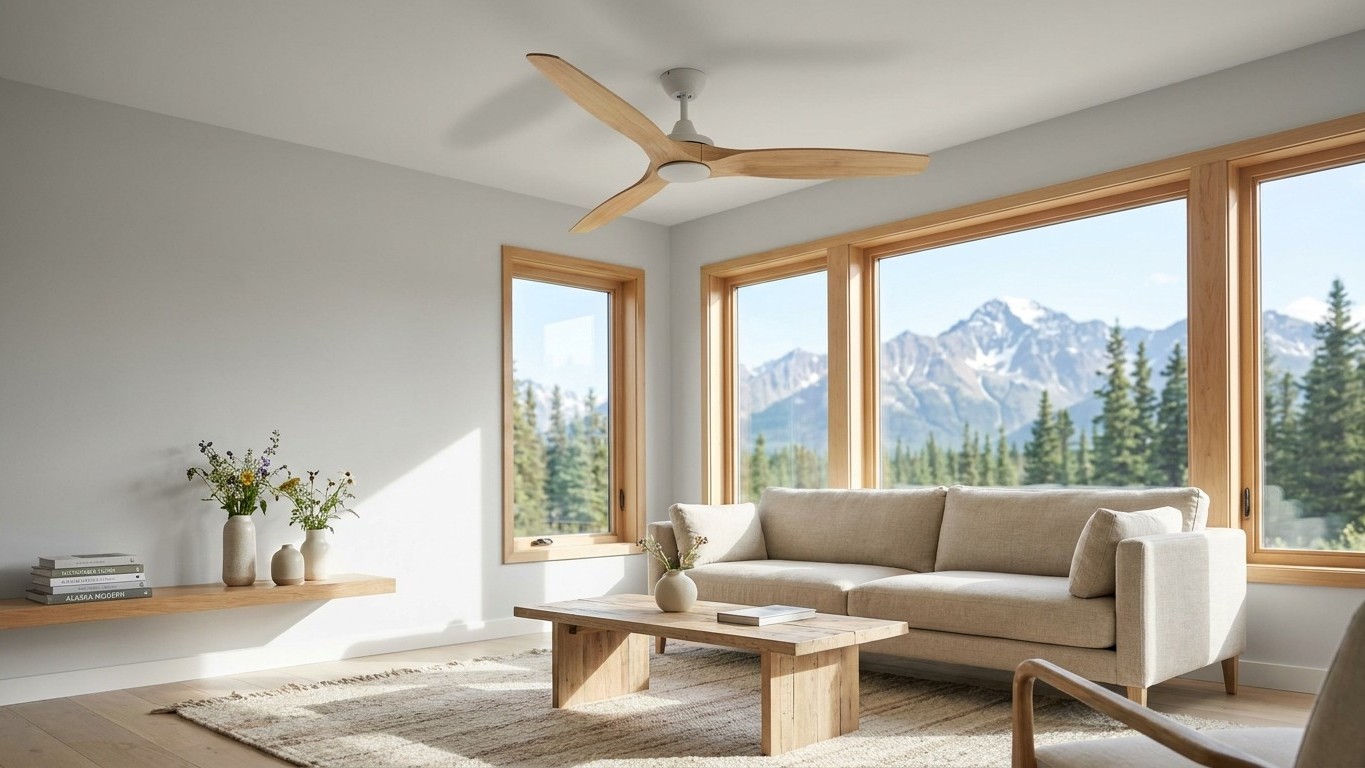

Oklahoma runs almost entirely on air conditioning, and unlike some states, most of that cooling comes from a single central system rather than a patchwork of window or wall units. Ceiling fans are nearly as common as the AC itself, working alongside the compressor rather than replacing it.
What homes in Oklahoma actually cool with
Start with the numbers as published: 96% of Oklahoma homes use some form of air-conditioning equipment, 83% run a central air-conditioning unit, and 20% use an individual unit, meaning a ductless mini-split, a window or wall unit, or a portable. Ceiling fans show up in 87% of homes, doing the job of moving air rather than cooling it.
The gap between “has air conditioning” and “has a central unit” is worth sitting with. In some states that gap is nearly the whole story of how people cool their homes. Connecticut, for example, reports air conditioning in 90% of homes but a central unit in only 34% of them, a 56-point gap filled almost entirely by window and wall units. Alabama runs closer together: 94% with air conditioning, 81% central. Oklahoma’s own numbers, 96% and 83%, put it in that same tight-gap category. Central air is the default here, not the exception, and the 20% running an individual unit are mostly supplementing a system rather than substituting for one entirely.
That 20% figure matters for a simple reason: it is not zero, and it is not a rounding error. A finished sunroom, a garage apartment, a detached workshop, an older addition without ductwork, these are the spaces that tend to get a window unit or a mini-split even in a state built around central systems. 83% of Oklahoma homes rely on a central air-conditioning unit, and that share reflects what got built into the housing stock decades ago, not a judgment about what works best today. A home built in 1975 with ducts already in the walls stayed on central air because ripping that out made no sense. A room added in 2015 without access to the trunk line got a mini-split because running new ductwork there would have cost more than the unit itself.
None of this is a recommendation one way or another. It is simply what got installed, and it explains why a neighbor’s cooling bill can look completely different from another’s despite similar square footage.
How much cooling the year actually asks for
The heat load figure for Oklahoma comes from the reference station at Oklahoma City: 70.7 days a year, on average, reach 90°F or higher. That is a count of days, not a temperature. It tells you how often the outdoor air crosses a threshold that pushes a home’s cooling system into its hardest, longest-running mode, not what the thermostat reads on an average July afternoon.
Seventy days above 90°F is a serious load. Spread across a summer, that is roughly ten weeks where an air conditioner is not just keeping a house comfortable but working against consistent, sustained outdoor heat, day after day, with little recovery time overnight in the hottest stretches.
Here is where the interesting comparison happens. In some states, a high day-count above 90°F pairs with a housing stock still leaning on individual units, because the heat arrived faster than the ductwork did, or the rental and manufactured-housing stock never got retrofitted for central systems. In other states, a mild climate somehow ends up almost entirely on central air, because the homes were built during a boom era when central systems were standard and never got swapped out.
Oklahoma is a state where the two figures actually line up. A heavy heat load of 70.7 days above 90°F pairs with a housing stock that is 83% central, which suggests the building stock and the climate demand grew up together: hot summers meeting a construction era when ducted central air was the expected standard, not an upgrade. That alignment is not universal across the country, and it is worth knowing that Oklahoma is one of the states where equipment mix and heat load tell a consistent story rather than a contradictory one.
Wet heat or dry heat, and what it changes
Summer rainfall at the same reference station averages about 11.7 inches across June, July and August, out of 36.4 inches for the full year. July is the driest of the three summer months at 3.59 inches, with June slightly wetter at 4.49 inches and August close behind at 3.6 inches. That is a measurement of precipitation, inches of rain falling from the sky, and nothing about relative humidity or dew point. Oklahoma’s summer is not soaked, but it is not desert-dry either; it sits in a middle zone where rain arrives in bursts rather than a steady drizzle.
The reason this matters for cooling has nothing to do with comfort trivia and everything to do with how an air conditioner actually works. Every system does two jobs at once: it lowers the air temperature, and it pulls moisture out of that air as it passes over the cold coil. Removing moisture takes run time. A unit that shuts off the instant the thermostat hits its target number never spends enough time in that dehumidifying phase, which is why a short, hard-cycling system can leave a room feeling cold and clammy at the same time.
In a genuinely dry summer, nearly all of an air conditioner’s job is temperature reduction, and moisture removal is a minor side effect. In a wetter one, a meaningful share of the system’s work is drying the air, and an oversized unit that satisfies the thermostat too fast never gets there. Oklahoma’s summer rainfall pattern puts it closer to the wet side of that spectrum than a true dry-heat state, which changes what a homeowner here should prioritize:
- Favor longer, steadier run times over a unit that blasts cold air and shuts off quickly.
- Use the fan’s “auto” setting rather than “on,” so the blower stops when the compressor does and doesn’t reintroduce moisture off a wet coil.
- Size the equipment to the room, not above it, since bigger is not safer here, it is precisely what causes the clammy result.
Sizing a room unit, from the published chart
For a window unit, a portable, or a single-zone mini-split, ENERGY STAR publishes a chart matching area to cooling capacity. It is reproduced below exactly as published, with no rows added and no interpolation between the steps.
| Area to be cooled (sq ft) | Capacity needed (BTU/hr) |
|---|---|
| 100 up to 150 | 5,000 |
| 150 up to 250 | 6,000 |
| 250 up to 300 | 7,000 |
| 300 up to 350 | 8,000 |
| 350 up to 400 | 9,000 |
| 400 up to 450 | 10,000 |
| 450 up to 550 | 12,000 |
| 550 up to 700 | 14,000 |
| 700 up to 1,000 | 18,000 |
| 1,000 up to 1,200 | 21,000 |
| 1,200 up to 1,400 | 23,000 |
This chart is a starting point for a single room, published by ENERGY STAR, and it stops there. It does not size a whole-house central system, which requires an actual load calculation done by a contractor, factoring in insulation, window area, orientation and duct layout. That distinction matters more in Oklahoma than in a state built on individual units, since 83% of homes here run central air and this table simply does not apply to that equipment.
Where the chart earns its keep is that other 20%: the sunroom, the converted garage, the mini-split covering a bonus room that never got ducted. Buying up a size “for margin” is the mistake to avoid, because an oversized room unit satisfies the thermostat fast, shuts off, and never runs long enough to pull humidity out of the air, which in a summer like Oklahoma’s, with nearly 12 inches of summer rain already in the air, is exactly the wrong outcome.
What actually needs looking after here
Maintenance in Oklahoma should follow the equipment that’s actually installed, and with 83% of homes on central air, that means duct-connected systems dominate the upkeep conversation more than window units do.
ENERGY STAR’s filter guidance applies across every setup: “Inspect, clean, or change air filters once a month in your central air conditioner, furnace, and/or heat pump.” That is once a month, not once a season, and it covers all three pieces of equipment together, a detail that matters for anyone assuming filter care is only a furnace chore. Skipping it has a measurable cost: ENERGY STAR notes that “airflow problems can reduce your system’s efficiency by up to 15 percent,” which means a system in otherwise perfect working order can still underperform simply because air can’t move through it properly.
For the central systems that make up the bulk of Oklahoma’s cooling, ducts deserve equal attention. ENERGY STAR states that “in a typical house, however, about 20 to 30 percent of the air that moves through the duct system is lost due to leaks, holes, and poorly connected ducts.” That figure explains a lot of rooms that never quite cool down even when the compressor outside sounds like it’s working hard, since the cold air is escaping into an attic or crawlspace before it ever reaches the vent. That caveat only applies to ducted, central systems; a home cooling itself with a window unit or a mini-split has no ducts to leak from in the first place, which is worth remembering given how many Oklahoma homes fall into that central-system majority.
A simple seasonal pass covers most of it:
- Check or replace the filter monthly through the cooling season, on every central system, furnace and heat pump in the house.
- Have ductwork inspected for leaks and loose connections, particularly in attics and crawlspaces where damage goes unnoticed.
- Confirm the fan setting is on “auto” rather than “on” before the first heavy heat stretch arrives.
For equipment-specific steps, the guides on this site covering central air conditioners, heat pumps and ductless mini-splits go deeper than a seasonal checklist can.