
In Hawaii, there is no month you switch the heat off, because there is essentially no heating season to switch off from. NOAA’s climate data show zero heating degree days in every single month at the state’s reference station. February is the calendar’s quietest stretch, but even then cooling demand never fully disappears, it just eases back. What follows is what that actually means for a thermostat here, and when the two seasonal maintenance jobs still matter.
The quietest month in Hawaii

February is the quietest month on the islands, and even that quietest month still totals about 246 combined heating and cooling degree days. Put that against the national picture: the lowest quietest-month figure anywhere in the fifty states runs around 70, and the highest runs around 246. Hawaii doesn’t sit near the calm end of that range, it sits at the top of it. The month with the least demand here still asks for roughly as much as the busiest “quiet month” recorded anywhere in the country.
Degree days aren’t a temperature reading. They’re a measure of how much heating or cooling a building’s systems are asked to do, calculated against a baseline comfort point. A day can be pleasant by any normal standard and still register cooling degree days, because the baseline used for this measurement sits well below what feels warm to most people. That distinction matters here more than almost anywhere else, because Hawaii’s numbers tell a story that has nothing to do with cold snaps and everything to do with a climate that rarely lets the air conditioning rest.
So is February a real pause, or just the point where the year exhales a little? The honest answer is the second one. A total near 246 is not a low number by any state’s standard, it’s the ceiling of what a “quiet month” looks like nationally. There is no stretch of the year in this state when a house genuinely asks for nothing. Winter here doesn’t behave like a heating season anywhere else does. Instead, cooling demand rises through spring, climbs to its heaviest load in the heart of summer, and then eases back down as the year turns toward its coolest, calmest weeks, without ever touching zero and without ever being replaced by heating demand.
That shape, a single long cooling curve that rises and falls rather than a real hot season and cold season trading places, is the whole reason this page exists. Anyone moving to Hawaii from a mainland climate goes looking for the month to “shut the heat off.” That month simply isn’t part of how the local year works. The more useful question, and the one the rest of this page answers, is when to service each system and how to run a house through days that swing from cool mornings to warm afternoons without ever asking for a furnace.
Shutting the heat down for the year
For the small number of homes here running an electric space heater, a wall unit, or a heat pump used occasionally for comfort heat, the shutdown at the end of the cool stretch is short and low-stakes, precisely because nothing here runs on a real heating season. Do it in this order.
- Stop calling for heat at the thermostat itself, dropping the setpoint or switching the mode off, rather than cutting power at the breaker or unplugging the unit outright.
- Let the system complete whatever cycle it’s already running rather than interrupting it mid-cycle.
- For any fuel-burning heater or water-heating loop tied into the system, follow the manufacturer’s guidance on shutdown, venting, and any seasonal combustion check. That guidance governs the fuel-burning side of the equipment, and this is where the homeowner’s job stops.
- Inspect, clean, or replace the filter now. ENERGY STAR’s own maintenance guidance is direct on this: “Inspect, clean, or change air filters once a month in your central air conditioner, furnace, and/or heat pump.” That’s a monthly habit for all three pieces of equipment, not a once-a-season chore, and it applies just as much to a heat pump run mostly for cooling here as it does to a furnace on the mainland.
- If a humidifier is fitted to the ductwork, this is the moment almost everyone forgets it. Shut it down, drain the reservoir or pad, and leave it dry until it’s needed again.
- Clear the area around any heating equipment, vents, or baseboard units of dust, stored items, or anything that’s accumulated against them over the season.
One caution that doesn’t apply the way it does elsewhere: NOAA’s normals show zero heating degree days in every month at the Honolulu reference station, with the normal mean temperature staying above 65°F all year. At sea level, there’s no frozen-pipe risk that would argue against shutting a heating system down completely. That figure describes one coastal station, though, not the whole state. Upcountry and high-elevation communities on the larger islands see genuinely cold nights that this number doesn’t capture, and a homeowner in those areas shouldn’t treat a coastal statistic as a guarantee against a cold snap.
The first run of the cooling season
Do this on a mild day, not the first hot one. A mild day gives a stalled compressor, a clogged drain line, or a dead capacitor the chance to show itself while the house is still comfortable without it. Waiting for the first 90-degree afternoon, and this state sees roughly 18.7 days a year that reach 90°F or hotter, means finding out about a broken system exactly when it’s needed most.
- Clear anything crowding the outdoor condenser, whether it belongs to a central system or a Mini-Split: leaves, trimmed vegetation, stored items, anything blocking airflow around it.
- Check the condensate drain path for algae or debris buildup, especially after a stretch of higher humidity.
- Change or wash the filter, depending on the type installed.
- Run the system in COOL for a full cycle on that mild day, not just a few minutes.
- Feel the air at a register farthest from the unit, not the nearest one, to check that cool air is actually reaching the far end of the house.
How much of that list applies depends on what’s actually installed, and in this state that’s worth being specific about. Federal survey data show 57% of Hawaii homes run some form of air conditioning, but only 12% run a central system. The other 48% run individual equipment, window units, wall units, ductless mini-splits, or portables, and 65% of homes also lean on ceiling fans. That’s a very different maintenance list from a mostly-central state: most of the checks above still apply, but for the majority of homes here, “the outdoor unit” means a mini-split condenser or a window unit’s own coil, not a single central compressor tucked beside the house. ENERGY STAR’s warning about airflow applies regardless of which setup is in the house: “Airflow problems can reduce your system’s efficiency by up to 15 percent.” A unit can be running fine mechanically and still cost more to operate than it should, purely because a filter or coil is choked.
The days that ask for both
Every heating-season page on this site uses one working convention: a month “asks for both” when it carries at least 50 heating degree days and at least 50 cooling degree days in the same month. That’s not a category NOAA publishes; it’s a threshold stated here to describe a recognizable situation, a house calling for heat at six in the morning and for cooling by mid-afternoon. In Hawaii, that situation doesn’t show up in the degree-day numbers at all: with zero heating degree days recorded in every month, no month here meets that bar. By the measure NOAA uses, the state never genuinely asks for both.
What residents actually feel is different, and it’s worth naming honestly. A cool 68°F trade-wind morning, especially upcountry, can feel like it wants a little supplemental heat even though it registers no heating degree days at all, because the degree-day baseline sits at 65°F and doesn’t capture comfort at the margins the way a body does. That’s comfort heating, run on a room-by-room basis with a portable unit or a heat pump’s heat setting, not a seasonal system doing daily double duty the way it might in a state with a real shoulder season.
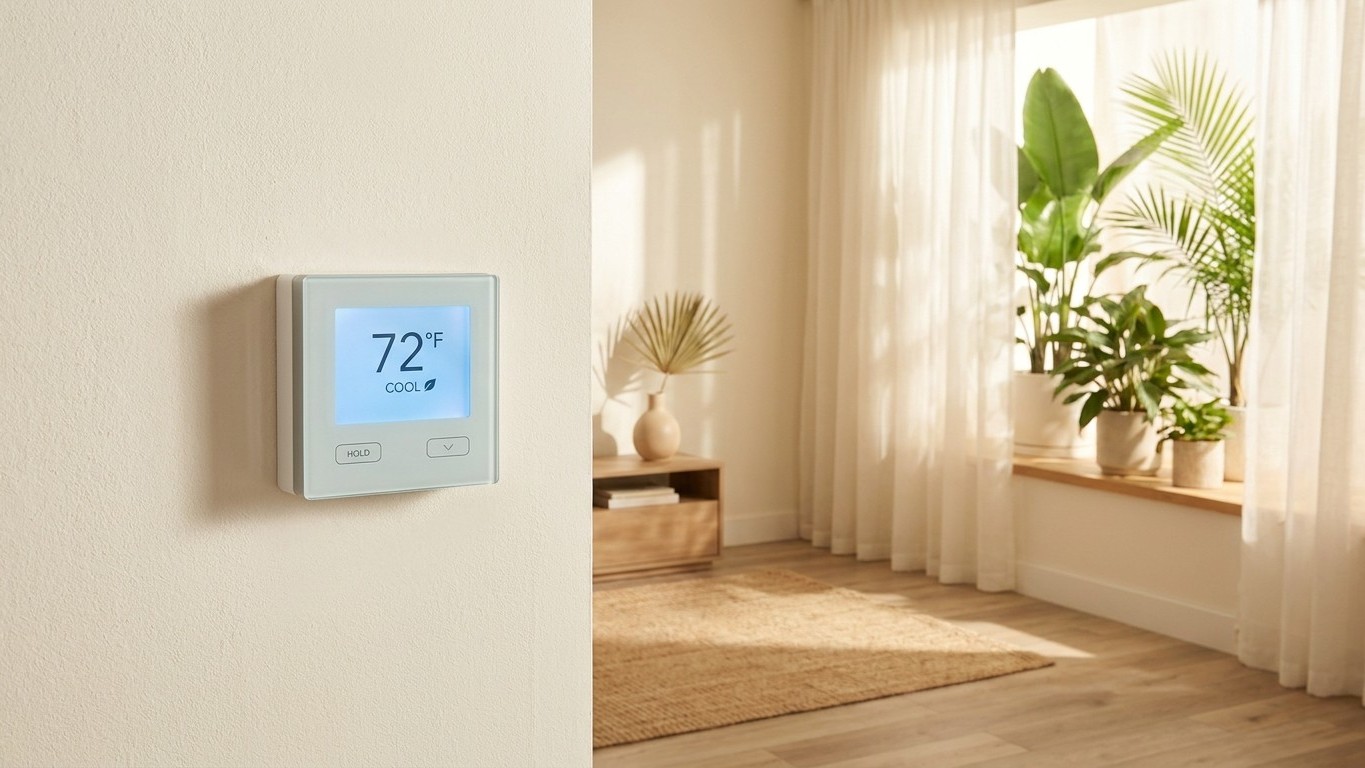
Because that daily swing between a cool morning and a warm afternoon is still real here even without matching degree-day numbers, the thermostat habits that matter elsewhere still apply.
| Setting | What it does | When to use it |
|---|---|---|
| AUTO changeover | Lets the system switch between heat and cool on its own through the day | Homes with a heat pump used for occasional comfort heat, where mornings and afternoons swing noticeably |
| Wide deadband | Leaves a gap of several degrees between the heating and cooling setpoints | Almost always, to stop the system reheating or recooling air it just conditioned |
| Narrow deadband | Heating and cooling setpoints sit close together | Avoid it; it’s the expensive mistake that heats the morning air and cools that same air again by afternoon |
| Windows open, systems off | Relies on trade winds and ceiling fans instead of mechanical heating or cooling | Mild, breezy stretches, common enough in this state that it’s often the simplest answer |
And the changeover in the other direction
There isn’t really a mirror-image changeover here the way there is in a state with a genuine cold season. NOAA’s normals put every month’s heating degree days at zero at the reference station, and the normal mean temperature never drops below 65°F across the year. What residents do instead, mostly in the cooler stretch from late fall into winter and mostly upcountry, is switch on a room heater or a heat pump’s heat mode for a handful of chilly evenings, then put it away again.
Federal survey data on what Hawaii homes actually heat with is thin: only electric heating is reported at all, at 5% of homes, while furnace, central heat pump, boiler, natural gas, and propane figures are either not reported or suppressed for reliability, and fuel oil isn’t reported at all. None of that means those fuels are entirely absent in the state; it means the survey sample was too small to publish a reliable number for them. What it does confirm is that heating equipment plays a minor, occasional role here rather than a seasonal one.
The detailed version of that seasonal changeover, filter checks, fuel-burning inspections, the order of shutting a system down, belongs on this site’s heating-season guide for Hawaii, built for the states where that changeover actually carries weight. Here, the useful takeaway is simpler: keep the cooling side of the house maintained year-round, treat any heating equipment as an occasional-use appliance, and check it before the first cool night rather than assuming it will just work.