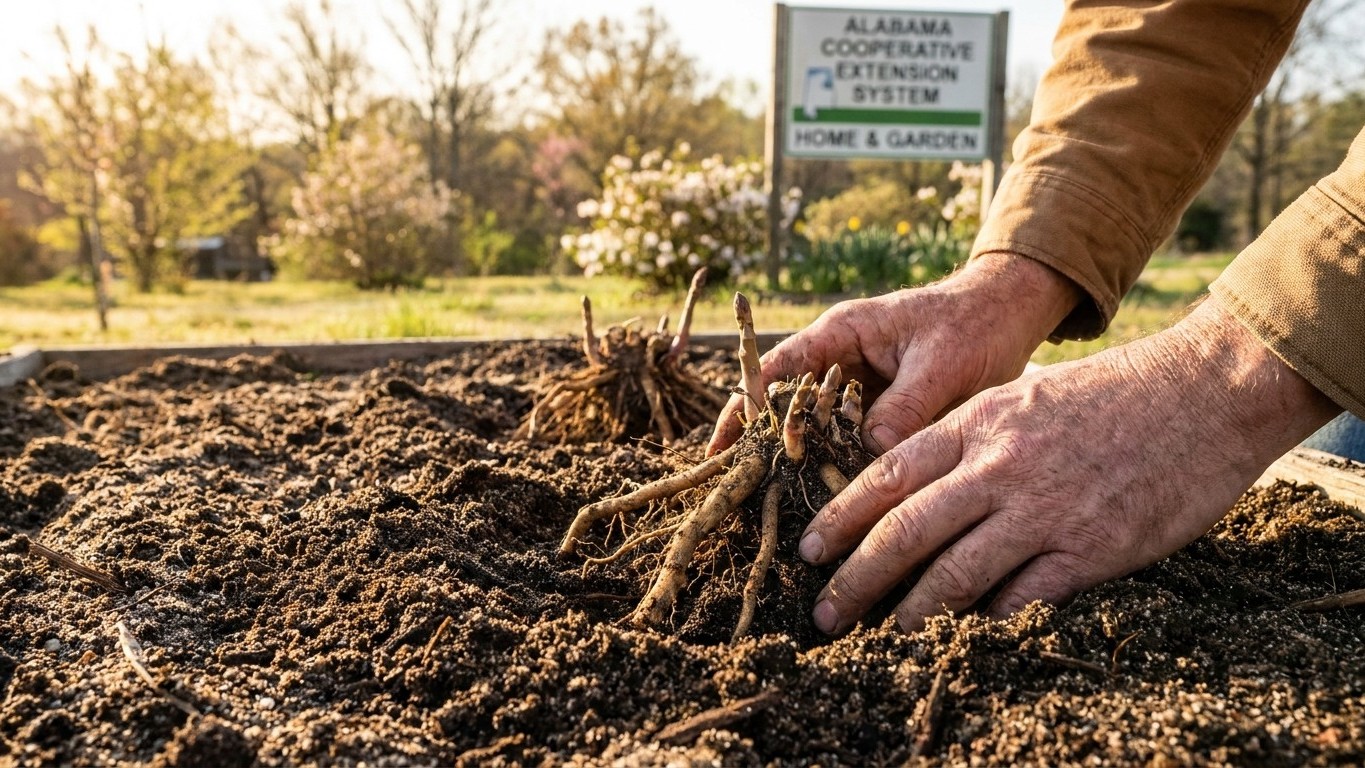

Hawaii has no frost season in the lowlands, so the mainland habit of counting backward from a killing freeze does not apply here. Timing instead comes down to soil drainage and the calendar’s driest stretch, which for many gardens on the islands falls in early summer. Get the bed into well-drained ground before that stretch begins, and the ground itself, not a frost date, decides whether this planting holds up for the fifteen years ahead.
The short answer
an Asparagus Bed is not a season’s project. Once the crowns settle in, they stay put for 10 to 15 years, which means the spot chosen now is the spot the garden lives with for well over a decade. The only real requirement the University Extension guidance attaches to that soil is that it drains. Most soils will do, the source says, provided water does not sit around the roots.
The soil USDA lists as representative of Hawaii is the Hilo series, an Andisol built from volcanic ash. It is light and porous, and it is unusually good at holding both water and phosphorus, which sounds like a contradiction until you picture ash rather than clay: it drains through instead of clogging. The surface horizon runs about 9.0 percent organic matter with a slightly acid pH near 5.8, and the texture breaks down to 10 percent sand, 35 percent clay, and 55 percent silt. USDA classifies it as well drained. For asparagus, that is the one box that matters, and this soil checks it.
That said, a state soil series is a representative average, not a reading of any one backyard. Hawaii spans lava flats, windward slopes soaked by trade-wind rain, and leeward ground that barely sees a shower, and a homeowner’s lot may have nothing in common with the Hilo profile. If a bed stays soggy a day or two after rain, that is the signal to raise it, not to fight it season after season with amendments that only patch the surface. A raised bed 8 to 12 inches deep, filled with a mix that drains freely, solves in one build what a stubborn clay pocket would otherwise turn into a decade-long complaint.
Once drainage is settled, planting itself follows a simple pattern: crowns go into furrows about 8 inches deep, spread out and covered lightly at first. The source names four varieties, sorted only by sex: Jersey Giant and Jersey Knight are all-male, while UC 157 F1 and Purple Passion are male and female. No flavor, yield, or regional-suitability claim comes attached to any of them in that guidance, so treat variety choice as a matter of availability rather than a Hawaii-specific pick.
Will the summer here water it for you?
Extension guidance is specific about water needs for a new bed: 1 to 2 inches every other week for the first two growing seasons, easing to every three weeks once the crowns are established. Measured against what a Hawaii summer typically delivers, that target is not something rainfall alone is going to meet.
- What the bed asks for: roughly 1 to 2 inches of water every two weeks through year one and two, which works out to something in the neighborhood of half an inch to an inch per week on average.
- What June brings: the driest month of summer, averaging just 0.5 inches for the entire month, which is a fraction of what a single two-week watering cycle calls for.
- What July brings: barely more, at 0.52 inches for the month, still well short of even one properly deep watering.
- What August brings: the wettest of the three summer months at 0.84 inches, an improvement, but still not enough on its own.
- What the whole summer adds up to: about 1.9 inches across June, July, and August combined, against a target that, over the same 13-week stretch, would run closer to 6 to 13 inches if the bed’s every-other-week schedule were met by rain alone.
- What that means at the spigot: during a Hawaii summer, irrigation is not a backup plan, it is the plan. Expect to supply nearly all of the bed’s water needs by hose or drip line through the dry months, and treat any actual rainfall as a bonus rather than a baseline.
These are climate normals for a single reference station covering 1991 through 2020, not a forecast and not a reading of any particular yard. A windward slope can see storms roll through weekly while a leeward garden a few miles off stays bone dry. A rain gauge staked next to the bed settles the question far better than a regional average ever will.
When to put the crowns in
University Extension guidance places crown planting in early spring, and on the mainland that instruction is shorthand for “after the last freeze.” Hawaii breaks that shorthand entirely. NOAA’s climate normals for the islands show no freeze at all in inhabited areas, meaning the standard percentile calculations for a 32-degree or 36-degree frost date come back not computable. There simply is no last-frost date to count forward or backward from in lowland Hawaii. Frost exists only on the summits of Mauna Kea, Mauna Loa, and Haleakala, ground no one is digging an asparagus furrow into.
What that leaves is a calendar untethered from freeze risk and governed instead by rainfall, elevation, and whether a garden sits on the windward or leeward side of an island. “Early spring” in this context is less a hard date and more a description of a cooler, workable stretch before the driest summer months set in, giving new crowns a season to root before the heaviest irrigation demands of June and July arrive. Treat any specific month as a rough target, not a fixed rule, since a mean date built from an average always carries some spread around it.
For growers who prefer starting from seed rather than buying crowns, the same Extension source treats it as a slower, less common alternative path rather than the default method, without laying out Hawaii-specific timing beyond the general early-spring window that applies to crowns. Seed-started plants also take longer to reach a size worth transplanting, which pushes the eventual production timeline out even further than the already patient three-year wait crowns require. For a bed meant to produce for a decade or more, most home gardeners find the crown route the more practical starting point, letting the extra year of seed-to-transplant growth happen at a nursery rather than in their own furrow.
Common questions
Is there a variety of asparagus bred specifically for Hawaii?
No. University Extension guidance names four varieties, Jersey Giant, Jersey Knight, UC 157 F1, and Purple Passion, and distinguishes them only by sex (all-male versus male and female). No flavor, yield, or climate-suitability recommendation is published for any of them, so choose based on what a nursery has available rather than a regional match.
How long until an Asparagus Bed actually produces?
No harvesting happens until the third year. Once harvest starts, the guidance limits picking to about 4 weeks in that first productive year, extending to roughly 6 weeks the following year, then about 8 weeks after that. Each season’s harvest ends not on a fixed date but when most of the spears coming up are thinner than a pencil, which signals the plant needs to stop putting energy into spears and start building next year’s root reserves.
Does the soil need a specific pH for asparagus?
The Extension source is silent on pH requirements for asparagus, so no target number is published here. The Hilo series representative surface pH runs about 5.8, slightly acid, but that figure describes a mapped soil series, not any individual garden. A basic soil test remains the only way to know what a particular bed is actually starting from.
How do you fill in the planting furrow once the crowns are in?
Backfilling happens gradually rather than all at once. The furrow gets covered in stages, with about 2 inches of soil added back every other month across the first year, rather than burying the crown completely on planting day.