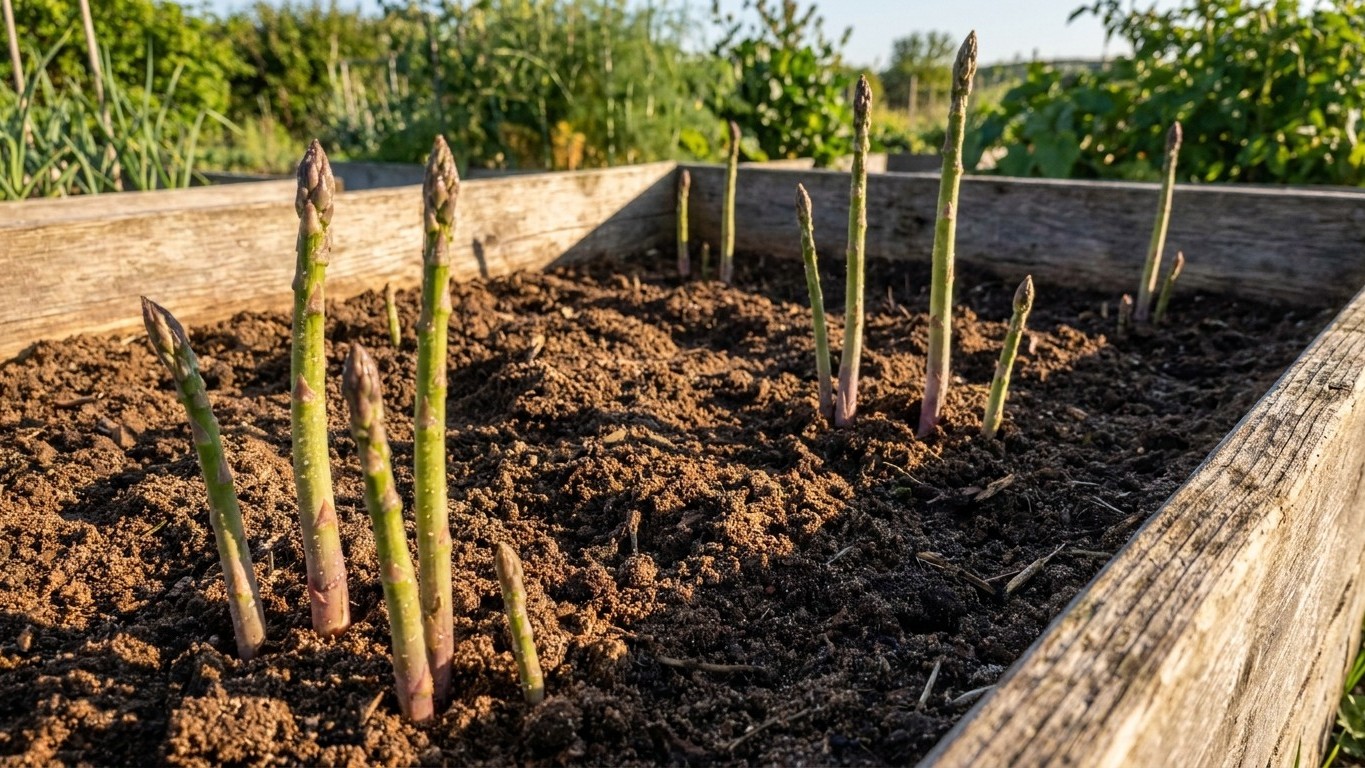

Yes, mostly. The Hilo series, the soil USDA lists as representative of Hawaii, is a well-drained volcanic-ash Andisol, and “well drained” is the only soil condition Utah State University Extension sets for an Asparagus Bed that has to keep producing for ten to fifteen years. That single requirement is met here. What decides whether a specific backyard bed lasts the full run is everything the state average can’t tell you.
The short answer
Start with what makes the Hilo series unusual. It’s built from volcanic ash, which gives it a texture that behaves nothing like a typical clay soil even though the lab numbers, 55 percent silt, 35 percent clay, only 10 percent sand, would normally spell trouble for drainage. Andisols like this one hold together in loose, porous aggregates rather than compacting into a dense mass, so water and air both move through more freely than the texture chart suggests. USDA records this series as well drained, and that’s the checkbox asparagus actually needs ticked. Organic matter sits around 9.0 percent at the surface, which is high for a mineral soil and helps the ground hold both moisture and phosphorus, both useful for a crop that sits in the same spot for over a decade without a chance to rebuild fertility through rotation.
Surface pH runs about 5.8, a bit on the acid side. The source on asparagus itself is silent on what pH the crop prefers, so there’s no published basis here for saying 5.8 is good, bad, or something to correct with lime. A gardener who wants a real answer on that point needs a soil test, not a guess dressed up as one.
Here’s the caution that matters most: the Hilo series is what USDA names as representative of the state, not a survey of any one garden. Hawaii’s soils vary enormously with elevation, rainfall, and how close a lot sits to old lava flows, and anything a builder has scraped, filled, or compacted for a driveway pad will drain nothing like the mapped surface horizon. If a test pit fills with water and stays that way after a hard rain, the fix isn’t to fight the native ground for fifteen years. Raised beds or mounded rows built up with purchased, well-draining mix sidestep the problem entirely and let a gardener plant with confidence rather than hope.
Why the drainage question matters this much: asparagus gives back nothing for the first two years, and even the third year is limited to a light four-week harvest, followed by six weeks the year after, then eight weeks once the planting is fully established. The rule for when to stop cutting each spring isn’t a date on a calendar; it’s a look at the spears themselves, cut until most of what’s coming up is thinner than a pencil, then let the plant grow to feed its roots for next season. Fifteen years of that cycle is a long time to discover, three years in, that the spot chosen was too wet all along.
Will the summer here water it for you?
Utah State University Extension’s watering guidance is specific: 1 to 2 inches of water every other week for the first two years while the crowns establish, then a lighter 1 to 2 inches every three weeks once the bed matures. Measured against what a typical Hawaii summer actually delivers at the reference station tracked by NOAA, that target isn’t close to being met by rainfall alone.
- Establishment years (first two summers): the bed wants roughly 1 to 2 inches every two weeks. June, the driest summer month on record, brings just 0.5 inches for the entire month. July isn’t much better at 0.52 inches, and August climbs only to 0.84 inches. Even stacking two dry months together doesn’t cover what two weeks of irrigation demands.
- The three-month shortfall: across June, July, and August combined, the normal is about 1.9 inches of rain. A mature bed on the every-three-week schedule would want somewhere near that amount roughly every three weeks on its own, not spread across three full months. The gap between what falls from the sky and what the roots need is wide for the entire summer, not just one dry stretch.
- What that means for the hose: a gardener growing asparagus through a Hawaii summer should plan to supply nearly all of the water the bed needs directly, whether by hand, drip line, or soaker hose, treating the rain that does fall as a bonus rather than a plan.
- Why a rain gauge still matters: these are long-term normals for one reference station, not a forecast and not a measurement of any single yard. Elevation, whether a garden sits windward or leeward of the island’s mountains, and how close it is to the coast all shift actual rainfall well away from the station average. A cheap rain gauge on the actual plot settles the question faster than any regional figure can.
The upshot for the fifteen-year math: irrigation isn’t an occasional backup here, it’s the main water source for an Asparagus Bed through the growing months, and a bed left to rely on summer rain alone is likely to arrive at year three undersized and underfed.
When to put the crowns in
Utah State University Extension’s timing is early spring, with crowns set into furrows about 8 inches deep. That furrow doesn’t get filled in all at once. As the young shoots grow, soil goes back in gradually, about 2 inches every other month across the year, so the crowns end up buried at full depth only once the first season’s growth is well underway.
Anchoring “early spring” to a calendar date is where lowland Hawaii breaks from most of the mainland playbook. NOAA’s climate normals show no freeze at all in inhabited areas of the islands, not a late one, not an early one, none. Frost exists only up on the summits of Mauna Kea, Mauna Loa, and Haleakala, nowhere near where a home garden sits. So there’s no last-frost date to plant around here, and nothing in the published record supports inventing one. What actually governs timing in Hawaii’s gardens is a different set of signals: the shift between wetter and drier stretches of the year, elevation, and whether a plot sits on the windward or leeward side of the mountains. Early spring still works as a planting window because it gets the crowns in before summer’s drier, hotter stretch sets in, giving roots a season to establish before they’re asked to survive on irrigation alone.
For gardeners choosing crowns over seed, Utah State University Extension names four varieties without ranking them on flavor or yield, only by sex: Jersey Giant and Jersey Knight are all-male selections, while UC 157 F1 and Purple Passion are male and female mixes that will produce seed of their own if left to flower. No nursery is named as a source for any of them, and no reason is given to prefer one over another beyond that basic distinction.
Starting from seed instead of purchased crowns is also listed as workable, though it adds a season of extra patience before seedlings are sturdy enough to move into a permanent bed. For a gardener willing to wait, it’s a cheaper entry point into the same fifteen-year commitment; for anyone wanting spears sooner, crowns remain the faster route.
Common questions
Does asparagus need acidic soil to do well in Hawaii? The published guidance on asparagus doesn’t specify a preferred pH at all, and the Hilo series’ surface pH of about 5.8 is a soil-survey figure, not a growing recommendation. A soil test on the actual planting site is the only way to answer this for a specific garden.
How do I know if my garden’s soil drains well enough? Dig a hole about a foot deep, fill it with water, and watch how fast it disappears. If water stands for hours after a good rain, the site likely needs raised beds or amended, mounded rows rather than an in-ground furrow.
Does elevation change when I should plant in Hawaii? Frost isn’t a factor anywhere people garden in the islands, since freezing temperatures are limited to the high volcanic summits. Elevation still matters for temperature and rainfall patterns, but not because of a frost risk on a garden plot.
When does an Asparagus Bed actually start feeding a household? Not before year three, and even then only for about four weeks. That stretches to six weeks the following year and eight weeks once the bed is fully established, with harvest ending each season once most spears come up thinner than a pencil rather than on a fixed date.